
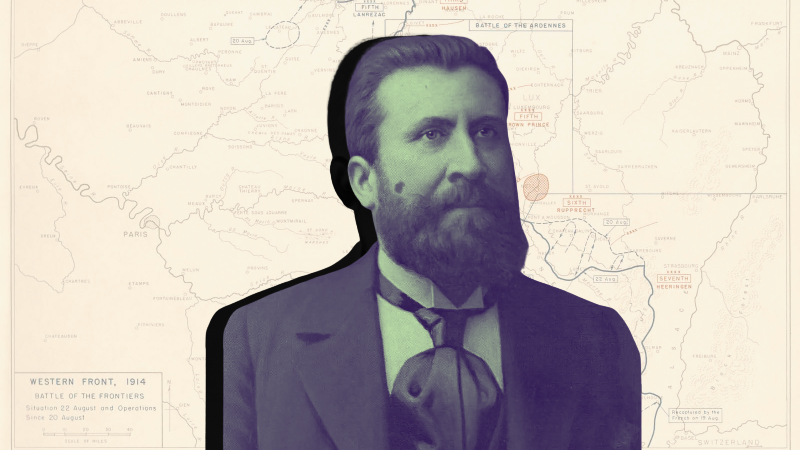
On the sultry evening of July 31, 1914, following their unproductive visit to the foreign ministry to press for France’s neutrality in the approaching conflict, Jean Jaurès and Jean Longuet (the grandson of Karl Marx) took a taxi to the offices of the socialist daily L’Humanité, where the socialist leader prepared notes for his next day’s editorial—a final plea for peace—before departing with a small group to dine at the nearby Café du Croissant on rue Montmartre. The heat was oppressive, and Jaurès sat with his back to a drawn curtain beside an open window. Roughly at 9:15 p.m., a young man named Raoul Villain shot him twice from the street. Jaurès died almost instantly.
Villain, twenty-eight years old, the son of a Reims court clerk, had been described by those who knew him as a reserved and courteous young man, yet he appeared unsettled and seemingly without clear purpose in life. He had previously been a member of the Christian-social movement Le Sillon (The Furrow) until its condemnation by Pope Pius X in 1910.
Subsequently he joined the League of Young Friends of Alsace-Lorraine, a campaign group backed by various right-wing politicians, including Maurice Barrès, which circulated propaganda among students about the so‑called “lost provinces” of Alsace and Moselle and prepared minds for the possibility of a renewed confrontation with Germany in the near future.
The dramatic rule articulated by Anton Chekhov—that if a pistol appears in the first act, it will almost certainly be fired later—has a certain pertinence when one considers the habitual rhetoric of French nationalism. If the claim that killing a political opponent can be framed as a patriotic duty is echoed often enough, it seems almost inevitable that someone will eventually translate that logic into action. A reader immersed in the nationalist press like Villain would hardly have missed the repeated accusations of treason aimed at Jaurès and the persistent calls for his elimination.
For many years, and especially after his 1913 campaign against extending compulsory military service to three years, Jaurès had become a particularly prominent target, not only by the usual adversaries: his former Dreyfusard ally Charles Péguy, once a socialist who had then shifted toward nationalism and Catholicism, had also subjected him to intense attacks.
War is above all, in their eyes, the occasion to demonstrate the most noble human virtues…energy, self-mastery, sacrifice to a cause that is greater than oneself.
For Charles Maurras, matters were always straightforward: “Jaurès is Germany.” His colleague “Critias,” writing in the newspaper L’Action française, went a step further: “We wouldn’t want to suggest that anyone should resort to political assassination. But Mr. Jaurès should be seized with trembling,” because a zealous reader of L’Humanité might be tempted to attempt to “resolve by the experimental method” the question of whether shooting him would yield the same effect as it did for Gaston Calmette. The editor of Paris-Midi even argued that a general who assembled a firing squad to “put some lead at point blank range into Citizen Jaurès’s brain” would be fulfilling his duty.
Jaurès’s pacifism, in truth, was not an absolute stance, let alone a stance bordering on treason. He consistently maintained that, while he would do everything possible to avert war, if his efforts failed and France found itself invaded, he would urge socialists to defend their country. This stance was endorsed by the trade unions and even by the modest, traditionally anti-militarist, far-left faction of the socialist party led by Gustave Hervé. Over the preceding decades successive governments had compiled a list of potential “subversives” who could be interned in an emergency to prevent resistance to mobilisation for war.
Yet on August 1st, the interior minister Louis Malvy, after evaluating the left’s mood following Jaurès’s assassination, concluded there would be no significant upheaval, and instructed local authorities to cancel the pending detentions. Mobilisation proceeded with a calm demeanor, even if the mood among the conscripts was one of quiet resolve rather than fervent enthusiasm.
The prospect of war did, however, ignite excitement in certain quarters. Péguy celebrated it as “the unleashing of all the virile and healthy forces of French youth.” In June 1913, two young intellectuals, Henri Massis and Alfred de Tarde, writing under the pseudonym “Agathon,” published a survey of opinion among the Parisian university milieu, entitled Les jeunes gens d’aujourd’hui (Young People Today). “Agathon” claimed to uncover a new psychological complex among the young that set them apart from the preceding generation: a revived religiosity, a repudiation of “intellectualism,” a zest for physical activity, sport and speed, and an openness to war, a purgative experience believed to revive a world dulled by routine and pleasure alike.
War! The word has assumed a sudden prestige. It is a young word, all new, adorned with the seduction which the eternal martial instinct has revived in the hearts of men. These young people attribute to it all the beauty of which they are enamoured and which everyday life fails to provide them. War is above all, in their eyes, the occasion to demonstrate the most noble human virtues…energy, self-mastery, sacrifice to a cause that is greater than oneself.
While the sample of students that “Agathon” drew on represented only a minuscule fraction of those who were young in 1913, they nonetheless signaled the early emergence of a shift in attitudes among intellectuals—one that was not confined to France alone. At the close of 1915, the Irish revolutionary Patrick Pearse welcomed the European war as a spiritual revival, proclaiming that “the old heart of the earth needed to be warmed with the red wine of the battlefields.”
On August 1st Germany declared war on Russia; and two days later, on France. On August 4th it invaded Belgium. On the same day Britain declared war on Germany.
As Italy joined the fray, the poet Gabriele D’Annunzio rejoiced: “The cannon roars. The earth smokes… Companions, can it be true? We are fighting with arms, we are waging our war, the blood is spurting from the veins of Italy! We are the last to join this struggle and already the first are meeting with glory…” In a more elegiac register, the English poet Rupert Brooke pictured young men marching off to war as if they were “awakened from sleep,” cheerfully embracing death, like “swimmers into cleanness leaping, / Glad from a world grown old and cold and weary.”
Such expressions of enthusiasm should cause little surprise. In each of the belligerent nations, elite schools had long treated it as their duty to cultivate a martial ethos among their pupils, especially those destined for the officer corps. They would have been steeped in the notion of sacrifice, with the idea of the nation or “fatherland”—now infused with religious overtones—replacing older religious sensibilities, an idea cemented by the Latin maxim of Horace, “Dulce et decorum est pro patria mori” (It is sweet and fitting to die for one’s country). Enlisted soldiers, even if they did not master the Latin, would have absorbed a sense of patriotic obligation, often seen more as a burdensome duty than a joyous privilege. On August 1st Germany declared war on Russia; and two days later, on France. On August 4th it invaded Belgium. On the same day Britain declared war on Germany.
German military planners envisioned a swift thrust into northeastern France through neutral Belgium, followed by a rapid drive toward Paris. A quick victory in the West would free up the bulk of Germany’s forces to meet Russia in the East. The French, for their part, preferred an assertive approach, pushing into Alsace and Moselle before pressing on into southern Belgium. The opening combat, later christened the Battle of the Frontiers, inflicted heavy casualties on both sides and left the French line shattered along much of the front. It is estimated that around 40,000 French troops fell in the early fighting near the border, a figure that was likely to have doubled by the end of August as German forces pressed westward, narrowing Paris’s distance to roughly thirty miles.
Then, in the second week of September, the Battle of the Marne produced a successful French counteroffensive, with General Joseph Joffre’s forces aided by the British Expeditionary Force commanded by Sir John French, spanning a front of about 140 miles from near Paris to Verdun in the east. German losses in September, according to official tallies—encompassing killed, wounded, and prisoners—amounted to about 220,000 out of a fighting strength of 1,300,000, with approximately 26,000 killed.
Despite that crushing setback, the Germans managed to retreat in good order, establishing a new line roughly twenty-five miles to the north. Further, intense clashes followed as both sides, in what came to be known as the “la course à la mer” (the race to the sea), tried to seize as much of the Channel coastline as possible. Germany failed to seize Calais and Boulogne, the ports through which British reinforcements docked, and the conflict settled into a protracted north–south arc from near Ostend in Belgium to the Swiss frontier. By mid-November, French losses had reached about half a million, while German casualties stood around 300,000. The initial phase—characterized by mobile warfare—had ended, giving way to a grueling “war of position” that would endure for four additional years of slaughter.
__________________________________
Excerpted from The Dark Side of France. Reproduced with the publisher’s permission, Liveright. © 2026 by Enda O’Doherty.
