
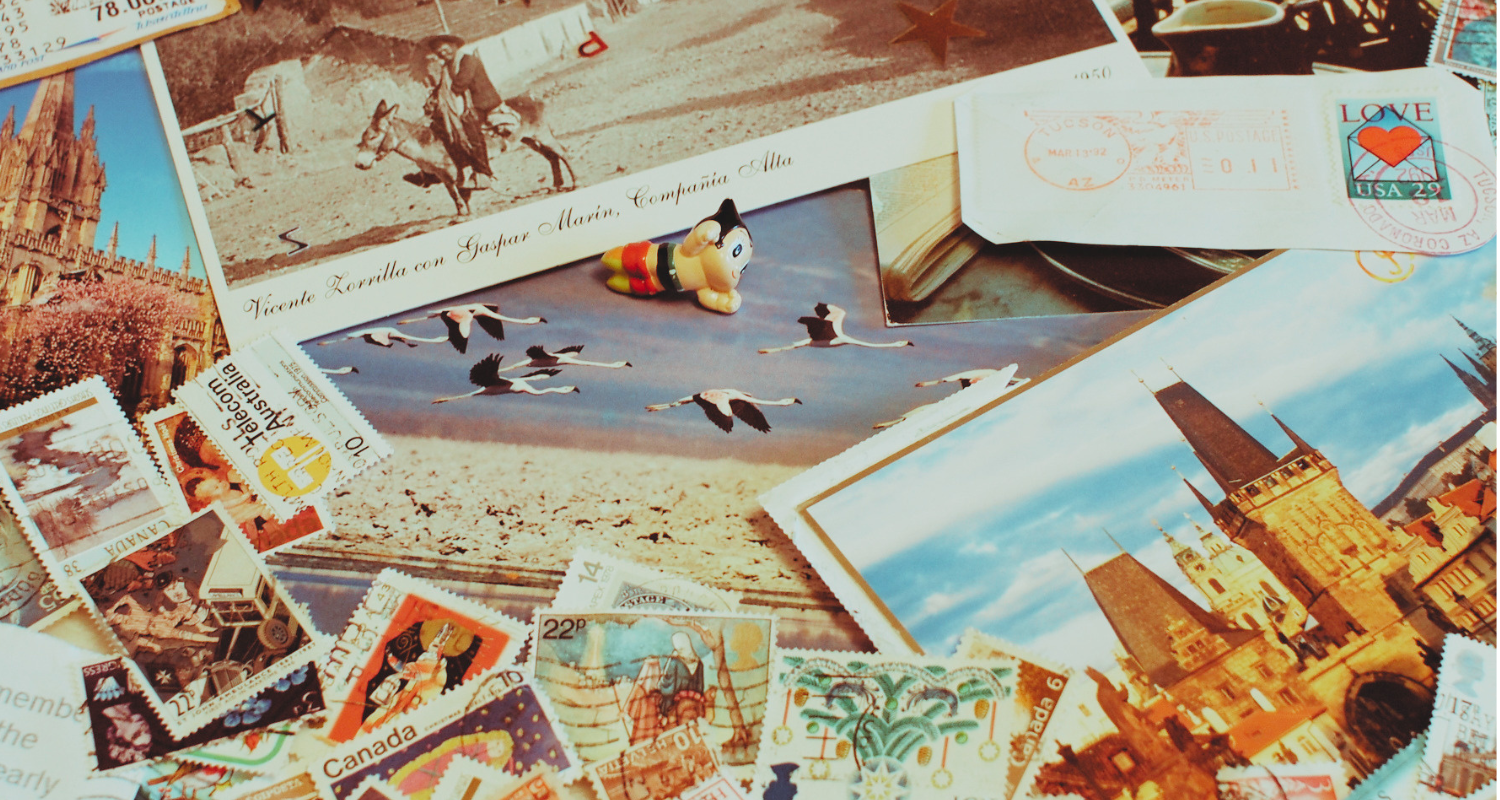
Back in 2017, as I began to explore the history of postcards, I found it surprising to learn that their earliest defining traits—conciseness and openness—ended up acting as guarantees of closeness across distance, markers of intimacy in their own distinct ways.
*
One version of the story of the postcard’s invention runs like this: On November 13, 1865, the fifth Austro-German Postal Conference began in Karlsruhe, in the Grand Duchy of Baden, a region that would become part of the German Empire six years, one month, and three days later. Up to that point, the Postal Union, founded in 1850, counted seventeen members, each with its own postal service—some venerable, some newly created.
The Union stood at the center of a broader push to simplify communications across these lines, which could shift and clash. A Prussian postal worker named Heinrich von Stephan was among the most passionate supporters of this effort, and that November he arrived in Karlsruhe bearing a proposal that felt almost dizzying: the open post-sheet.
It would be crafted from thick cardstock, with one side indicating the destination and the other side—allowing it to be flipped over; there would be no seal—and it would offer a compact arena for transmitting essential facts. Stephan also insisted that the postage charge be kept as low as possible, perhaps about 1 silver groschen, no matter how far the form traveled.
This new form—this new technology—would be accessible to nearly everyone, and through that accessibility, the open post-sheet would unlock a whole new world.
*
Stephan’s idea was rightly deemed radical, and in that chilly November, his proposal to introduce the open post-sheet was rejected.
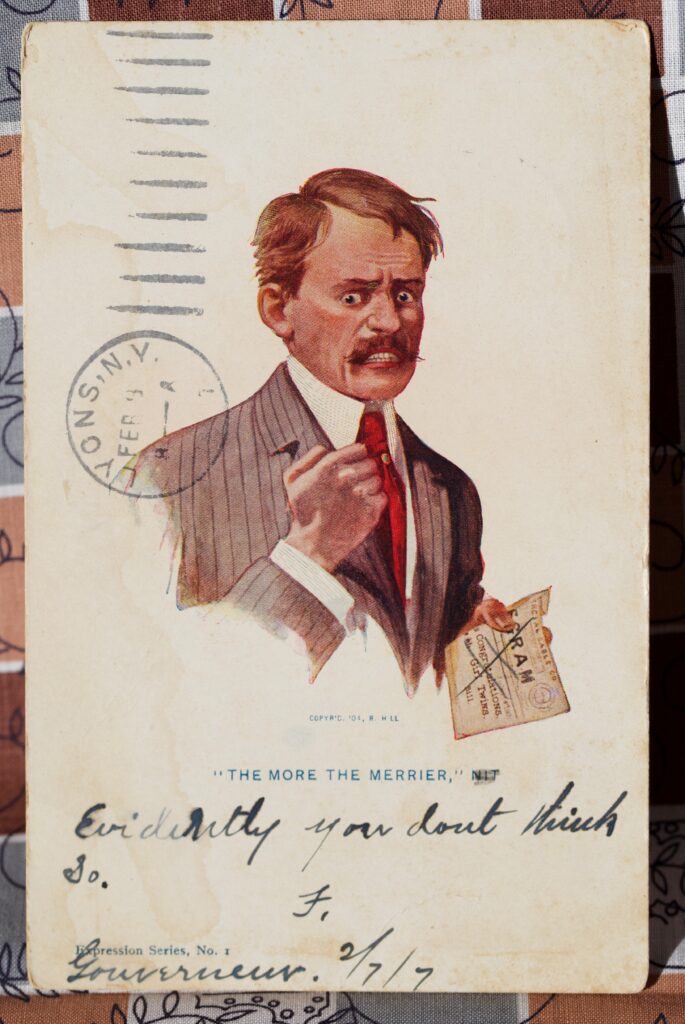 “Evidently you don’t think / So. / F. / Gouverneur. 2/7/7” The horrified or maybe panic-stricken man is shown holding a telegram that congratulates him on the birth of twin girls, which F. has decorated with a double cross.
*
Stephan’s proposition was radical because it would have signaled an unprecedented democratization of communication. To shed the envelope, along with its wax seal, would amount to undoing centuries of epistolary custom, unsettling established roles and hierarchies, and replacing the careful handling of letters with something more like carefree visiting cards while also challenging the idea that visiting cards must be delivered by the visitor rather than sent anonymously anywhere in the world.
Stephan’s suggestion was radical even by Karlsruhe’s standards, a city already known for its experiments in redefining the relationship between distance and time. Its own notable sons included Karl Drais, the inventor of the bicycle (1785-1851), as well as Carl Benz, the inventor of the automobile (1844-1929).
*
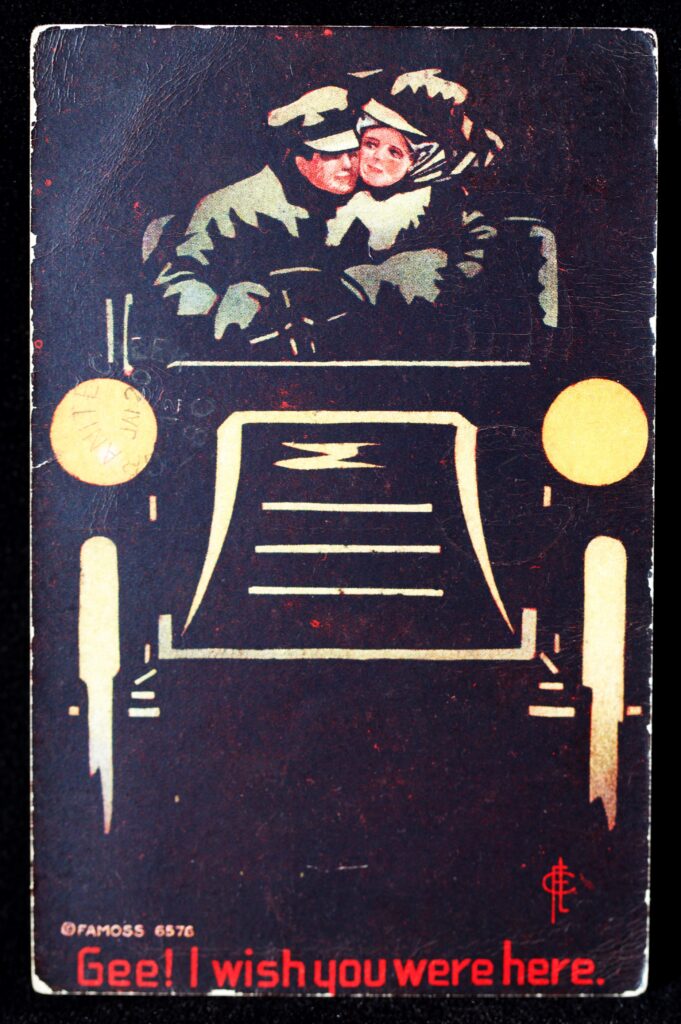 (Notice the postmark in the headlight, the wrinkles in the cardstock at the top.)
*
It wasn’t only postcards that threatened dramatic transformation. The 1860s were also a moment of forging identities, expanding empires, and it was all made possible by a spectrum of new technologies that accelerated movement and the conveyance of people, goods, and information—cheaper, faster, and safer. The Meiji Restoration helped Japan forge a cohesive national identity, aligning dialect and establishing a unified education system. Italy achieved unification. Argentina and the Empire of Brazil extended their territories at the expense of Paraguay (though that fact is contested here as it often is). Millions of Russians were freed from feudal servitude.
1865 marked the liberation of millions in the United States, which, at least on paper, remained united or moved toward greater unity. In that year a Bolivian seed hunter named Manuel Incra Mamani finally managed to obtain Cinchona calisaya seeds and delivered them to Charles Ledger, a British alpaca farmer who had once rescued him when he was drowning. Exporting cinchona seeds was strictly forbidden, but Ledger sent these seeds to his brother in London, who in turn sold them to the Dutch government, which then sent them to its colonies in Nusantara (Indonesia), where they thrived.
The bark of Cinchona calisaya, also called Cinchona ledgeriana, was exceptionally rich in quinine, the only treatment for malaria available until the 1920s. When quinine could only be obtained in South America, supplies were extremely limited, which restricted European expeditions into tropical regions. With the new supply, however, plenty was available. Mamani’s sacrifice—he was beaten to death—saved countless European lives. It also made possible the near-total colonization of Africa, and the deaths of millions of indigenous people (some scholars estimate around 10 million in the Congo Free State alone).
*
If the 1860s signaled an era of streamlining, erasing differences, consolidation, and absorption, there were observers who noted the discrepancies, absurdities, and calamities produced along the way. Here again, technologies played a crucial role. The American Civil War became the first conflict to be thoroughly documented by photographers. When Mathew Brady exhibited his Antietam photographs in Manhattan in 1862, a New York Times writer described the wreckage of those who came to view it: “If he has not sent bodies into our yards and along our streets, he has done something very like it.” After the war Brady’s work fell out of favor, and he died in bankruptcy, having also gone blind.
It was the era of War and Peace, Thé rèse Raquin, and Great Expectations. Two weeks after Stephan’s failed postcard proposal, Lewis Carroll published Alice’s Adventures in Wonderland, the tale of a young girl wandering into an underworld that is both terrifying and festive, as when the Red Queen invites her to play croquet with flamingos for mallets, with hedgehogs as balls and unpaired soldiers acting as wickets. “Alice soon came to the conclusion,” Carroll writes, “that it was a very difficult game indeed.”
*
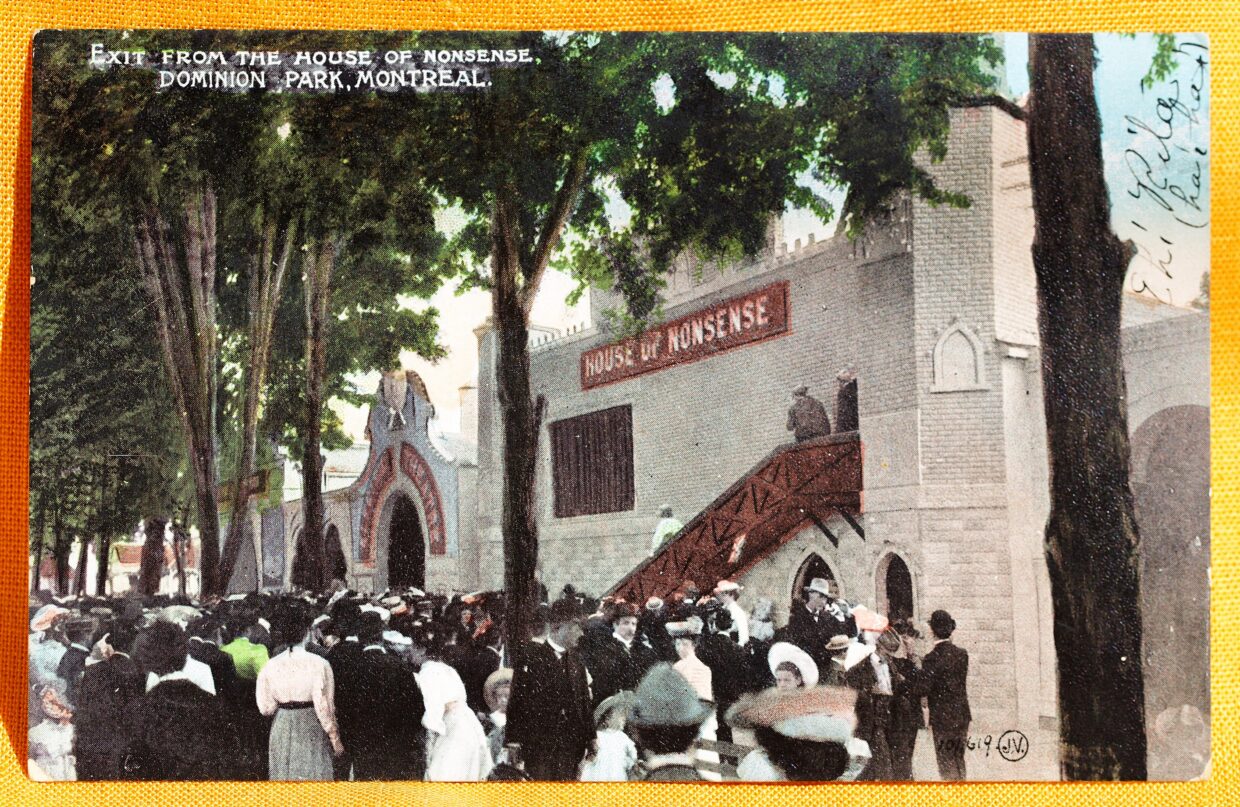 “Eh! Rila / (ha! ha!)”
*
Every time I fell in love, it felt as if I were tumbling slowly down Alice’s rabbit hole, except I knew I wouldn’t have a clear idea of how to behave or what the other person might unlock in me—a future radiant with children, with unwavering affection, and a love that would endure.
It wasn’t that I saw men as mere means to an end; it was more that I considered all the possible futures a relationship might bring—friction, fixation, metamorphosis, and the emergence of entirely new people born from shared connection.
I didn’t only yearn for children. I also desired sex for its own sake, conversation for its own sake. I wanted a companion as well.
*
I met Juan soon after relocating to Buenos Aires in January 2010. I had received a grant from Northwestern University to study writers in the city, which would cover my living costs for at least a year, with the hazy plan to stay forever.
I soon began co-teaching workshops on American fiction with an Argentine poet who kindly tolerated my Spanish, which still sounded like a rickety wheel at times. The class Juan enrolled in met on Tuesdays from 7:30 to 10:00 p.m. at a café on Avenida Santa Fe or at the poet’s place in Monserrat.
Juan seemed to have read everything. In our third session, he rattled off T. S. Eliot in a gleaming British accent that clearly came from Cambridge, where he had studied for his bachelor’s and master’s degrees. He stood tall, about six-feet-three or four, though he carried himself with a stoop and a distinctive, statue-like bearing. He possessed large hands and a head like a weathered statue, his skin pale like old stone—quite unlike my previous partner’s well-tended complexion. I sensed he liked me, but after our fourth class, I wasn’t certain I felt drawn to him, at least not yet.
Or perhaps I did, but I was also perplexed by him. I kept trying to draw conclusions about who he was, only to erase them by the next week. Before the fifth class, I found him on Facebook, yet his profile only muddied the picture further. He worked at his uncle’s condom company, which meant he reposted many provocative advertisements featuring mostly naked women. Beyond that, his timeline seemed segmented into epochs curated by a woman who I could assume had been a girlfriend who had tagged him in unflattering photos, posted public declarations, and invited him to events I couldn’t decipher. Unlike the condom ads, those women didn’t look especially sexy to me, but they shared that common thread.
I wasn’t sure we would mesh. Usually the spark arrived—an irresistible plunge into the rabbit hole—laden with possibility and a hint of doom. But with Juan, I felt nothing of that sort. Perhaps, I thought, that might actually be a good sign?
*
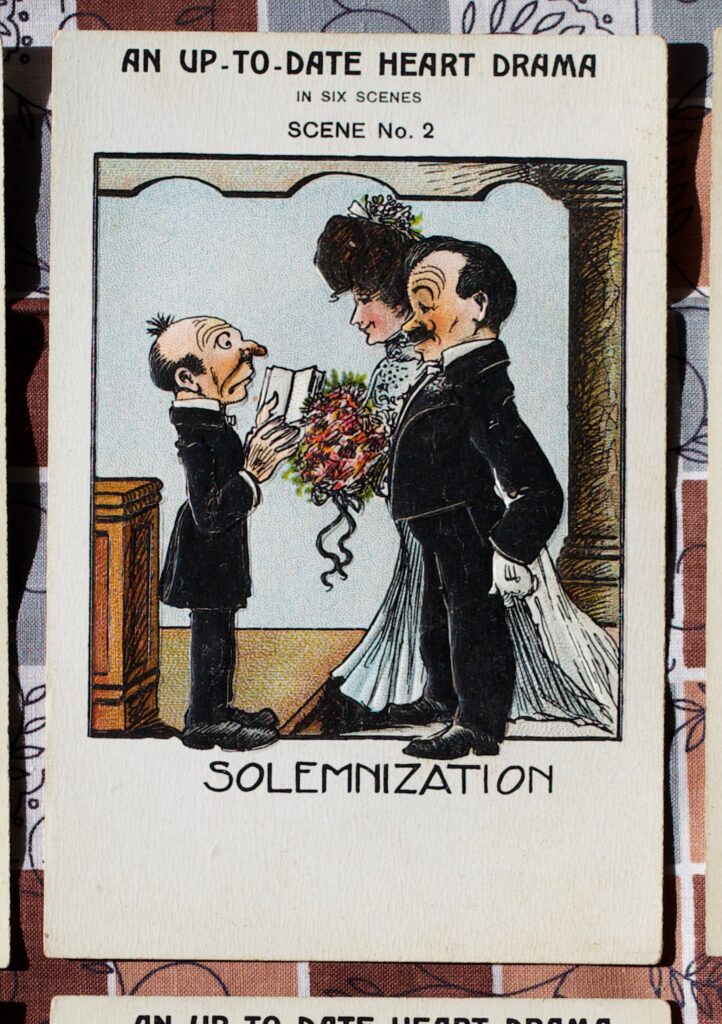
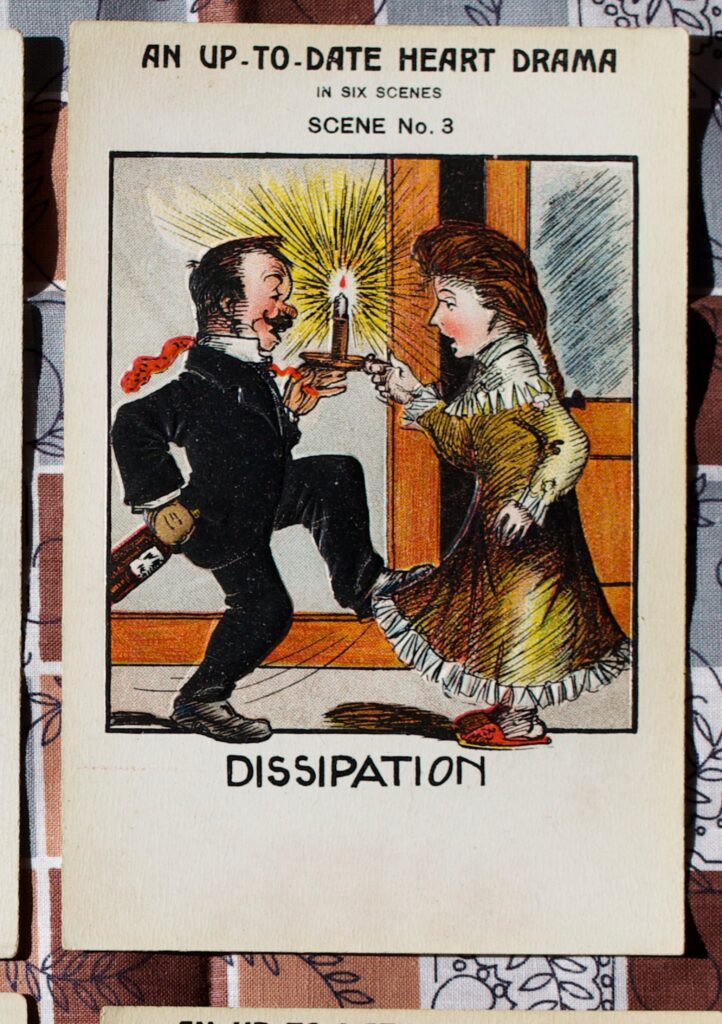
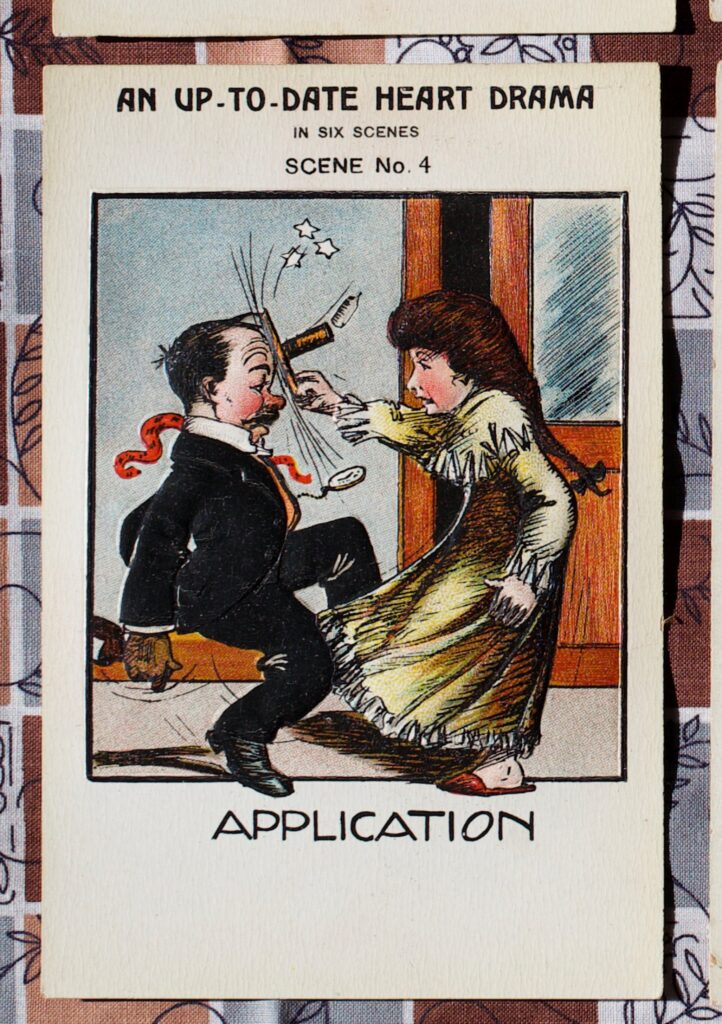
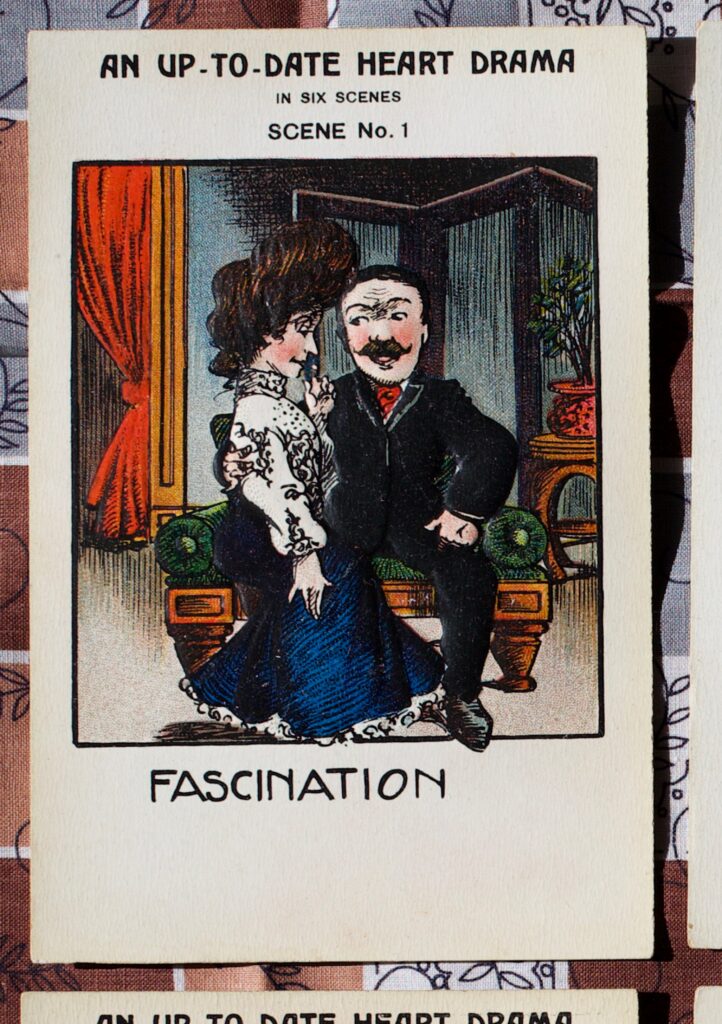 Series of postcards, including ones that narrated fairy tales and other stories, were initially popular (and reflected a faith that mail would arrive in a certain order that we may not trust today).
*
For reasons I can’t quite name, after that fifth class I invited Juan to a housewarming party for a Danish acquaintance. It was late April, and the pink blossoms of jacaranda trees were shedding their petals. The party was dull, with mostly empty rooms and no music, but I distinctly remember the moment I felt Juan’s hand resting low on my back. I marveled at the steady, confident touch as he guided me through the space. For the first time, I felt a longing to be led—even if I couldn’t fully trust him, the reassuring steadiness of his grip seemed beyond doubt.
And as he walked me home, engaging me in a lively debate about whether he should accompany me to my door, I recall the lamplight in Parque Las Heras, the rows of palm trees along the sidewalk, the moonlit night, and the way his words felt both firm and comforting. Just before we reached my building, he gently tightened his grip on my shoulder, turned me toward him, slid his hand up to my throat, and kissed me, pinning me to the cool concrete of the park wall until he eclipsed me.
*
*
After that, I longed for him all the time. I loved vanishing for days at a time into his creaky little attic on Avenida Santa Fe, listening to horns and shouts and parrots squawking at Plaza Vicente López, sitting with him in the mornings over espresso, and later, being whisked again and again into the stiff deep-red sheets on the mattress on the floor.
*
We’d been together for a year when I received an offer for a translation fellowship in Kraków. I didn’t want to leave Buenos Aires, and I was deeply in love with Juan, but we talked it over and decided that not only should I go, but that he would accompany me at first, travel with me, to help me settle and so I could show him Poland for as long as his uncle could grant him time off from work.
Gradually the trip grew larger. He decided he wanted to visit friends in London; I suggested we also visit a friend of mine who lived near Paris. Juan didn’t relish travel—unlike me, he felt uneasy in motion—but he adored people and was deeply in love with me. Although I had never enjoyed traveling with someone as much as traveling alone, I felt certain that a journey with Juan would be uniquely wonderful, knowing him, his almost magical ability to turn the ordinary into something glorious, his affability, and our chemistry—believing I knew everything I needed to know.
We began in France. We had sex, we drank wine, we ate bread and cheese, and we walked for long hours in the February dusk, a mood that felt illicit and all-encompassing after the warm south. I was right: it was already the best trip I had ever taken. Wonderful was nothing next to Juan.
Then we went to London. I met his friends. I liked his friends. One night I pressed him about them, asking after someone named Anna who I hadn’t met yet but who had been mentioned by a few people. Juan said he didn’t know any Anna, there was no Anna, and with a sharpness I’d never heard from him, he declared that he was tired.
We didn’t have sex, and when he slept, I, for the first time, quietly opened his iPad and searched his emails and Facebook messages for the name Anna.
*
*
For some reason I let Juan sleep until morning. Then, very calmly, after we had both had a cup of coffee, I told him we were breaking up.
Turns out there were two Annas. One in Buenos Aires and one in London. He had slept with both of them during the past year.
Perhaps if I had searched for common female names in Argentina—Tamara, Romina, Martina—I would have found more affairs. But it never occurred to me then. The Annas stood out so starkly against the relationship I believed we shared that there was no room for more.
Juan was horrified; he begged not to lose me; in a rage-driven trance, I slammed the heavy white door of his friends’ apartment in his face and walked to the train station alone. It was Valentine’s Day 2012. A part of me—almost all of me—hoped he would come after me, somehow miraculously turning our circumstance into something else. But he did not follow, and I boarded the train back to Paris by myself.
*
*
In November 1865, Heinrich von Stephan had told the Austro-German Postal Union that traditional letters could not be “brief enough, because, if a letter be written, convention necessitates something more than the bare communication.” That, then, was the central problem the postcard, if allowed to flourish, might solve.
*
Stephan intended the postcard for urgent messages—“Come home at once, your father’s dying” or practical ones like, “It’s cold—send socks!”—and it’s true that postcards did fulfill those functions at first.
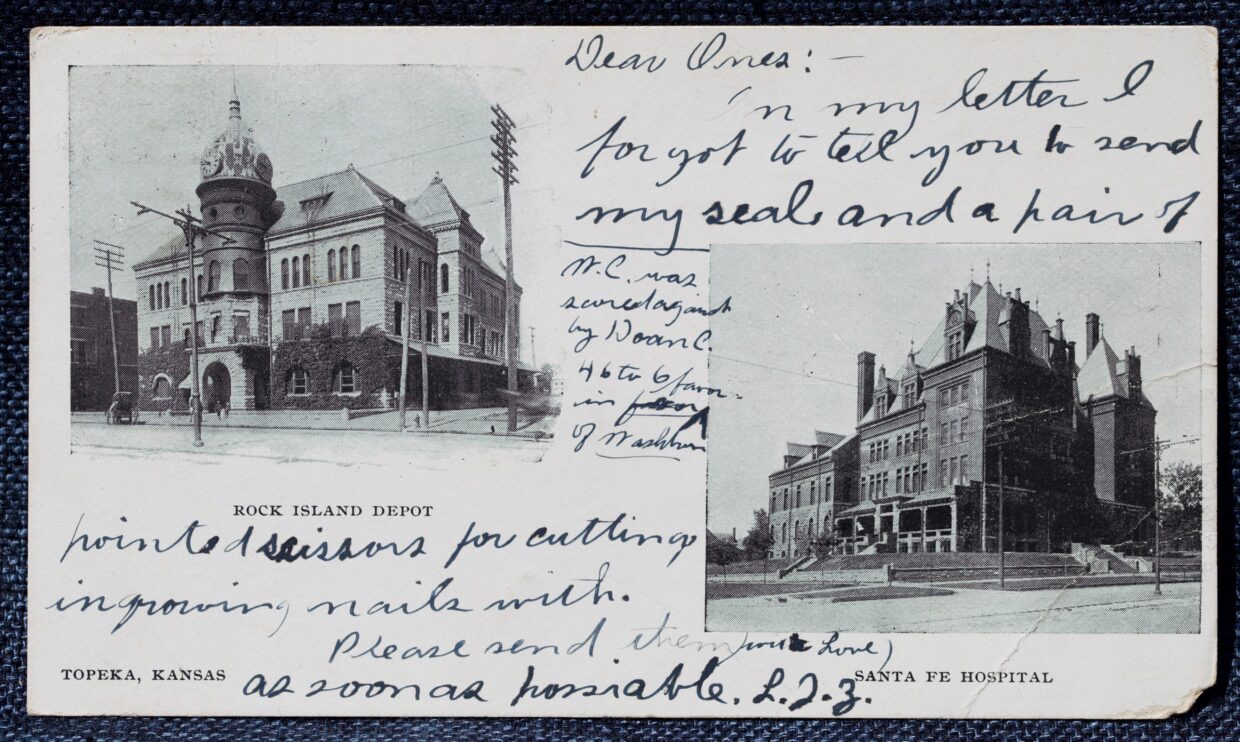 “Dear Ones: — / In my letter I / forgot to tell you to send / my seal and a pair of / pointed scissors for cutting / ingrowing nails with. / Please send them )with love) / as soon as possible. L.I.Z.” Middle box: “W.C. was / scored against / by Dean C. 46 to 6 / in favor / of Washburn”
*
In fact, the earliest postcards carried no imagery (apart from the portraits that would later be canceled on stamps), meaning there was literally nothing to distract from urgent messages.
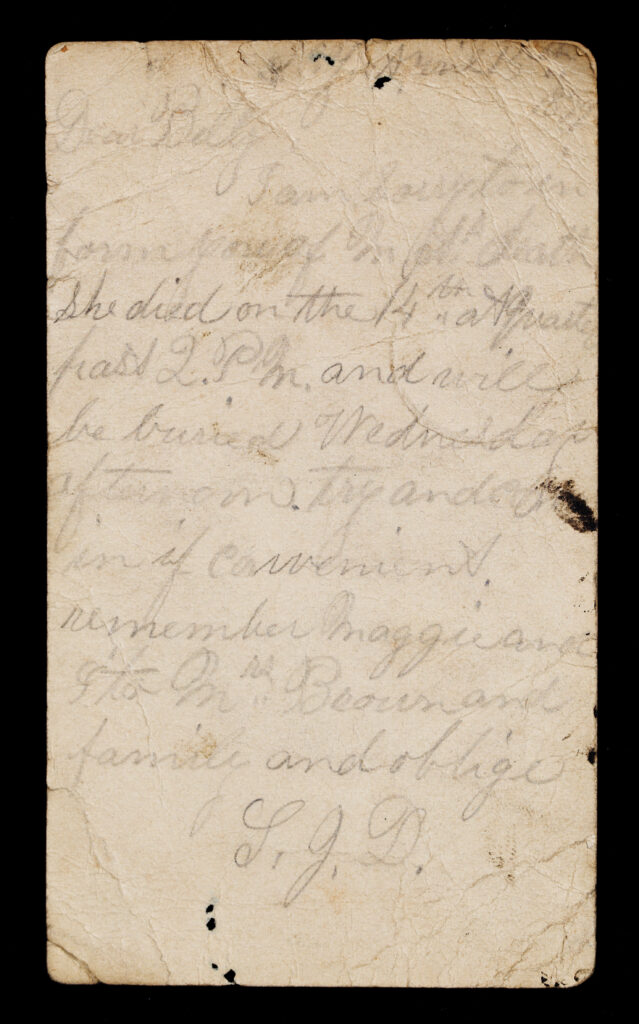 “Dear Billy, / I am sorry to in / form you of M[. . .]’s death / She died on the 14th at quarter / past 2 p.m. and will / be buried Wednesday / afternoon try and come / in if convenient / remember Maggie and / S to Mrs Brown and / family and oblige / S.G.D.”
*
Yet there had to be more to bare communication than sorrowful notes and routine updates. Stephan also envisioned a totally new medium with the power to refresh human connection by laying bare the mechanics of communication.
So how could correspondents render language naked, stripping sentences down to exactly what was necessary to convey meaning?
*
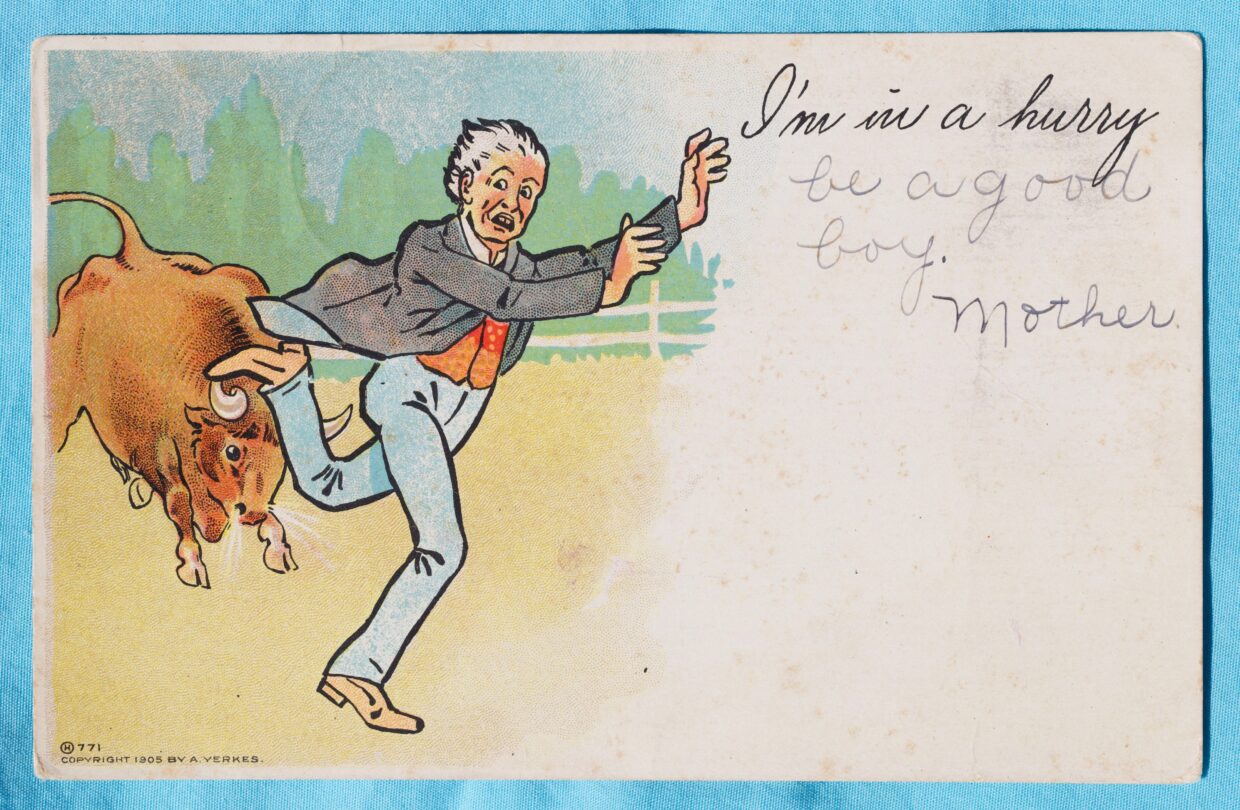 “be a good / boy. / Mother.”
*
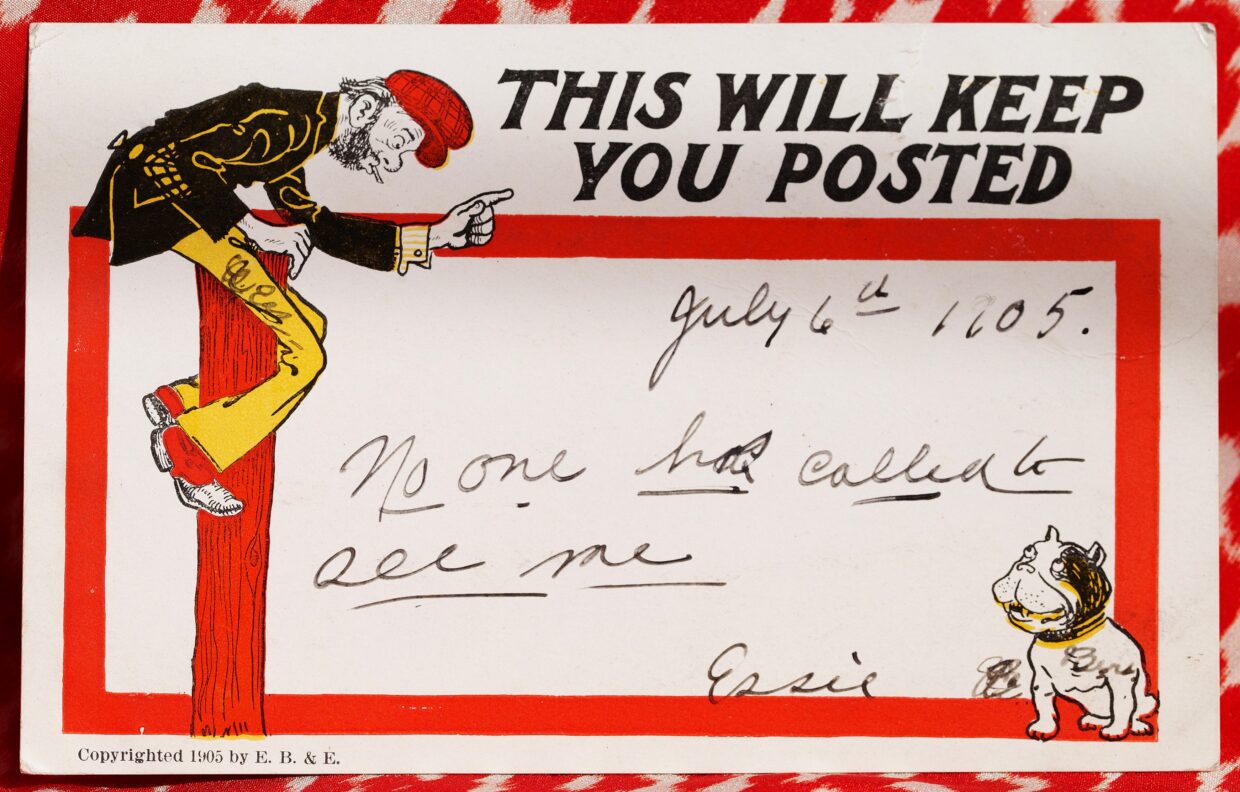 “July 6th 1905. / No one has called to / see me / Essie”
Early postcards often functioned as pleas for visits or letters, as if saying, I’m still here, or I wish you were here.
*
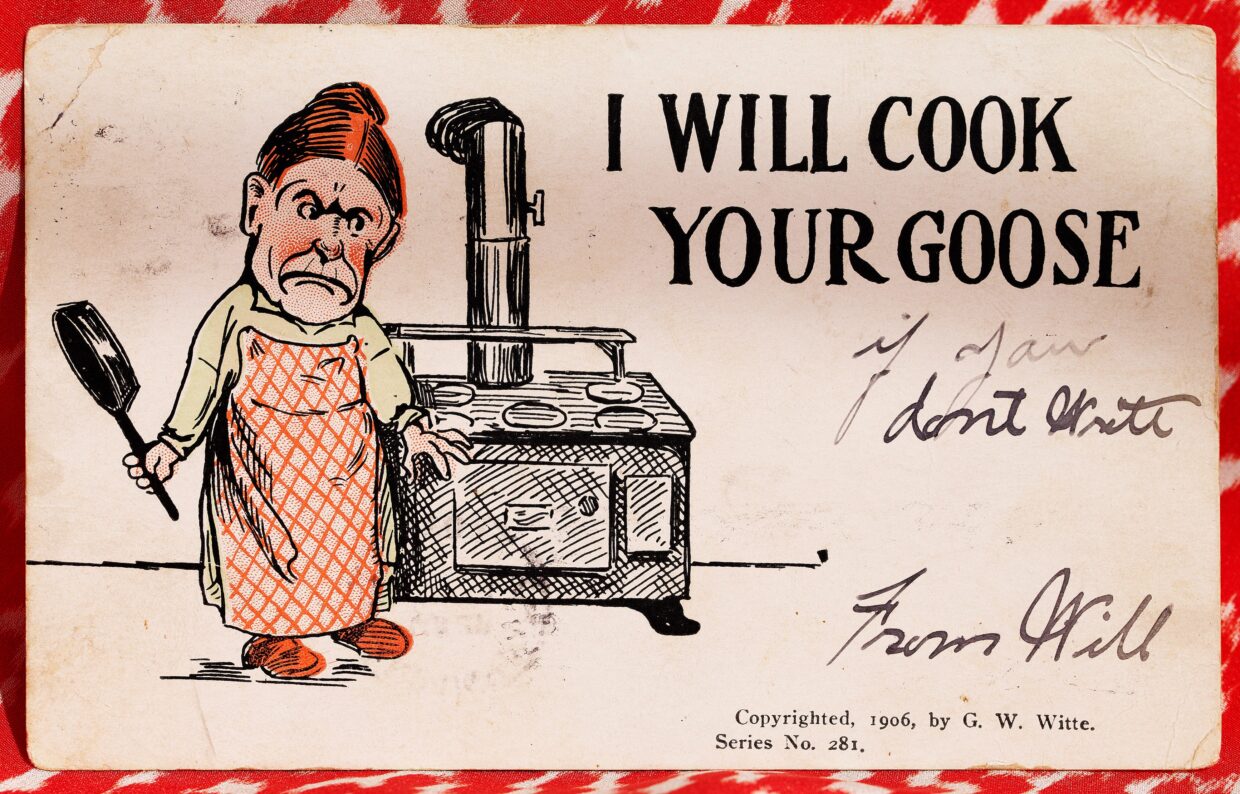 “if you / don’t write / From Will”
*
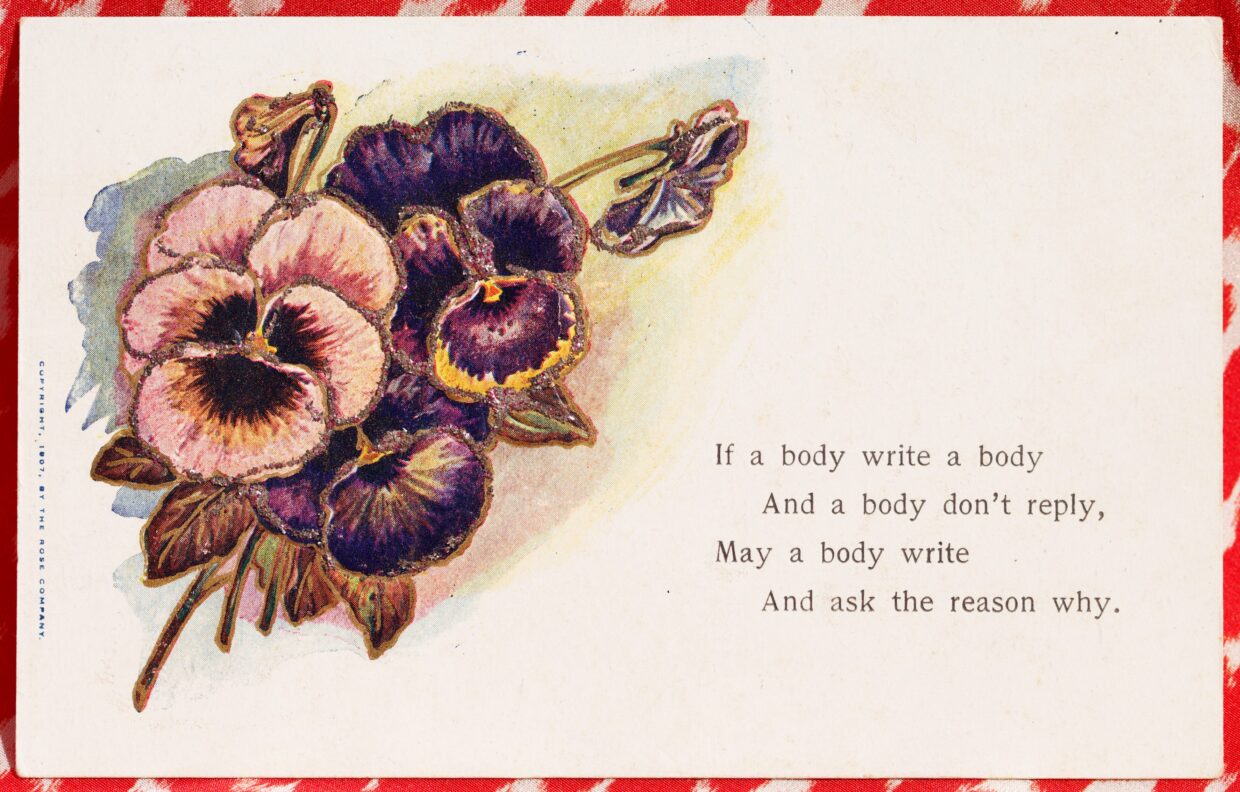
Could these requests (threats, rebukes) be bare communication? The bare minimum that makes absence become presence?
*
Could bare communication be the opposite? The promise of arrival, and little else?
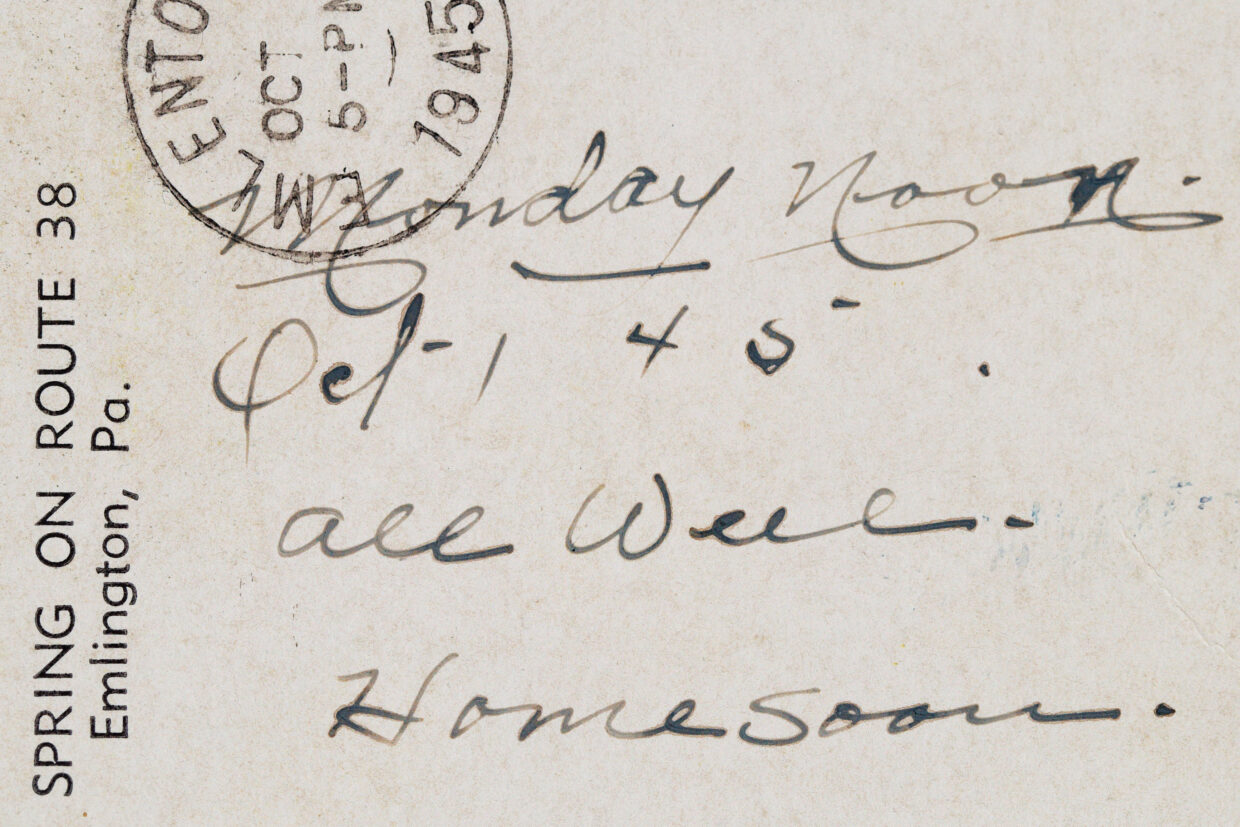 “Monday noon. / Oct 1 45 / All well. / Home soon.”
*
Is heartfelt contact simply a version of bare communication? Is baring the soul, in other words, the same as communicating with almost nothing at all?
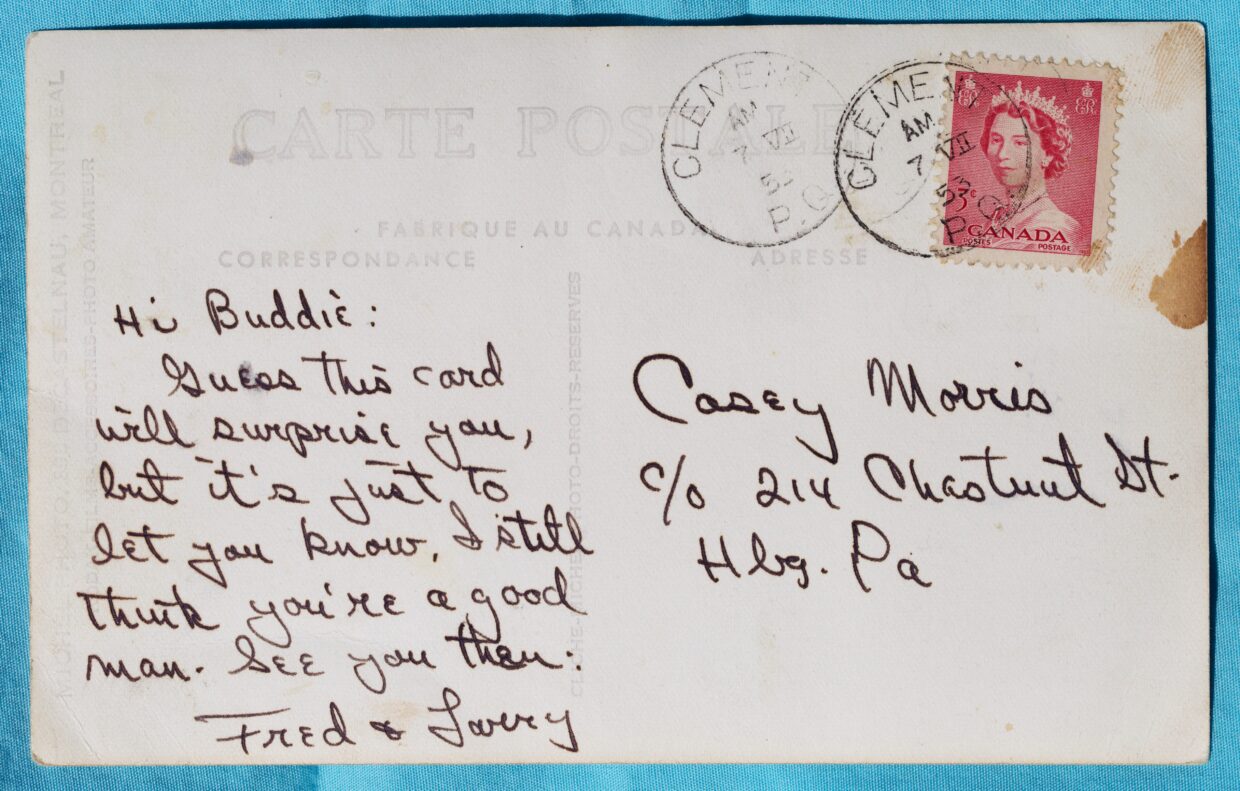 “Hi Buddie: / Guess this card / will surprise you, / but it’s just to / let you know, I still / think you’re a good / man. See you then: / Fred & Larry”
*
Could humor be a form of bare communication?
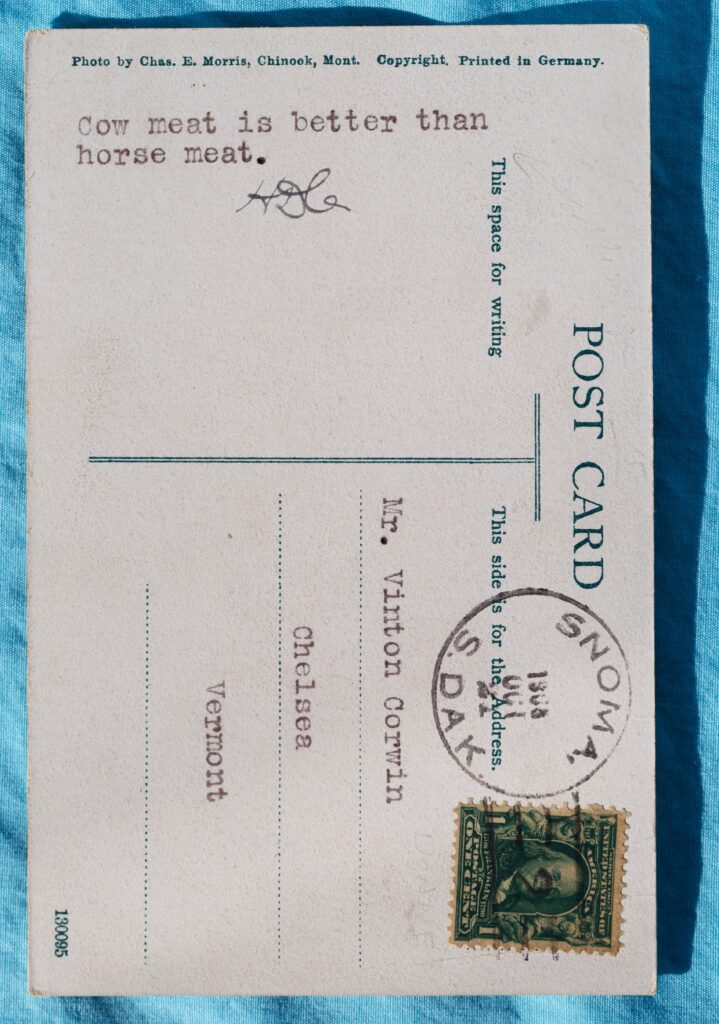
Can typed words be naked, or is nakedness reserved for handwriting?
*
Is condolence an essential term?
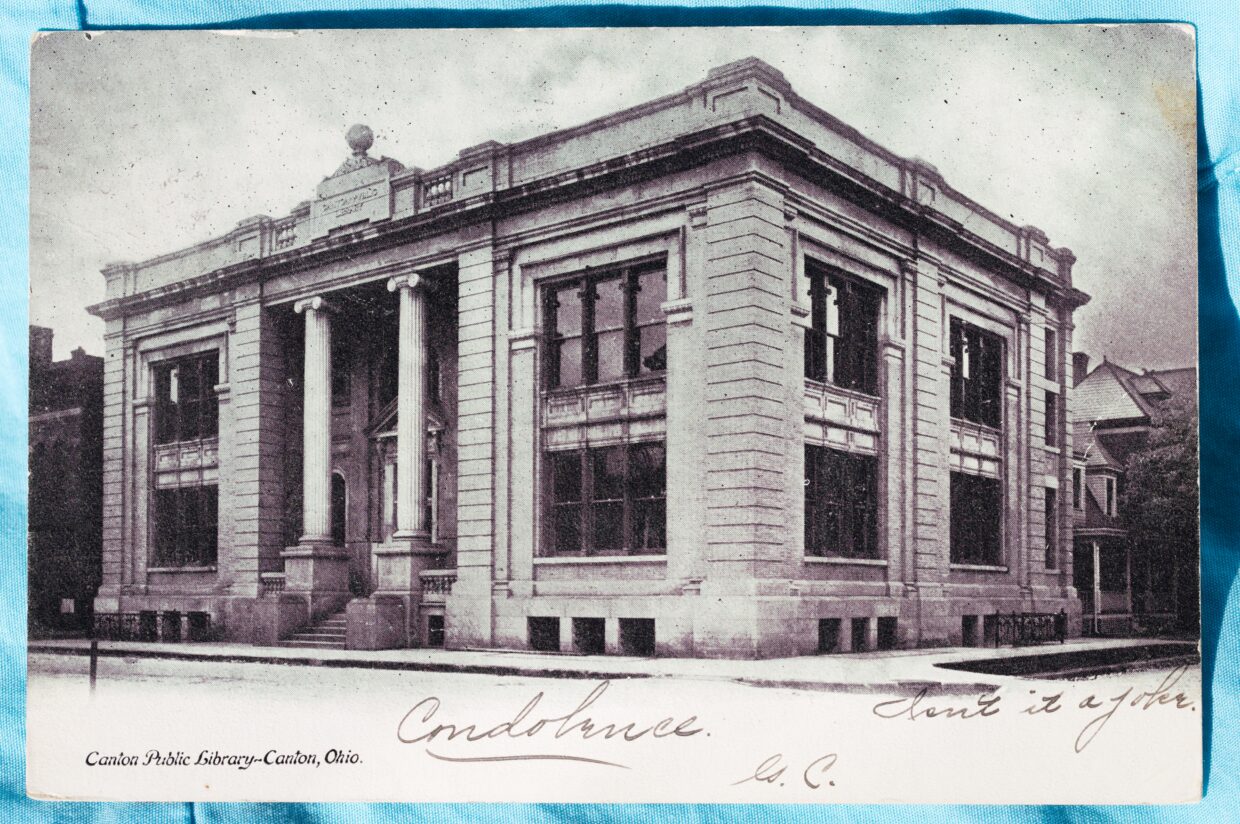 “Condolence. Isn’t it a joke. / G.C.”
What about life and death?
*
I know my life is tiny on the global arc of history. But in truth, so are postcards. So are Bolivian seeds.
*
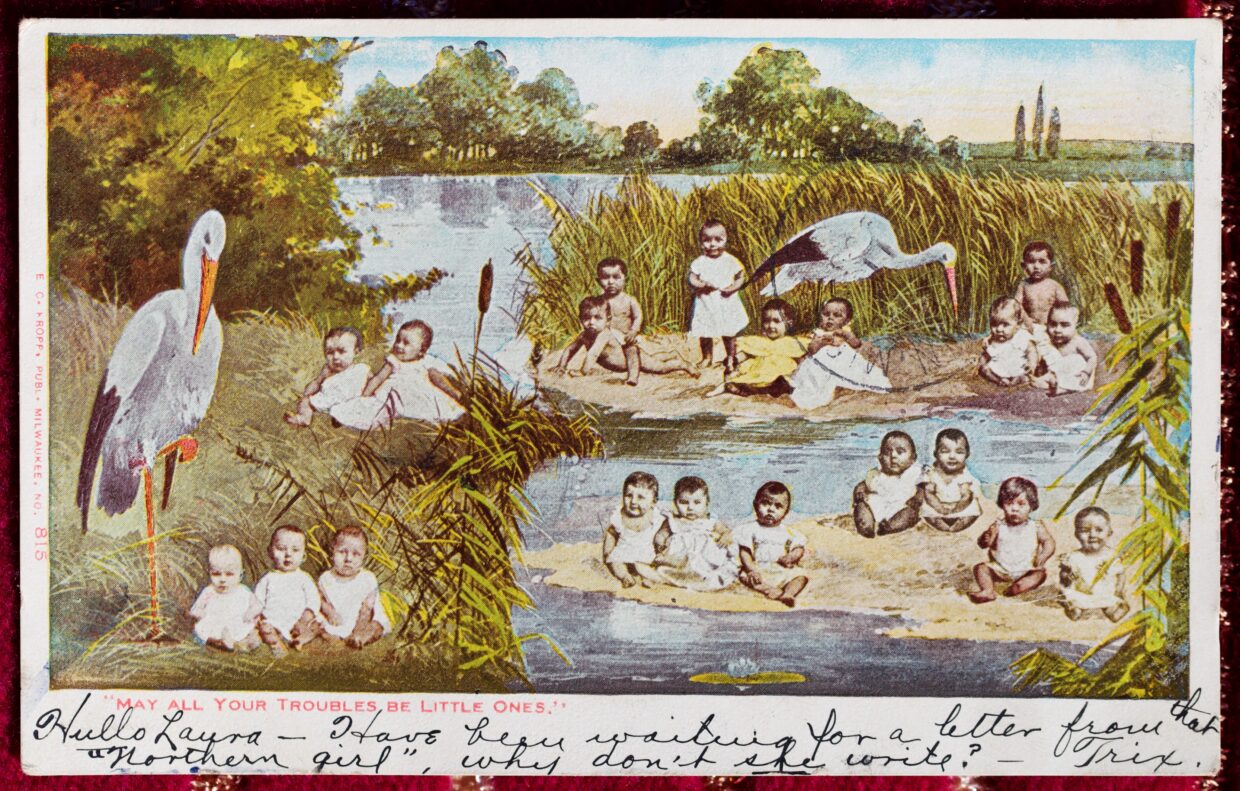 “Hello Laura—Have been waiting for a letter from that / ‘Northern girl’, why don’t she write? —Trix.” (Notice the postmark around the second stork.)
*
When I finally returned to Paris, I found myself thinking about Juan’s sad, drooping eyes, his thick, anxious fingers, and how he enjoyed squeezing my shoulders to prop me up. Emerging from the Gare du Nord, I missed him terribly.
Yet Juan wouldn’t answer. He replied to only one of my messages—the first I sent after the explosion—from the train. He said he was deeply hurt by what I’d written and that he planned to fly back to Buenos Aires the next day from London.
*
*
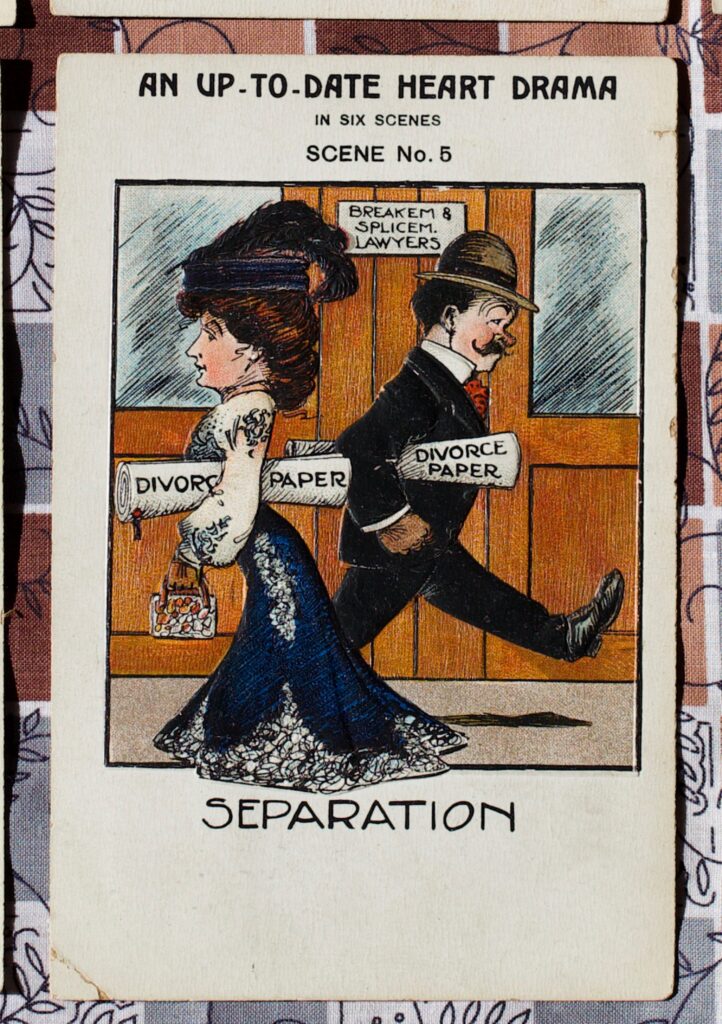
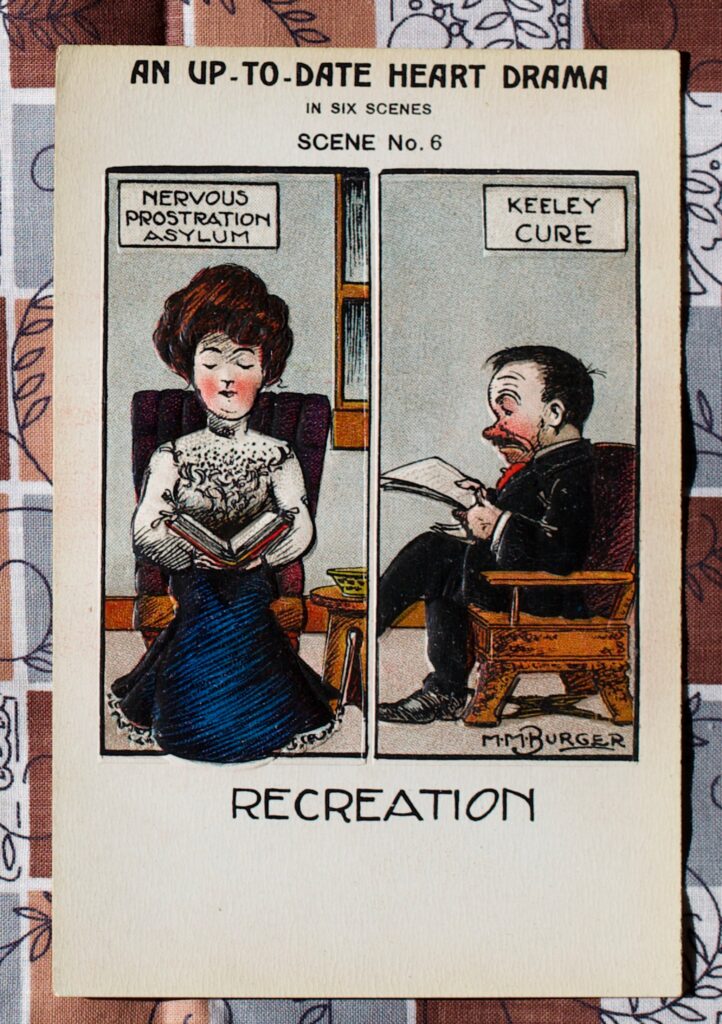
For a month I bombarded him with postcards, which were harder to evade (since burning them or tossing them away would still reveal something). I stayed with a friend near Paris instead of heading to Kraków, and every day I rode the train into the city and hunted for a good postcard. Then I would stop somewhere—often a park bench—and write something brisk or begin with his Santa Fe address, though sometimes just thinking I might never enter that apartment—my own wonderland—again overwhelmed me, and I’d take the card back to my friend’s ramshackle quarters, finish it there, and mail it the next morning from the box near the station.
Again and again I watched the same video of us making love, crying and drinking Belgian beer until sleep claimed me.
*
*
Eventually the postcards did their job. Juan and I reconciled several months later, once I had returned to Buenos Aires. One day he emailed me out of the blue, saying he had been thinking about what I’d written in those messages. By then I couldn’t recall what I’d said. I wish I had asked, because I still wonder now. Could it have been something I articulated? Or was it simply that my dozens of postcards proved I cared enough to move beyond what he’d done?
The relationship never fully recovered. I never spoke of it to anyone, but I kept checking his messages, becoming both obsessed and ashamed about how oblivious I had been before. I’m not sure whether he truly didn’t know or was simply applying his knack for deception to pretend he hadn’t a clue.
He eventually ended things with me in 2013, three weeks before my Northwestern dissertation defense, at a dreary café we had never visited near where his car was parked at night, perhaps hoping I wouldn’t make a scene, or if I did, that it wouldn’t humiliate him before people whose opinions mattered to him. He could then return home and send me away in disbelief in a cab.
*
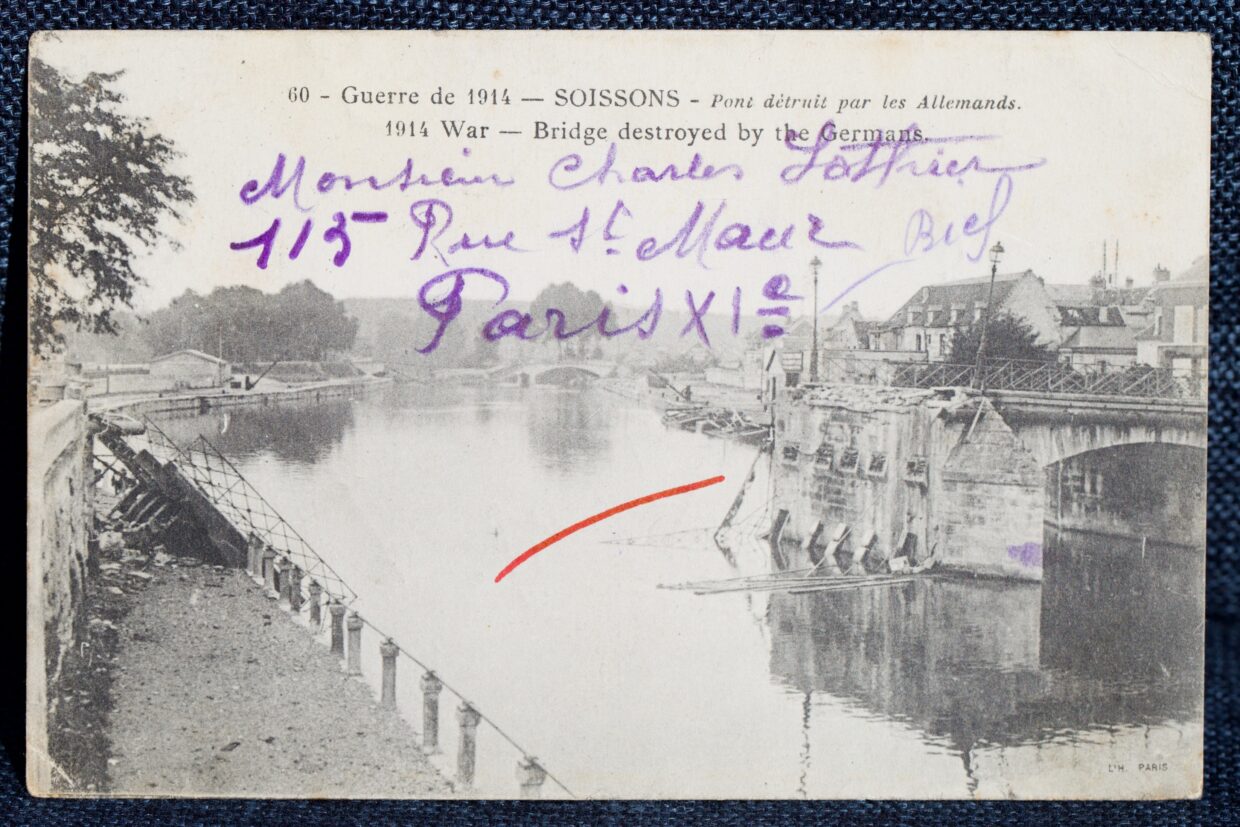
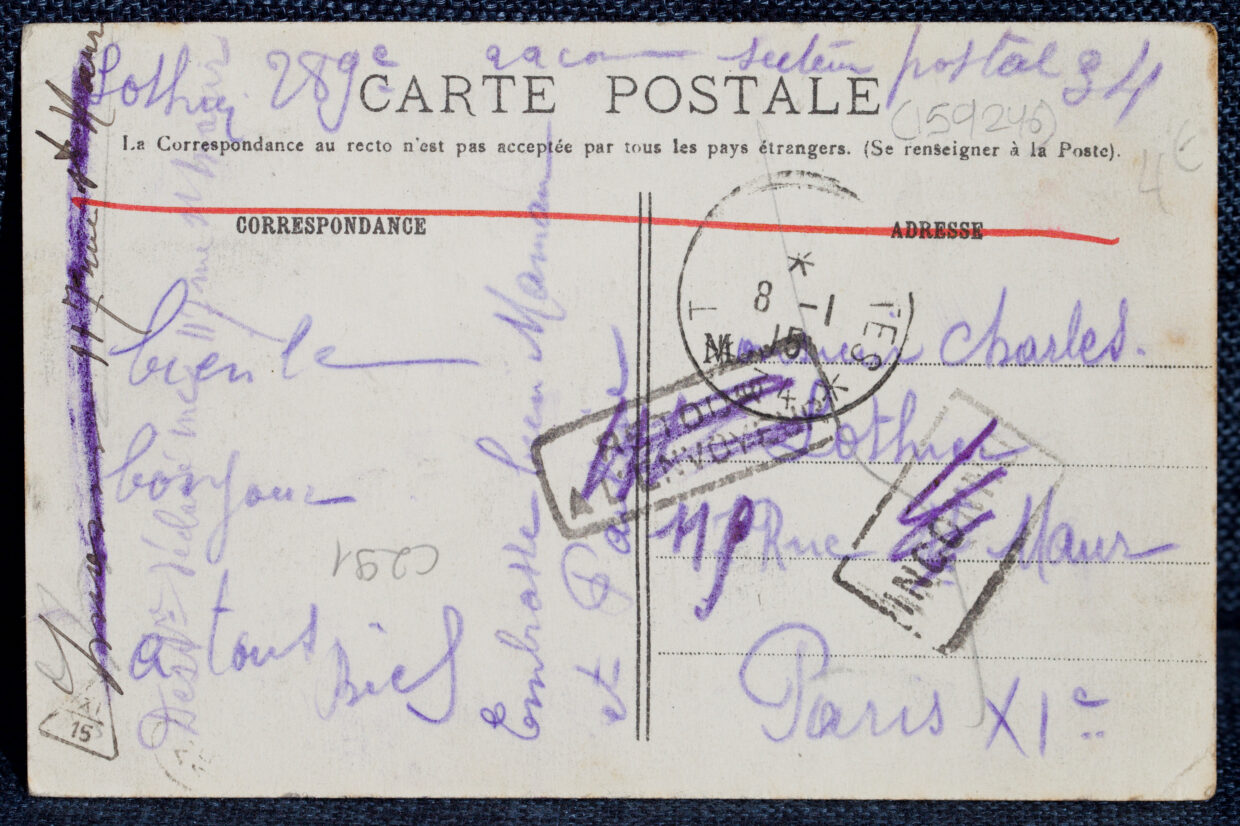
That was our second rotten ending. After that, I stopped contact entirely. Yet whenever I wandered into spots that sold old postcards, I began seeking ones whose messages appeared incomplete, fragmented, cut short by urgency of every kind, or whose notes were written in languages I couldn’t read, or where the postmarks blurred or the destination was missing—the kind that never reached their recipient because the person had already left.
*
______________________________
From Notes on Postcards: A Memoir by Jennifer Croft. Copyright © 2026. Available from Catapult.
