
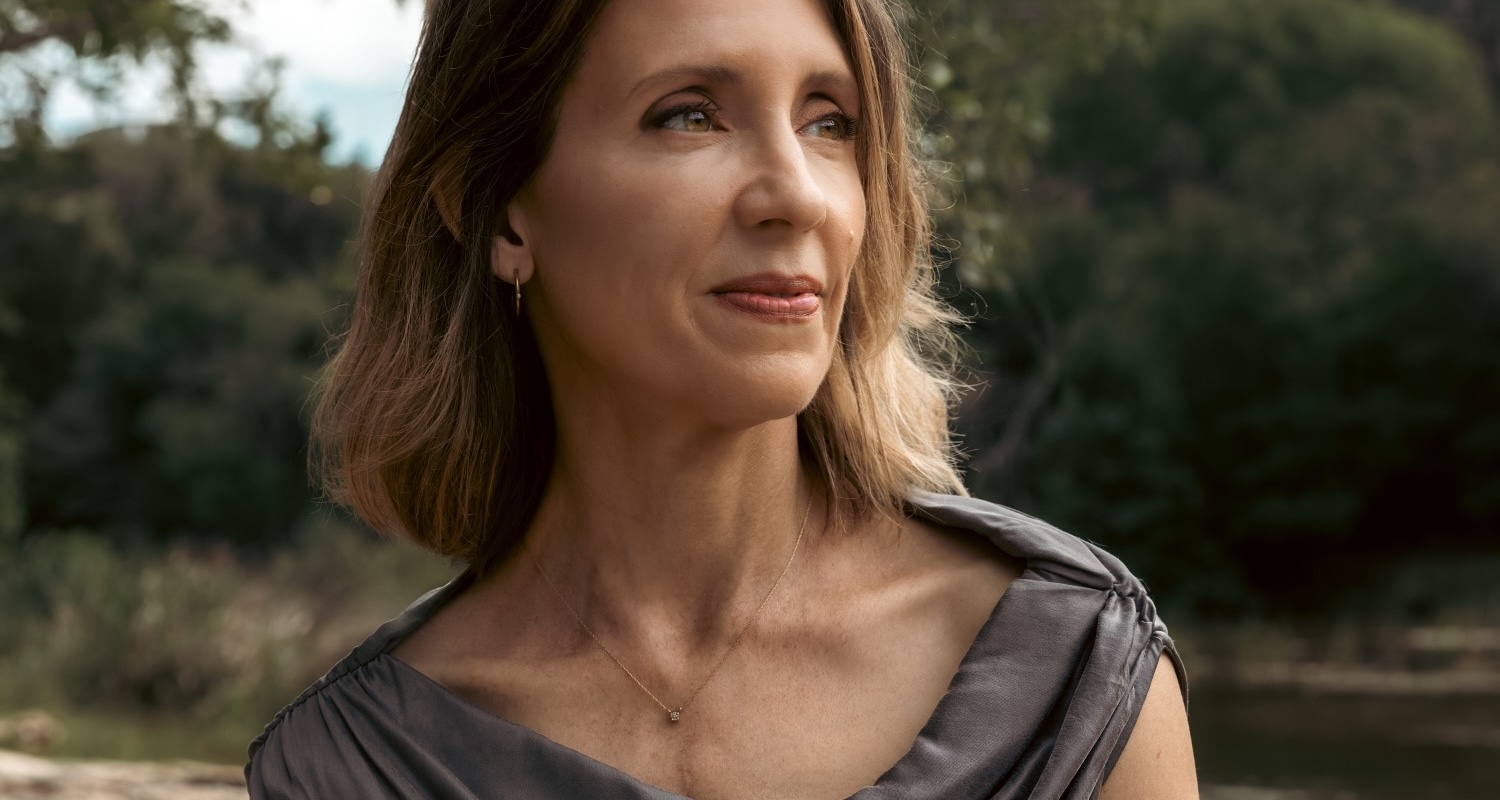
Austin-based novelist Karen Olsson’s background in journalism—writing as a contributor-at-large for Texas Monthly and serving as an editor for the late The Texas Observer—has enriched her fiction from the outset of her career.
Waterloo, her debut novel, offers a refined lens on the political life of a Texas capital that bears a close kinship to Austin. Her vividly drawn characters feel both larger-than-life and sharply authentic, blending realism with a touch of satire. Among them is Nick Lasseter, a political reporter who deliberately avoids designated press zones, credential tables, and Q&A sessions; he “never quite fit into that club, and as a writer for a publication barely holding its own, he wasn’t exactly the club’s ideal guest.” Then there is Beverly Flintic, a newly elected conservative state assemblywoman who observes, “After nearly a year in office, the protocols of this place still elude her; the longer she stays, the more its coded workings reveal themselves. There’s a surface layer of information—the loose soil and carrot tops fed to the reporters—and a second, more intricate stratum that becomes accessible only according to one’s position, beneath which lie still deeper tangles, warehouses of trivia, historical grudges, and petty paybacks she can’t quite grasp.” Waterloo was a runner-up for the 2006 PEN/Hemingway Award for Best First Novel; two decades on, it still feels timely.
Her sophomore work, All the Houses (2015), places a fractured father-daughter dynamic against the backdrop of the Iran-Contra era, delivering a layered portrait of Washington’s political machinations and foreign policy intrigue that would resonate with fans of the Netflix series The Diplomat. “Here you have both the grand mystery of government and its small human movers—carrying their travel mugs,” Olsson writes, “so tiny compared to the vast architecture around them.”
Dear Thorns, her latest novel, threads together South Texas history and development (set in a region not far from SpaceX’s Texas hub), the oil and gas industries, border immigration issues, species decline, and a ranching-heir artist into a nuanced story about a biologist who becomes drawn to a much younger intern within a wildlife refuge that shelters ocelots. All of this is delivered with Olsson’s characteristic acuity and insight. Dear Thorns is slated to be featured at the Texas Book Festival on November 15.
What sparked this novel? I asked Olsson. “Nearly twenty years ago, while reporting a magazine feature in the Rio Grande Valley, I stopped at the Santa Ana National Wildlife Refuge near Alamo, Texas,” she explained. “A photo display in the lobby introduced me to the ocelot, a wild cat I hadn’t encountered before. Ocelots are strikingly beautiful, and one night-time shot captured by a motion-trigger camera literally stopped me in my tracks.”
“But the book didn’t begin with the ocelot, exactly. I’d been spending time with journalist friends who’d covered violence near the border, and I began wondering about the emotional toll their work exacts. The questions I carried about the personal impact of witnessing destruction shifted from the realm of gang violence to something quieter. I imagined a woman living alone, working far from her upbringing, carrying this burden. She wasn’t an ocelot biologist in the earliest pages, but at some point I recalled the Santa Ana images, and that became her vocation.”
*
Jane Ciabattari: How did you settle on the title?
Karen Olsson: The book unfolds in the thornscrub country of South Texas, characterized by Tamaulipan mezquital—a thornscrub landscape. At first the word “thornscrub” compelled me as a title. Eventually I revised it to better capture my protagonist’s affection for a sometimes-hostile environment.
It’s difficult to pin down a single approach. In general, I keep digging, keep writing pages, and let whatever surfaces guide the work.
JC: Lora, your narrator, is a forty-something ocelot biologist who operates at a refuge just above the U.S.–Mexico border. After seven years there, she’s used to solitude, with interns nearby and occasional volunteers. In your opening passages you describe, “Lora, for one, had set aside the idea of close companionship…She was proudly independent. Still, wasn’t there some sunken root in her, burrowing and splitting and looking for water?” What was your method for giving voice to her loneliness, her unfulfilled longing, her fear that ocelots might disappear?
KO: There isn’t a single formula I can name. Generally I persist in drafting and see what emerges. Although the book is written in close third person, in this particular passage I wanted a narrator with a broader perspective—someone who can speak about Lora from a distance.
JC: The refuge you place her in, just north of the border, is an isolated thornscrub landscape—“low, thorny trees and bushes like mesquite, huisache, and Texas ebony.” It draws inspiration from Laguna Atascosa National Wildlife Refuge in South Texas, home to a small ocelot population. How did your research shape the refuge in which Lora lives and works?
KO: I spent a couple of days at Laguna Atascosa in early 2020, right before the pandemic, learning a great deal from the ocelot biologist there. Afterward I stepped back so the novel’s refuge wouldn’t mesh too closely with the real place. The fictional refuge shares physical likenesses and I’ve strived to accurately re-create what I learned about ocelots and their monitoring. That said, the novel’s refuge employs fewer staff than the actual one, and Lora isn’t modeled on the real biologist who was working there at the time. I did worry that people there might mistake her for that person. For the record, I never suspected any romantic entanglements among staff and interns at the real Laguna Atascosa.
JC: How did you learn so much about ocelots? Did you happen to see one during the writing of this novel?
KO: Ocelots are nocturnal and elusive, which is part of their allure. Even the people who work with them often don’t actually see them, and I was drawn to that idea of pursuing something unseen. In addition to visiting Laguna Atascosa, I read extensively about ocelots and attempted to view one at the San Antonio Zoo, but the enclosure was undergoing renovation on the day I visited, so staff couldn’t tell me where the animals had gone. I ultimately saw an ocelot at the Mexico City Zoo. It was stunning, though viewing wildlife in a zoo is inevitably different from seeing it in the wild.
JC: The circumstances at the refuge bring Lora into close proximity with Ben, the new intern. What were the main challenges in portraying this older-woman/younger-man dynamic?
KO: I began with an early draft from Ben’s vantage point, but once I shifted to Lora’s perspective, making Ben a fully realized character proved tricky because Lora doesn’t always perceive him clearly.
I was really drawn to the idea of chasing after something unseen.
JC: The refuge’s new director, Greg, appears more eager to welcome hunters than to view a newly discovered ocelot in one of Lora’s traps. He wants Lora to discard the archival discs she’s determined to preserve. They seem at odds from the outset. Is this a common fault line in this field?
KO: Broadly speaking, there are “wildlife management” professionals who tend to view ranching, hunting, and conservation through an economic lens, and there are conservationists who prioritize safeguarding animals and their habitats. A version of this divide plays out between Greg and Lora, though Greg isn’t meant to stand for wildlife-management professionals as a whole. He’s a comic figure rendered mainly through Lora’s eyes, and she never gives him a fair shake. In reality, both strands have vital roles to play in conservation.
JC: In your view, what would be most instrumental in saving the ocelot from extinction?
KO: Ocelots inhabit Central and South America as well as the United States, where the species is endangered everywhere and especially vulnerable in Texas’s two small populations. The primary threat is habitat loss; expanding their living space is crucial. Reforestation and creating corridors that link separated habitats—such as across highways—would help. In Texas, work on highway underpasses has begun to reduce road fatalities. A project called Recover Texas Ocelots is just taking shape, aiming to breed more ocelots and release them on a ranch west of the current populations. If successful, this could yield a growth in U.S. ocelot numbers.
JC: Have any novels or nonfiction works influenced you while crafting Dear Thorns?
KO: The Peregrine by JA Baker, The Moth Snowstorm: Nature and Joy by Michael McCarthy (kudos to New York Review Books for publishing both), The Song of the Dodo by David Quammen, and the novels of Willa Cather have all left their imprint.
JC: What are you working on now or next?
KO: It’s still early in the process to share details.
______________________________
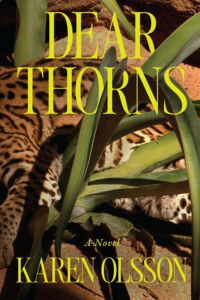
Dear Thorns by Karen Olsson is available from Astra House Publishing.
