
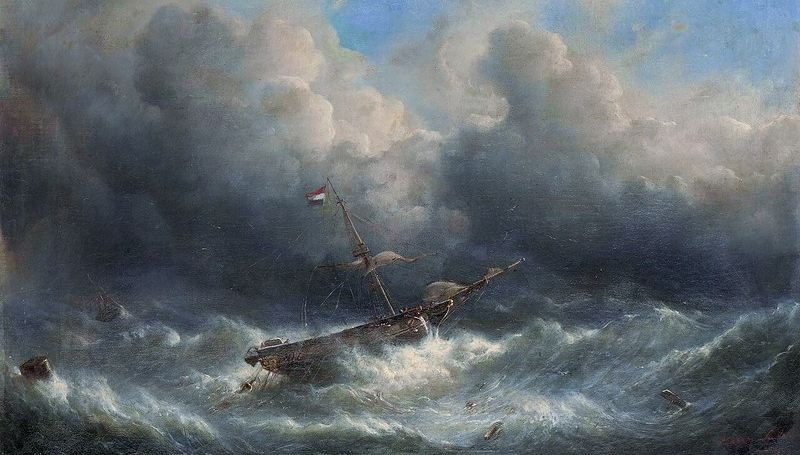
You guys, the sea is vast and intimidating, yet it gleams with a kind of awe that’s almost spiritual. Even after countless reckonings with its vastness, my mind still falls short of fully grasping it. I grew up in the Midwest along the shores of the magnificent, albeit less intimidating, Great Lake Michigan, and I didn’t set foot in an ocean until I was nineteen. When I finally ventured into the sea off Costa Rica during a spring break in 1999, I experienced the first—and most piercing—panic attack of my life. That enduring mix of fear and reverence for the ocean is a major reason I felt compelled to write Man Overboard!, a story about Kick Kilpatrick, a 33-year-old Nebraska man who works as a physical therapist by day and a gym enthusiast by side job. He plunges (or perhaps is pushed) from a cruise ship into the Gulf of Mexico while on a Thanksgiving family vacation, and then spends hours treading water in desperate anticipation of rescue. It’s meant to be funny!
Just like me, Kick is an avid aficionado of survival narratives in all their forms. He grew up devouring Reader’s Digest’s Drama in Real Life, dreaming of bear encounters that end with a survivor’s hard-won escape, or backcountry avalanches that are dug out by sheer grit. Yet the ones that stay with him—and eventually haunt him as well—are the sea-drenched accounts of people who vanish and fight to be found. In the course of researching this novel, I immersed myself in volumes about that very struggle, discovering some of the finest passages I’ve ever encountered.
*
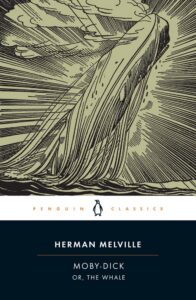
Moby-Dick; or, The Whale by Herman Melville
Okay, this one is widely recognized as brilliant, though it maintains a reputation for being misread or undervalued at times. It took me several attempts across many years before I truly connected with the book, but the effort paid off handsomely. In high school I started it, sensed its greatness but didn’t quite engage, and the same happened again in graduate school. In 2019, Melville’s two-hundredth birthday year, Chicago’s Newberry Library hosted an all-night live reading of the work—a marathon event that invited local writers to participate. While my partner, the writer Martin Seay, was eager to join because it’s his favorite novel, I only joined after I’d devoured the entire epic in ten days. That reading remains one of the high points of my life. When the pages opened like a flood, I felt the force of the whale as if it were rising from the depths:
“Suddenly the waters around them slowly swelled in broad circles then quickly upheaved, as if sideways sliding from a submerged berg of ice, swiftly rising to the surface. A low rumbling sound was heard; a subterrous hum; and then all held their breaths; as bedraggled with trailing ropes, and harpoons, and lances, a vast form shot length-wise, but obliquely from the sea. Shrouded in a thin drooping veil of mist, it hovered for a moment in the rainbowed air; and then fell swamping back into the deep. Crushed thirty feet upwards, the waters flashed for an instant like heaps of fountains, then brokenly sank in a shower of flakes, leaving the circling surface creamed like new milk round the marble trunk of the whale.”
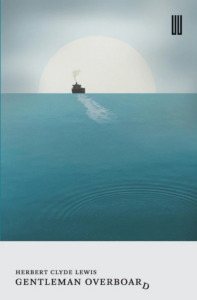
Gentleman Overboard by Herbert Clyde Lewis
Although the gentleman of the title is, to be clear, never rescued from his plunge into the Pacific somewhere between Hawaii and Panama (spoiler alert), Brad Bigelow and Boiler House Press have breathed new life into Herbert Clyde Lewis’s slender existential tale by bringing it back from near-forgotten obscurity. The 168 pages showcase a rare omniscience, granting us not only the inner life of Henry Preston Standish, the eponymous gentleman, but also those of his shipmates, including Bjorgstrom, a seaman whose perspective on the sea carries a blend of Wodehouse wit and Sartrean gravity that Lewis excels at:
“Once Bjorgstrom had sailed on an American passenger ship plying between New York and Havana, but he quit after one voyage, even though he badly needed the job. Those frivolous people with their cocktails and their dancing in the moonlight, they had no respect at all for the sea. They thought God made the sea to entertain them, while every sensible sailor knew God made it to transport merchandise quietly from one continent to another. As a result the sea got angry and reminded them of their arrogance every once in a while, burning them in a fire aboard ship, freezing them in a northwester, or beating their brains out against mile-high waves. And it was so funny how easily the sea put them in their places, easier than an elephant stepping on an ant. That was why Bjorgstrom thought hazily, sailors did not wash more than they had to. Landlubbers who did not understand the sea imagined it was because sailors were naturally dirty, but it was only because they did not wish to get too much of the sea on them.”
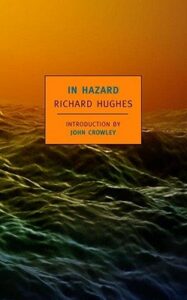
In Hazard by Robert Hughes
Robert Hughes’s 1929 novel A High Wind in Jamaica, a tale of children seized by pirates, remains a personal favorite among survival-at-sea tales aimed at adult readers. Yet my preferred Hughes entry from a pure survival-at-sea angle is the 1938 novel In Hazard. Grounded in the real story of a merchant steamship battered by a hurricane, Hughes follows four days aboard a small vessel as the crew fights for their lives. The atmosphere is terrifying and claustrophobic, and it powerfully conveys the kind of fear such a trial would generate: “There was a smell of stale sea, stale food, and stale air; but there was another smell too: bitter, ammoniac. It was quite faint, but the captain knew it. You do not forget it, if you have ever smelt it. It was the smell of fear. Disciplined men can control their muscles, even their facial expressions. But they cannot control the chemistry of their sweat glands.”
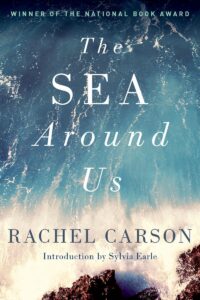
The Sea Around Us by Rachel Carson
Before becoming a biologist, Rachel Carson wrote with a lyric’s grace, and this middle volume of what would become her Sea Trilogy reveals that talent. While it isn’t a straightforward survival-at-sea narrative in the traditional sense, its broad, empirical, and lyrical treatment of ecology invites the reader to recognize that we are all adrift on a planet dominated by oceans and the creatures within them. Our future as a species depends on the oceans’ well-being and the ecosystems they sustain.
I mean, one excerpt makes the point with striking clarity: “The tragedy of the oceanic islands lies in the uniqueness, the irreplaceability of the species they have developed by the slow processes of the ages. In a reasonable world men would have treated these islands as precious possessions, as natural museums filled with beautiful and curious works of creation, valuable beyond price because nowhere in the world are they duplicated. W.H. Hudson’s lament for the birds of the Argentine pampas might even more truly have been spoke of the islands: ‘The beautiful has vanished and returns not.’”
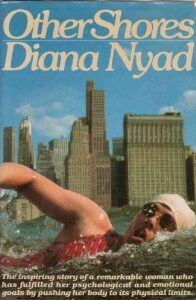
Other Shores by Diana Nyad
Kick and I share a certain admiration for Diana Nyad as a complicated favorite. On one hand, this outspoken long-distance swimmer has achieved some remarkable feats in the water. On the other, she’s been accused of embellishing and bending the truth about rivals. Her memoir Find a Way—published after her 2013 Cuba-to-Florida swim at 64, which was not ratified by the World Open Water Swimming Association due to insufficient evidence and possible crew assistance—receives more attention. Yet I’m drawn to her earlier, less polished memoirs, where the brash confidence and willingness to push one’s limits are laid bare. Nyad captures the physical strain and the mind’s kaleidoscopic blur that accompanies hours spent suspended in liquid space:
“To me, the long swims have become hypnotic sessions, deprivation tank experiences, LSD trips. My memory delves back into my childhood, to even as early as two years old, to sift through events and reinterpret dialogue that I couldn’t possibly remember when ‘conscious.’ My imagination flowers to the point that I am wonderfully entertained by the scenes I paint on my eyelids and I am sincerely frightened by the horrors I imagine myself to be confronting.”

Outerbridge Reach by Robert Stone
It’s a thriller that invites a broad audience to think along as it unfolds with cool, restrained prose, a blend of confidence and restraint. The story follows Owen Browne, a former Navy man and Vietnam veteran who sets out to complete a solo global voyage in a highly publicized race. Think of it as a masculine counterpart to Joan Didion’s explorations of endurance, filtered through a maritime lens. The author, Robert Stone, framed this as a loose echo of the real-life figure Donald Crowhurst, yet his approach thrives not only in Browne’s arc but also through the ambitions of his wife Anne and the documentary-minded filmmaker Ron Strickland who captures the voyage on camera for the project’s life.
Dread hangs like fog; the ending is as much a meditation on how to derive meaning when everything around you feels meaningless as it is about avoiding a watery demise: “Carefully, he examined his imagined positions on the chart. All the stories were embroidered, so it was said. Sailors privately ridiculed each other’s accounts. No one had ever brought the truth ashore. It was not to be had.”
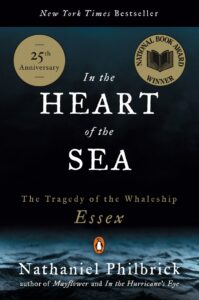
In the Heart of the Sea: The Tragedy of the Whale Ship Essex by Nathaniel Philbrick
Nathaniel Philbrick delivered the keynote at that Newberry Library Moby-Dick event, and it was a terrific talk. The book itself tells the tale of the 240-ton Essex, a Nantucket-bound vessel that, in 1820, was rammed and sunk by an 80-ton sperm whale, an event that inspired Melville’s famed novel. The narrative follows the crew through a 90-day struggle to survive on the open ocean, facing exhaustion, dehydration, and the relentless pull of the sea. Philbrick’s inclusion of survival psychology and practical considerations adds another layer to Kick’s imagined ordeal, including a passage that resonated deeply with me: “Success in a long-term survival situation requires that a person display an ‘active-passive’ approach to the gradual and agonizing unfolding of events. ‘The key factor’…[is] the realization that passivity is itself a deliberate and ‘active’ act,’ the survival psychologist John Leach writes. ‘There is strength in passivity’.”
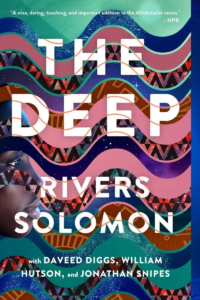
The Deep by Rivers Solomon
Like Carson’s work above, this isn’t a conventional survival-at-sea story, but it uses the ocean as a lens to explore how history threads into the present and how distant events influence the world we inhabit now. The book blends folklore with Afrofuturist imagination, telling of an underwater civilization created by the wajinru, descendants of enslaved people tossed overboard in the Atlantic. Yetu, the society’s historian, recalls past traumas on behalf of everyone, a burden so heavy that she eventually rises to the surface to confront the world her people left behind and whether she can continue bearing that weight.
Rivers writes with lyrical resonance about the kinds of questions literature set at sea can raise: “One can only go for so long without asking ‘who am I?’, ‘where do I come from?’, ‘what does all this mean?’, ‘what is being?’, ‘what came before me and what might come after?’. Without answers there is only a hole. A hole where a history should be that takes the shape of an endless longing. We are cavities.”
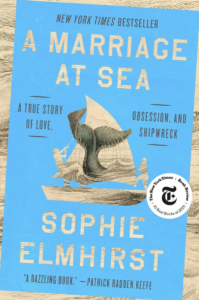
A Marriage at Sea: A True Story of Love, Obsession and Shipwreck by Sophie Elmhirst
This title appeared too late for my research trail, but I still like to keep tabs on contemporary survival-at-sea narratives. It drew my eye when Barack Obama included it on his Favorite Books of 2025 List (a reminder that a president once enjoyed reading for pleasure). Journalist Sophie Elmhirst narrates the saga of Maurice and Marilyn Bailey, a married couple who set course for a life afloat in 1972. They enjoy relatively smooth sailing until a sperm whale rams their vessel, piercing it and forcing a Pacific‑side struggle for survival in a tiny raft for months. Blair Braverman sums up the book’s core tension: wilderness survival is a slow burn, demanding the gradual lowering of standards as one clings to dignity, even as the possibilities of killing animals—some odd, some familiar—become recurring choices. This book captures that very tension—the sense that little is happening, and yet everything is—making survival-at-sea stories irresistibly gripping.
____________________________
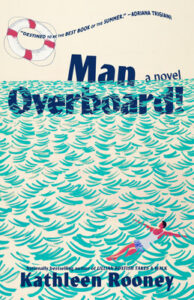
Man Overboard! by Kathleen Rooney is available from Gallery Books, an imprint of Simon & Schuster.