
The sunlight streaming through the arrival hall windows was a dirty gold the afternoon our flight from Paris landed. The airport’s walkways, draped in stock images of healthy, smiling families, submerged arriving passengers in advertisements recalling the sentimental beige hue from, say, The Bridges of Madison County (a film I loved, despite its singular Americanness), or any number of American films from the 1970s.
I had dreaded passing through this airport for months beforehand. Hassan, one of the graduate students, was questioned for over two hours for no reason other than racial profiling. He was a French citizen with a Tunisian surname. He was left to wait in one of the “Arab rooms,” the legendary places of interrogation known to Arabs who travel here. Two border police had entered separately to ask Hassan the same questions in turn, mostly the names of his father and grandfather, who were French citizens born in Tunisia. It was as if his interrogators were so surprised by an Arab presence here, they needed to ask the same questions five or six times.
I was relieved to have arrived without a glitch after weeks of worry about buying the right kind of travel cancellation insurance because of a startling number of reports about a new flu from China that could change or end our itinerary.
Khaled stood in front of a currency exchange kiosk with Chloë, his co-organizer for the delegation. Chloë was preoccupied with logistics; she and Khaled would be narrating our routes and destinations. She waited until everyone had gathered on the other side of the passport control kiosks and explained the plan to leave the airport for our hotel. We walked in a group toward the parking garage and the bus. As we slid our suitcases into the hold in turn, Chloë introduced us to each other and to our driver, Nihad, a guy in his twenties who she said was Palestine’s championship chess player. At least half of the twenty-one delegates were from Quebec, three were from Cameroon, and the rest lived in or around Paris. One lived in Marseille. All of us stood together waiting for everyone to organize themselves. A friend in Montreal had mentioned the delegation to me because she was working with an affiliated institute for West Asian scholarship. The trip was designed for scholars, not tourists. It had no particular study agenda, though, which appealed to me. I jumped on board because I knew I’d never travel around Palestine alone. It was a way to learn about “the situation,” as Palestinians call it; to speak to Palestinians at home; to see a bit of daily life, the towns and cities, the hills and valleys, the checkpoints and suspicion.
The first thing Khaled said to me was “Welcome home.” I noticed the unusual colour of his eyes, dark amber through a hazel screen. He looked younger than me—I had just turned fifty-one.
I was overcome with self-consciousness, though I was jet-lagged, hyper-aware of my immediate surroundings, of Palestine, of Khaled’s mesmeric beauty. As if I had fallen through a hole in the fabric separating my Montreal world from my present circumstances and could absorb only the present, everything around me was made more intense as he started to ask me all kinds of questions. Chloë had already told him my father was born in Palestine and left for the US as a young man. I said something about my father’s neighbourhood in Quds, wondering if he lived there himself, though I didn’t ask. The thought of it, the possibility, had a surreal quality. I don’t remember his questions, only that there were several and I was unused to being the object of anyone’s interest in this way—curiosity about my father, when he left the country, and where he had lived. I mentioned my sitto and jiddo, who were forced to leave the city fourteen years after their son, to live with my parents in Winnipeg after 1967. Well, they weren’t forced exactly, but they were close to seventy by then, and they had endured Israeli military occupation since 1948 and, decades before that, British divide and rule.
This conversation was my first encounter here with a Palestinian. His amber eyes were fixated on mine. Their unusual intensity intimidated me. I met them, but I grew nervous as we spoke—aware of my speech and the way I sounded, the way an echo might surprise you were it to capture your tone. As we spoke in the parking garage that afternoon, I lost myself in a hyper-awareness of Khaled’s physical nearness to me. I found myself smiling too much. In new social situations, I usually moved between care and indifference, presence and absence. The attention he paid me and my history didn’t minimize the curiosity about him kindling at the back of my mind, though I would normally be repelled when faced with that sort of scrutiny. The truth is, I felt too shy to ask him anything. I thought of other shy people I knew, and it seemed to me that their shyness magnified their presence; an aspect of their behaviour, always unspoken, was a way of drawing attention to themselves instead of enabling their disappearance. Hiding to be found, as if they knew that performing the shame they felt would draw more attention. How many filmmakers create this psychodynamic with the camera? There’s an essay or a monograph in the question that I want to write one day. In the moment I was too perplexed by receiving this focused attention from a beautiful stranger to formulate any questions for him in turn. I was fixed, frozen. I wasn’t conscious of my attraction until later. In retrospect, I don’t know if I felt attraction or curiosity that day. Is there a word for this in-betweenness? Frisson?
Our conversations were a mystery, he would tell me later. Now, his eyes met mine and searched my face as I spoke. I didn’t experience it as invasive, merely intense. There was kindness in his voice, his inquisitiveness an authentic curiosity. When I am the object of someone’s curiosity, I sense they want something from me, as if I am about to be robbed, but he never gave that impression. I was reminded of a line in Hiroshima, Mon Amour: “Do you mind talking with me a little? It is very late to be lonely.”
After five minutes, I interrupted the flow and told him I was going to find a seat onboard the bus. I regretted it immediately, as if I had cut short something irreplaceable, and the regret persists to this day, strangely intense for the kind of decision anyone might make in a parking garage, anticipating leaving. I sat on the bus and watched him from the window. I understood later that my ringing regret was tied to subconsciously apprehending his curiosity about me, or attraction, though I didn’t know which it was at that time. I ruminated on whether he would perceive my decision to stop the conversation and climb aboard as cold, even rude. Maybe he would interpret it, if at all, as jet lag.
When everyone was on-board, Khaled faced us, holding a slip of blue paper that was the entry visa issued at the customs kiosks. He warned us not to lose this little piece of paper the size of a small Post-it note under any circumstances, to put it somewhere safe, to be able to retrieve it at any time, when asked at checkpoints or anywhere else. He displayed more self-confidence speaking to the group than either of us had mustered during our conversation, and as he finished, he looked at me and smiled before turning to take his seat.
__________________________________
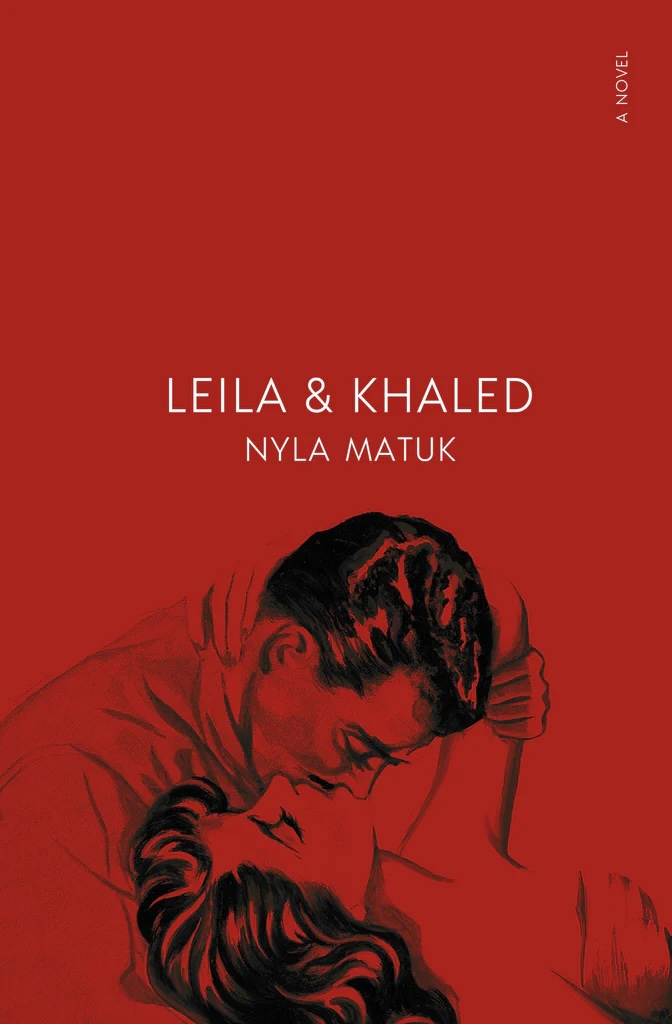
From Leila and Kahled by Nyla Matuk. Used with permission of the publisher, House of Anansi. Copyright © 2026 by Nyla Matuk.