
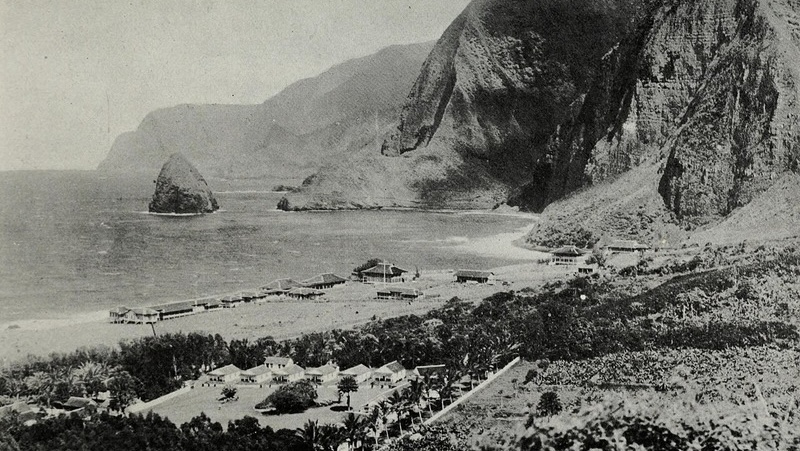
Father Damien was a dirty man. Everyone agreed on that. Dirt would accumulate under his fingernails; he rarely washed his hands. His clothes—his habitual cassock and wide-brimmed hat—were worn for days on end; he saw no reason to clean his hut in Kalawao, the leprosy colony on the Hawaiian island of Molokai. His detractors claimed he lacked elegance too: burly with a “piggish” head, they complained, he squinted from behind a pair of wonky wire-framed circular spectacles. He was eager to learn Hawaiian, it was noted sniffily, but otherwise he had little enthusiasm for languages. His Latin came only by official requirement, his English was sparse; a native Flemish speaker, even his French was stilted. The prose of his letters lacked refinement whatever their language: “coarse…headstrong and bigoted” was one particularly vitriolic posthumous assessment.
None of this worried Damien. Hawaiian did him fine. From that messy home, built in sight of Kalawao’s cemetery, Damien wrote to his brother Auguste, also a priest, to say that Molokai was exactly where he wanted to be.
We eat what Providence sends us. The calabash of poi is always full; there is also meat; water in quantity, coffee and bread sometimes, wine or beer never. As I have had to work all week and cook on Sunday, you will excuse me if my hands are not as clean as yours, which do nothing, I suppose, but turn the pages of books. Sometimes the plates are not well washed either. But what matter. Hunger and habit make us eat just the same. For dessert, we smoke a pipe. That finished, quickly back on the horse.
In the saddle, Damien would traverse Molokai’s rugged terrain; his parish stretched over more than two thousand square kilometers, and he would ride from Kalawao into the valleys beyond, crossing waterways and tilled fields to reach the community’s most isolated members. Today that landscape is protected as a national park, where wild garlic scents the air, its white blossoms threaded among ferns, while yellow hibiscus and ki trees—whose bark was once used to brew a strong beer—dot the hillsides. In this garden the honeycreeper, a small songbird, darts about the red blossoms of the evergreen ‘ōhi‘a lehua, and Damien would haul lumber and essential medical goods, eager to offer both practical aid and spiritual solace (though he never departed without constructing a makeshift altar from four sticks and a plank). At times he had to abandon his horse and climb by hand up sheer cliff faces that impeded his mission. For Damien, dirtiness served as a sign of his work—the tangible mark of his labor and devotion.
Leprosy, however, had become totemic of a moral depravity or sexual freedom that Europeans had long imagined pervaded the South Seas. The leprous, lascivious body was a perversion that Western proselytizing could fix.
To the colonial rulers who envied order and propriety, Damien’s unrefined manner, his habits, and his blending with the local people felt like an affront to Western discipline. Religion, they believed, should purge indigenous customs, erasing the supposed idolatry and idleness of local life, whether patient or healer. Yet Damien embodied a different mode of existence, one that seemed to borrow from the colonizers’ language and ways. His body and the bodies of those he ministered to were already entangled, even before he himself contracted the disease. This tale begins in 1872, when some pious observers argued that his unsophisticated temperament stemmed from a rural Belgian upbringing. “It is absolutely beyond doubt that he contracted the disease through his careless ministrations and uncleanly personal habits,” a representative of the Hawaiian Board of Health tartly observed, while acknowledging that he would keep leper boys at work in his kitchen to free more time for his duties, rising from dawn to far after dark.” Dirty in body, dirty in mind, a far harsher accusation—namely, sexual proclivity—was whispered. Damien’s brother, far away in a clean cassock reading Latin, faced none of these insinuations.
*
Damien was never meant to become the famous symbol he would become—a beacon in a climate of global imperial anxiety and the seed of religious fetish: a bronze statue in which he stands with his broad hat and staff now anchors the state of Hawaii in the Capitol’s Hall of Columns. He never anticipated becoming a topic of culture wars in his own lifetime or afterward: in 2020, Congresswoman Alexandria Ocasio-Cortez condemned the choice of a white man to symbolize Hawaii as the Polynesian state. Damien had been destined to stay tending his parents’ fields in Tremelo, a modest village in a modest corner of Belgium. The sudden celebrity that fell upon him, lifting him from the quiet life of a priestly mission to embody the discourse on the disease of leprosy, says more about the world that orbited him than about his own actions or their political talent. There were many other missionaries across colonies facing various health crises, spreading faith and the soft touch of empire. Yet leprosy had become a symbol of supposed moral ruin or licentiousness that Europeans had long imagined inhabited the South Seas. The leprous body, in particular, was a distortion that Western proselytizers believed they could rectify.
Damien was born Jozef, in 1840, the youngest son and seventh child of Frans and Anne-Catherine de Veuster. While Auguste and two of Damien’s elder sisters, Eugenie and Pauline, were being prepared for religious service by their mother, Frans wished Jozef to remain on the family farm. The boy possessed robust strength and energy that endured most of his life, only giving way in the final moments of his death. In Gavan Daws’s well-regarded biography of the priest—written in the 1970s as a scholarly counterweight to earlier hagiographies and hostile sketches—the Honolulu-based historian notes that Jozef left school around age thirteen to help harvest the family crops.
Yet the young man had other plans. After visiting his brother at a seminary in Leuven, Jozef—who had adopted the name Damien a few years earlier—convinced his parents on Christmas Day in 1858 that he too should join the priesthood, declaring bluntly in Flemish that to deny him God’s will would bring cruel consequences upon them. Once the holidays ended, he packed his belongings and followed his brother. His stubbornness resurfaced again five years later when Auguste, now a priest, fell ill with typhus and could not join a voyage of six priests and brothers heading to Hawaii. Still a seminarian, Damien circumvented his immediate superiors and appealed to higher authorities in Paris to permit him to take his place. On October 23, 1863, with great anticipation, the young man boarded the ship R. W. Wood along with his fellow seminarians and a small group of nuns for nearly five months of travel to the other side of the globe.
*
For Indigenous Hawaiians, leprosy arrived just as Damien did—a foreign visitor that followed across the sea. The disease may have lingered in the islands since Captain Cook’s era, but it did not become a public health concern until roughly eighty years later. “The commander manifested a laudable humanity, in endeavouring to shield the population from the evil effects which so inevitably result from connection between foreign seamen and the native females,” wrote one sympathetic European account of Cook’s voyage. The alleged consequences were not only moral failings but illness as well. “But his efforts were in vain. If the discipline of his own crew could have been strictly enforced, the eagerness of the women was not to be repressed.”” Historically, this origin story—whether the women consented or not—tied sickness to sex in the minds of Hawaiian natives and their European observers, and it placed the burden on the locals to explain or justify disease transmission.
The haole—the white newcomers—escaped direct blame from Hawaiians for leprosy as cases multiplied. The illness came to be known as ma‘i pake, the so-called “Chinese sickness,” named after the thousands of Chinese workers who had arrived at the invitation of American traders seeking to create an export economy, initially centered on sandalwood and later on sugar. A Scottish physician warned that the only way to keep Oceania from becoming leprous was to exclude or severely restrict Chinese laborers. Wherever the disease originated, contact between groups shattered the Indigenous population: the number of Polynesians on the islands fell from roughly 683,000 in Captain Cook’s era to just under 40,000 a century later, battered by disease and displacement.
By the mid-nineteenth century, the Hawaiian throne and the British were waning in influence as US sugar interests rose to dominance. Under a feudal arrangement, land belonged to the monarchy but was controlled by a network of chiefs; soon two-thirds of the archipelago would be owned by outsiders, principally American sugar corporations. A newly formed Board of Health took charge of imported epidemics—smallpox, influenza, and cholera—but under pressure from business interests, the fight against ma‘i pake became its prime concern. William Hillebrand, a German-born white officer among the Board’s ranks, warned that the disease threatened to spread further.
A few months into 1864, the situation grew sterner, with the English-language Pacific Commercial Advertiser declaring that the terrible illness had begun a slow but inexorable advance, and castigating the government for inaction. It noted that a year earlier there had been only one case of Mai Pake in the district and that the same native, now in a pitiable condition, remained unremoved from the population, while instead many natives were dragged to the house where he lived to pay taxes.
Curiously, the original inhabitants of the islands seemed to fear leprosy far less than Western observers did and did not exhibit the reflexive disgust directed at patients by outsiders. In a 1823 journal entry, Charles Samuel Stewart—traveling with a party of early English Protestant missionaries—described a scene where Hawaiians sat on the ground, eating poe while swarms of flies buzzed around, sharing their food with dogs, pigs, and ducks that helped themselves to the dishes of their masters. He found the table scene almost intolerable to behold, yet those suffering from what he called the “most infective, and loathsome cutaneous disease” appeared at the gathering without restraint, beyond the judgment of a foreign observer. He further noted that he had, in disbelief, newly encountered the same “itch” when shaking hands with a senior member of the Hawaiian court. Over the following decades, other doctors would claim that Hawaiians slept with lepers without visible concern, and even a British physician justified experimenting on a healthy inmate of Honolulu’s prison by inoculating him with leprosy in exchange for his freedom, arguing that Hawaiians viewed foreigners’ fears with blind contempt.
It was widely believed, too, that leprosy prevention laws were a useful weapon the settler industrialists could wield against any Polynesian locals who baulked at colonization.
In 1865, as Hansen’s segregation policies gained traction in parts of Europe, the American lobby secured royal approval in Hawaii for two separation sites: a hospital near Honolulu to evaluate suspected cases, and a colony on Kalawao, along Molokai’s northern shore, where confirmed patients would be marooned. Health authorities grumbled that many relatives tried to shield their kin from doctors and police—risking a fate like Verdi’s Aida hiding in Radamès’ tomb—for sentimental reasons and the law’s sake.
Hawaiians perceived the new rules as oppressive; those afflicted tended to vanish into the island’s mountains, always on the run. The opera’s imagery of confinement in the “valley of tears” captured only a fraction of the trauma inflicted on the patients, who were effectively removed from the larger society yet deprived of even a voice in their own fate. Edward Said’s critique of Aida—describing an imperial spectacle designed to impress a largely European audience—could be applied to Kalawao’s role in Hawaiian society.
When Kalākaua died in 1891, his sister Liliuokalani attempted to restore some measure of native sovereignty, but her efforts were thwarted by a US-backed coup in 1893. The path to full annexation followed within a few years, and in 1958 Hawaii would become the fiftieth state of the United States. It was also widely believed that leprosy prevention laws were a convenient tool for settler capitalists to push indigenous Hawaiians off their land when they resisted the encroachment of colonization.
Dr. Chris O’Day, an American physician who served as Liliuokalani’s physician, asserted that many people had been misdiagnosed with the disease as a tactic to force them off their lands to sugar interests. Those individuals were shipped to Molokai’s colony where businessmen could seize their property; a local person left with a diagnosis on Molokai had little recourse. “The last king of Hawaii stood with the sugar interests,” O’Day stated in a series of critical addresses. “Once the victim was landed on Molokai the world closed its doors against him, and more effectively than in the tomb was he swallowed up.” The Advertiser dismissed his claims as “spiteful perversions” — yet his charges resonated with similar accounts across the Pacific. Later, O’Day’s speeches spurred appearances in other outlets, including Appeal to Reason, the era’s most prominent socialist newspaper, which voiced scathing condemnation of profit-driven greed. O’Day eventually gained access to Kalawao and found numerous healthy individuals who had been placed there, seemingly to discredit the colonial project. Public pressure led the government to reexamine nearly two hundred Molokai residents; many were released, returning to their hometowns to find their lands and communities gone, and their families dispersed, as Appeal to Reason reported. Things had moved far beyond private concerns into the realm of broader economic and political interests.
Dwight Baldwin, a U.S. medical missionary, supported the idea of institutionalization, arguing that a dangerous disease stalked the region and that even the healthy were too often mingling with the leprous, which should not be allowed in that way. His son, Henry Baldwin, subsequently financed dormitories on Molokai with the fortune he accumulated from sugar, and the enterprise he established—Alexander & Baldwin Inc.—grew into one of Hawaii’s largest landowners, a legacy that reverberates to this day.
____________________________
From Outcast A History of Leprosy, Humanity, and the Modern World by Oliver Basciano. Copyright © 2026. Available from Graywolf Press.