
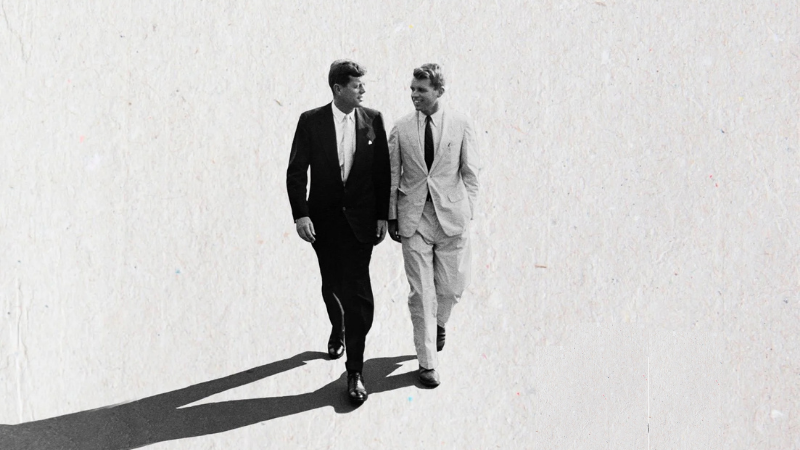
A few summers ago, while the Supreme Court was deciding whether or not abortion would remain legal, I was writing a novel about Bobby Kennedy.
During the day, I was a woman in the twenty-first century whose body was endlessly, feverishly debated by politicians and regulated by the state with little I could do about it. After hours, I moonlighted as a man in the fifties who not only tread the highest halls of power, but directly influenced the course of the country.
That same summer, my sister and I decided to go to a protest in favor of keeping abortion access on the books. We invited one of our brothers (generally a Good Man who supports women’s rights) to come with us, but surprisingly, he declined.
Before I started writing my novel, I thought I had a pretty good idea of what mid-century masculinity (and by default, power) looked like: wearing suits and looking cool as hell smoking cigarettes and cheating on your wife—the Don Draper of it all.
“You’re not going to be able to find parking,” he said, “and they’re going to overturn Roe anyway.”
We couldn’t find parking. And they did overturn Roe anyway.
All this to say that at the time, the way power functioned seemed obvious to me: some people (predominantly men) had power. Others didn’t. Power equaled control. The people who had power dictated to the people who didn’t how they could live, what they could do with their bodies, etc. And the people who didn’t have power…basically had to suck it up until the midterms.
Yet the longer I lived with Bobby, the less straightforward things became. Writing male power from the inside didn’t remotely resemble the simple authority it looked like from the outside. Instead, it was a constant negotiation between allies, rivals, public expectation, historical circumstance—and even siblings. The challenge wasn’t simply learning how a powerful man walked and talked. It was understanding how power actually worked from his vantage point, how this messy web of competing factors influenced his performance of power—and how to portray all this without mythologizing it.
Before I started writing my novel, I thought I had a pretty good idea of what mid-century masculinity (and by default, power) looked like: wearing suits and looking cool as hell smoking cigarettes and cheating on your wife—the Don Draper of it all. But as I went deeper into my research, my protagonist started complicating this view.
I didn’t know much about Bobby at the start, just a couple of facts I could shake together like loose change: he’d been Attorney General during his brother’s presidency, and, like his brother, he’d been assassinated.
What I learned was this: Bobby was a fumbler. Nothing came naturally to him. He was the seventh of nine children, overlooked and ignored for much of his early life in favor of his older, more promising brothers. There’s a picture I came across of a young Bobby in Southern France. He’s twelve years old, sitting beside a garden pond, looking down at the ground. His hands are in his lap, one wrist clasped almost self-consciously. It’s one of my favorite photos of him because you can still see that boy in the man he later became: a little awkward, a little uncertain, perpetually ducking his head from the camera.
And yet I wasn’t only writing the public persona; I was also writing the private man, and his power stemmed from almost the exact opposite traits.
In other words, Bobby wasn’t the smooth operator you’d expect of a man in power, then or now. He was neither heir nor spare, but the runty third son, so far down the family totem pole he once wrote to his father: “I wish, Dad, that you would write me a letter as you used to Joe & Jack about what you think about the different political events and the war…” Bobby only became a piece in the family’s political games after his eldest brother, Joe, died during the Second World War, upsetting the planned order of succession.
Power for Bobby wasn’t innate; it was accidental, produced through family dynamics and happenstance. It was practiced, perfected, worked at. Above all, it was performance.
Over the course of the fifties, Bobby perfected his performance of power, calibrating and re-calibrating to fit his family’s political aims. First, he was a cold warrior working under the infamous Senator McCarthy; then he was a crusading investigator taking on corruption; and through it all, his brother’s wily campaign manager and shadow self, working in tandem with him to create an increasingly well-oiled political machine in the leadup to Jack’s bid for the presidency.
Over time, his public persona solidified into one word: “ruthless.” In the 2016 movie Jackie, which chronicles the immediate aftermath of JFK’s assassination, Bobby bemoans to Jackie that their legacy has been wasted with Jack’s death. “We could have done so much,” he says. “Civil Rights, the space program. Vietnam…We teed up Vietnam. Now Johnson gets to knock it down.” No sign of grief for his murdered brother; only disappointment that the keys to the kingdom have been lost. It’s the exact kind of callous caricature of him that fits with the public persona he crafted, one which was very much in line with male power archetypes.
And yet I wasn’t only writing the public persona; I was also writing the private man, and his power stemmed from almost the exact opposite traits.
Take this episode for example: In the summer of 1956, shortly after Jack’s breakout performance at the Democratic National Convention which launched him into the national spotlight, Jackie Kennedy suffered a stillbirth. The baby, a girl, would have been her first child.
The loss of a child at any age or stage or era is undoubtedly painful for the parents involved; yet it wasn’t Jack Kennedy who sat at his wife’s bedside. He was abroad, vacationing after a strenuous political convention. It was Bobby who rushed to the hospital in the middle of the night to be by Jackie’s side, and Bobby who later arranged for the burial of the child.
And yet, how to write a man in a high place believably when I lacked the actual experience of being a man in a high place?
I found hundreds of other instances like this, of Bobby being the one people in his family leaned on. He was trusted with the most intimate emotional labor in his family; trusted to be the caretaker, the one who looked out. As Jackie Kennedy said, “You knew that, if you were in trouble, he’d always be there.”
Bobby’s role within the Kennedy family, vital to the functioning of the broader Kennedy political machine, was built on caretaking, loyalty, devotion to his brother—all traits we’d typically define as being more “feminine” than “masculine.”
This wasn’t a version of male power that I’d known existed. I’d expected ambition and ruthless political maneuvering; I’d come prepared for scenes in smoke-filled back rooms and Congressional offices. But here was Bobby, sitting at Jackie’s bedside, perhaps looking at the ground, one wrist clasped in his hand.
American history spoon-feeds us the idea of national exceptionalism built on the backs of great men. It’s patriarchy packaged as patriotism—you don’t need me to tell you this. And the Kennedys are of a piece with this mythos. So, having been conditioned to believe in such great man history since elementary school, another challenge lay before me: how could I portray male power honestly, without mythologizing it the way I’d been taught?
I think of Claire Vaye Watkins’ essay On Pandering, where she describes the activity around which she arranged her life as a young woman: “watching boys do stuff.” When I first read this essay in an undergrad workshop, it resonated with me; that was what so much of my life as a young woman had been about too. My initial reaction was something like “Yeah, you know what? Fuck this. I’m done watching men!”
But now a confession: in writing my book, I was thrilled to watch boys do stuff. I was thrilled to see things through a man’s eyes, to swim through a world that was built with me in mind, even fictively. Writing Bobby was a refuge, a place to cast off the daily complications of experiencing the world in a woman’s body.
And yet, how to write a man in a high place believably when I lacked the actual experience of being a man in a high place?
I don’t think you need to know what it’s like to run a campaign or hold political office to write about these things. You can take what you do know and use it to inform what you don’t, and what I did know was my brothers. Four of them: frustrating, intentionally naïve, inveterate manspreaders—but also funny, unexpectedly thoughtful, some of my favorite people in the world.
The more I wrote, the more I saw that the men in my story weren’t small gods in suits; they were men like my brothers—fallible, contradictory, projecting an image of themselves to the world that often clashed with the private self. I tried not to think of Bobby as a monument, but as an ordinary man, like the ones I knew. After all, if my brothers could be annoying, affectionate, and self-aggrandizing all at once, why couldn’t a man in the history books?
I tried to recreate what Bobby might have been like; what he might have said; how he might have behaved. I’m sure I got some of it wrong; but that’s something else writing Bobby taught me: power, like people, is slippery. You might be surprised by what you find.
__________________________________
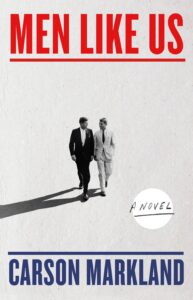
Men Like Us from Carson Markland, published by Algonquin Books.