
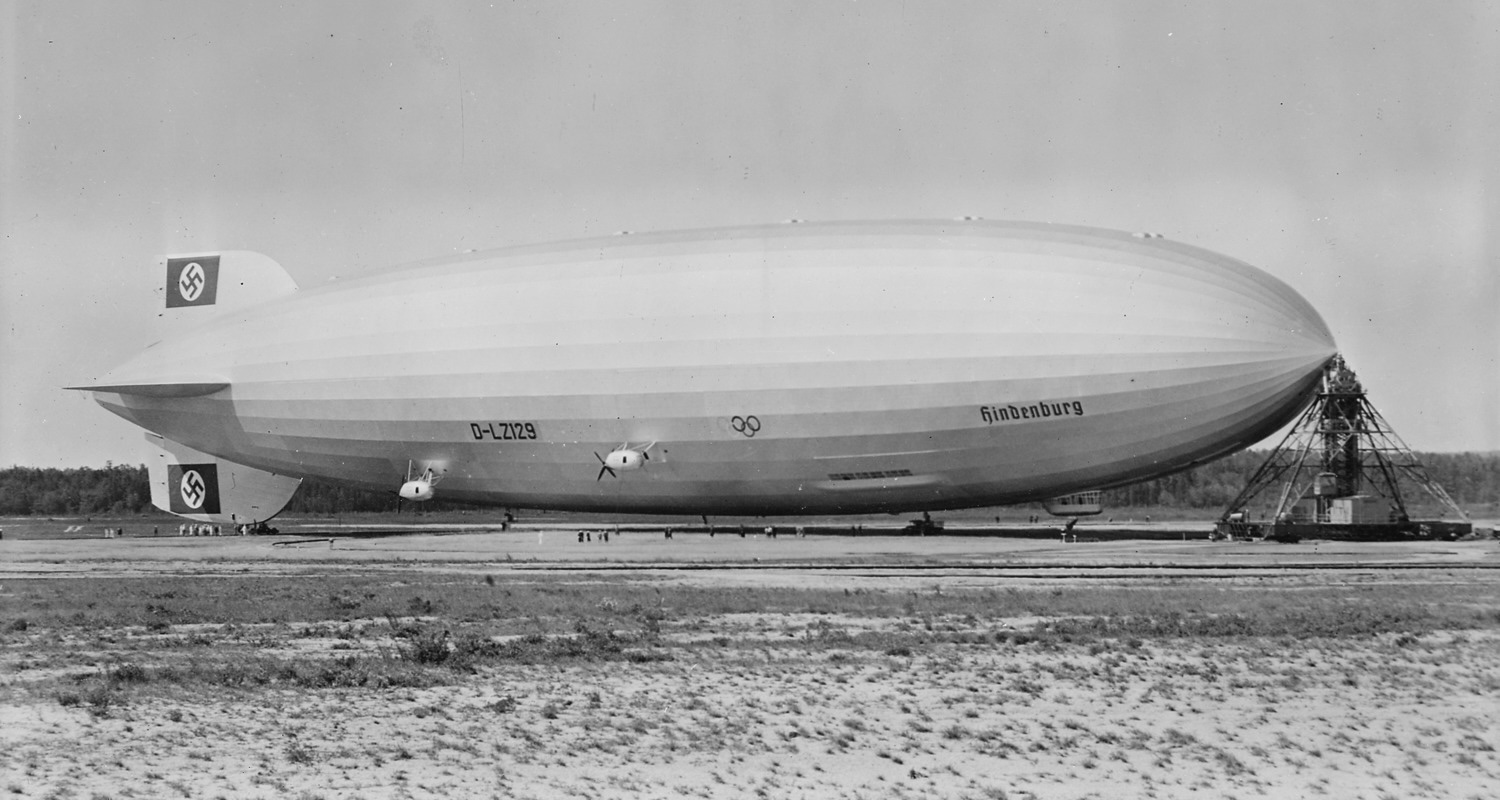
Over the Atlantic Ocean: May 4, 1937
Ernst Lehmann, during his years as captain of airships, had ferried a curious menagerie aboard at various times—prize Trakehner horses from Prussia; gorillas, chimpanzees, and other primates used for experiments; guinea pigs; canaries; carrier pigeons; even queen bees—but perhaps the creature that proved the most irritating for the crew were dogs. Dogs always showed up with American celebrity owners who seemed unable to travel without their four-legged companions. The year prior, the silent-film star Douglas Fairbanks—famed for swashbucklers such as The Mark of Zorro, Robin Hood, and The Three Musketeers—was returning from Europe with his new wife, Lady Sylvia Ashley, and their six‑month‑old Scottie, Bobby Burns. While on board, Mrs. Fairbanks let poor Bobby Burns roam off the leash so he could examine the facilities. As steward Wilhelm Balla dryly observed, the pup left his “business cards everywhere” while Mrs. Fairbanks worked on a jigsaw puzzle.
Lehmann was endlessly astonished by how little passengers seemed to react to the sheer marvel of flight, or how easily they drifted into mundane earthly habits as if the skies were no more extraordinary than a comfortable train ride. On the Graf Zeppelin’s inaugural flight over Germany in 1928, he checked the dining room and found two travelers already tired of gazing out the window and quietly occupied with a game of chess. “How rapidly men become accustomed to the improbable!” he commented with a touch of scorn.
Humankind had dreamt of winged travel for centuries. “What was miraculous yesterday becomes ordinary today,” he wrote in his memoirs. Lehmann’s grievance echoed that of many pioneers in aviation—whether he or other aviators of heavy‑ or light‑air craft considered their craft a sacred art or a commercial enterprise. Even Charles Lindbergh, in his own reflections, wondered aloud if, in turning aviation into a business and replacing the thrill of danger with the discipline of safety, we might surrender the “miracle of air.”
Passengers’ casual disregard for the sheer wonder of flight, or just how quickly they became bored and defaulted to their mindless earthly activities, never ceased to amaze Lehmann.
To Lehmann it was notable that the Hindenburg’s 1937 season began only about eighteen days before the tenth anniversary of Lindbergh’s celebrated “miracle of flight.” While Lindbergh’s feat was extraordinary, many seemed to forget that he had merely achieved what airships had demonstrated since the British beat the Germans to transatlantic zeppelin crossings in 1919. Beyond the rivalry between airships and airplanes, a fraternity of aviators had witnessed some extraordinary sights in the early decades of the twentieth century. Only an aviation veteran could know that when skimming above London the Thames’ lights resembled the Milky Way, and only from the air could one truly grasp the vast, indifferent swamps, forests, and rivers of Siberia in their immense scale.
The route for the long‑distance journey was so uncharted that while planning their crossing over the Stanovoy Range in the Russian Far East, the crew could locate almost no data about the range’s altitude beyond one report hinting at 3,500 feet. As a precaution, Eckener added an extra 2,000 feet of clearance as they threaded their way through fog and cloud. Just before reaching the Sea of Okhotsk, the clouds parted, and only then did the crew realize they had cleared the ridge by a scant three hundred feet. After Siberia’s wild, inhospitable expanse, the next dawn brought them to the island of Hokkaido and a view of neatly laid rice fields, gardens, and tidy houses below.
As a DZR marketing pamphlet put it, “the prophetic vision of Jules Verne has come to life.” Passengers could personally experience the materialization of science fiction’s promises. In describing the balance between marvel and commerce, DZR perhaps overplayed its hand by convincing nervous travelers that airship travel could be as simple as lounging in their living rooms. In the passenger lounge, where card games and jigsaw puzzles tended to appear after the first full day of the crossing, some guests acted as if they were oblivious to the fact that they were actually aloft.
Perhaps Lehmann’s frustration with the passengers was misdirected and largely due to the duties that his role required, expanding far beyond the flight deck to the promotional and operational matters of the venture. He now had to handle the nonflying aspects of running the airship business, elements he cared little about but which left a strong impression on travelers. Advertising, marketing, and the minutiae of internal operations had come to dominate his obligations.
In the preceding year, DZR had invested heavily to project an image of zeppelins as embodiments of comfort, convenience, safety, and glamour in travel for its international clientele. It had intensified its overseas advertising and pursued a targeted effort to promote airship service to Europe for the coronation and the Paris Exposition. The company even offered complimentary flights to some business partners in exchange for a written report with impressions and improvement ideas. Among those invited was George Grant, an assistant manager at the London firm that handled zeppelin bookings, who joined the current voyage on a paid holiday. Grant appeared to be enjoying the experience, though he had neglected his duties as a reporter, save for a note suggesting linen covers at cabin heads to prevent grease marks on the fabric walls, and he spent his time touring the airship with the stewards instead.
While DZR invited feedback from its own staff, the general public occasionally wrote in with unsolicited ideas. The company received a letter from Hinrich Schröder, a German‑born manufacturer of children’s toilet seats. He had spotted a newspaper article about DZR employing a stewardess and inferred that future voyages would carry more children, therefore requiring more sanitary facilities for “little guests.” He proposed that DZR place an order for his fold‑away toilet seats that attached to the main seat and allowed adults to avoid discomfort. Schröder did not receive the response he hoped for.
DZR’s principal focus during the last year had been a high‑stakes push to win over wealthy American travelers, who, attracted by the time saved, comprised 70 to 80 percent of its paying customers by 1937.
“Our century has been called the technical age. It has also been called the age of abbreviation,” Lehmann wrote in his memoir with a hint of disdain. “Time is money, the American says; to shorten the time is to save money.” This strategic pivot toward the American market had begun in earnest the previous October with the Hindenburg’s “Millionaires Flight,” when more than seventy affluent and prominent American travelers enjoyed a ten‑and‑a‑half‑hour cruise along the Eastern Seaboard. Among them were Wall Street financiers like Nelson Rockefeller and Winthrop Aldrich, aviation luminaries such as World War I ace and Eastern Airlines’ General Manager Eddie Rickenbacker, Pan Am founder Juan Trippe, and Goodyear’s Paul Litchfield. In total, their combined net worth amounted to well over a billion dollars.
By early 1937, the strategy seemed to be paying off. It was only May, and roughly three‑quarters of the Hindenburg’s 1937 reservations came from American clients. The sight of American guests lounging in the smoking room or carefully inscribing postcards in the writing room suggested that DZR was attracting the very high‑end clientele it had pursued.
Nelson Morris, the wealthiest passenger aboard, and his companion Bert Dolan were particularly interested in the voyage’s speed and the thrill of flight. Morris showed little patience for the moody, aloof passengers Lehmann disliked; he treated the journey as another flight of a fellow aviator and eagerly sought out a tour of the ship’s vast interiors from the stewards.
Another eager traveler was Peter Belin, a Yale alumnus returning to Washington, DC after a year in Paris. Belin’s ties to the Du Pont family, prominent gunpowder magnates, underscored DZR’s emergence among Washington’s circles. His father, F. Lammot Belin, had shifted from private business to diplomacy, serving as the State Department’s chief protocol officer before becoming ambassador to Poland from 1932 to 1933. Peter, likewise, envisioned a similar career path and possessed a natural ease with cosmopolitan settings. Like Morris, he enjoyed the technical sides of flight.
Belin, a member of the undefeated Yale soccer team, the Alpha Delta Phi fraternity, and the Book and Snake society, had taken flying lessons at New Haven Municipal Airport and held a pilot’s license from the Boeing School of Aeronautics. Throughout the day, the square‑jawed, dark‑haired young man would unfurl a map of the Western Hemisphere on a small writing table, tracing the airship’s position and connecting dots to chart their progress since Frankfurt.
High‑net‑worth travelers like Morris and Belin could be persuaded to join air travel as fellow, if relatively inexperienced, aviators. Yet San Francisco canned goods producer Moritz Feibusch belonged to a slightly lower profile but highly successful tier of Americans drawn to the promise of adventure. Feibusch, a German Jewish immigrant originally from Rogasen (Rogoźno), a town that had changed hands many times, was a slender, gray‑haired man of fifty‑seven. He lived in San Francisco, where he had made his name in commerce after starting out with Prager’s Department Store. He built his own canned foods business, selling items such as Pebble Beach Tuna Flakes, Sardines and Calbear Fruit Salad. He owned a home near Golden Gate Park and, with his wife—a violinist and composer—had traveled extensively across Britain, Italy, Turkey, Czechoslovakia, Egypt, Syria, the British Mandate of Palestine, and back to Germany and Poland to visit relatives. He had even managed to bring three brothers, their wives, and three nephews to live in San Francisco, and he was in the process of adopting one of his nephews. After his wife’s death in 1935, Feibusch extended his travels, including a stop in Paris, where he began a new travel tradition. He had commissioned two hundred custom postcards printed, picturing a caricature of himself as a giant wearing a boater hat and spats, triumphantly standing atop the Eiffel Tower, to send to business associates, family, and friends. He carried on his custom of sending keepsakes, printed with the words Souvenir de mon ascension.
Feibusch rode home from his annual European business trip aboard the Hindenburg. His manager and secretary returned by steamship, but Feibusch chose to linger for a few extra weeks, treating the voyage as a grand finale to his time abroad. He had previously sent souvenir mail to his brother in Berlin during the Graf Zeppelin’s 1929 around‑the‑world flight. On this trip he produced two hundred custom postcards, this time a collage of his passport photo and an image of the zeppelin above. (Interestingly, despite his Jewish background, he opted for an authentic nod and included the Hindenburg’s conspicuous swastikas on the drawing.) While travelers eager to evangelize zeppelin travel would share their enthusiasm with friends and family, DZR was happy to sell seats to anyone who could pay for them.
Philip Mangone, who had kept a relatively low profile in the public rooms and largely remained in his cabin, was a solid fifty‑two‑year‑old Italian American and a passenger who traveled with an efficient practicality. This was just another transatlantic crossing in a long career that spanned nearly fifty years after he and his family moved from Calabria to New York as children. A seventh‑generation tailor with an eighth‑grade education, he had begun as a fitter at B. Altman on Fifth Avenue in Manhattan and rose to become one of the era’s most fashionable designers, specializing in women’s tailored garments, particularly suits and reversible capes. Mangone was best known for inventing the swagger coat and its matching topper. In 1915, he had been booked on the Lusitania’s voyage but canceled at the last moment, narrowly escaping disaster when the liner was torpedoed off Ireland. That near‑miss seems to have left him unfazed. His Hindenburg booking was purely pragmatic—he chose to fly to save four days and stay on schedule with his autumn collection.
The reality, of course, was that as the novelty of airship travel faded and crossing the Atlantic became as routine as a sea voyage, a growing number of travelers would share Mangone’s view rather than the enthusiasm of Morris, Belin, and Feibusch. Lehmann had little choice but to accommodate such practicality, for those time savings separated a profitable operation from a status symbol that might become a quaint relic of a short‑lived era.
DZR had recently instituted a number of adjustments for the 1937 season to ensure the onboard experience met American expectations. The situation carried a certain irony, since the zeppelins’ outward image grew increasingly associated with the Nazi regime, while life aboard the airships and DZR’s commercial practices were becoming more and more American by the day.
During the winter, Willy von Meister, DZR’s U.S. representative, had written Lehmann a twenty‑page missive filled with suggestions for improvement. Von Meister—six foot six inches tall, a striking figure compared with Lehmann’s shorter stature—was well placed to press these points. Through his German father, the former governor of Hesse, he was a godson of the last Kaiser, Wilhelm II, yet his mother was American and had grown up in London. He had lived in the United States for more than a decade.
That such mundane minutiae should frustrate Lehmann was no surprise. He was not a businessman who enjoyed tinkering with inputs to maximize the bottom line. He was a true airman in his heart and soul.
First and foremost, von Meister urged Lehmann that stewards should provide carafes of ice water on tables in the lounge and dining room: “Americans should not have to give up the habit of drinking ice water on board.” Menus and notices in the reading room should be printed in both German and English, and whenever trips to Germany were planned, the chief steward should announce which golf clubs Americans could use while in Frankfurt. He also pressed for more onboard entertainment, no doubt to Lehmann’s chagrin, since this implied that zeppelin travel should be more engaging. With the first day or so largely spent introducing passengers to one another for games of bridge and skat, the stewards should provide more two‑person games like chess and backgammon, along with light, portable amusements such as Ping‑Pong equipment for a game on the long dining tables between meals, and jigsaw puzzles featuring pleasant scenes that could be completed within the short voyage.
Having a physician aboard was essential. Up to that point, DZR had been fortunate that no passenger had fallen seriously ill in flight, but as von Meister warned, sooner or later a German doctor without a private practice or with insufficient clinical interest might consider such a unique role attractive. He argued that the extra weight and cost would pay off handsomely, especially since some American passengers tended to appear intoxicated and could injure themselves. When not needed, the doctor could lead airship tours or organize bridge games as a kind of “entertainment czar.” Since doctors generally had good rapport with people, he suggested that the physician could serve as a liaison between American guests and the German crew. Passengers had sometimes complained that stewards could be overly forceful about changing into formal evening attire, and DZR accepted von Meister’s proposal and hired twenty‑seven‑year‑old Dr. Kurt Rüdiger for the 1937 season.
Another clash between guests and crew concerned meals, especially peculiar dietary requests the kitchen was reluctant to honor. “The kitchen is commonly described as ‘difficult,’” von Meister told Lehmann. “A large percentage of Americans have delicate stomachs or idiosyncrasies that prevent them from eating certain foods.” Each morning, the crew should lay out the full day’s menu (in English) at breakfast so guests could indicate what they could not tolerate. The bar steward, Max Schulze, also needed to be “more courteous in his dealings with the guests,” since he patrolled the smoking room access to keep anything flammable from leaving behind the airlock. A former passenger once quipped that the bar’s security was so tight that “one felt like a boy behind the greenhouse” in trouble, imagining Dr. Eckener waiting outside with a birch and mortarboard. Schulze should also “drink less himself and refrain from ingratiating himself too much with the guests.” It was crucial that the bar never run out of liquor, especially rye or bourbon, essential ingredients for the ever‑popular Manhattan. Von Meister even suggested supplying a small metal “skewer” used to garnish cocktails, a souvenir from the Waldorf‑Astoria, as a keepsake for passengers.
Finally, DZR needed to concede to American preferences for cleanliness and comfort. In the four B‑deck restrooms, the company should provide either a basket of single‑use hand towels or disposable napkins for drying hands, rather than a single shared towel “which, by American standards, is highly undesirable.” “The American has a need for freshness” and does not want to participate in communal drying. Similarly, Americans rejected the duvet in favor of a bed arrangement with a sheet and several wool blankets, even though the duvet was easier for stewards to manage in tight cabins. While not the German way, von Meister believed that “these things don’t cost much and are amenities that improve the overall impression of the service.”
Von Meister did have one more major suggestion: expand the fire‑protection measures in passenger compartments. “I am considering rapid‑fire extinguishing systems using compressed carbonic acid and smoke detectors, as used on ships,” he wrote, noting that such devices could be helpful if a drunken passenger began smoking. Of course, he admitted, these tools would only prove useful in the early stages of a fire.
None of von Meister’s recommendations were meant as direct rebukes of Lehmann or any individual employee. They simply reflected the reality that “we are dealing with a very spoiled North Atlantic service” where travelers would only tolerate a journey that was seamless, comfortable, and free of mishaps.
Lehmann’s irritation at such minutiae was unsurprising. He was not a businessman who enjoyed tweaking every input to boost profits. He was, at his core, an airman. Nor was he alone in his frustration with the direction in which his beloved industry was headed. Reflecting on how attitudes toward air travel shifted in the few short years since his first transatlantic crossing, compared with the millennia of yearning for flight, Charles Lindbergh mused, “Will people fly through the heavens in the future without seeing what I have seen, without feeling what I have felt? Is that what we call human progress—that the gods retire as commerce and science advance?”
Since the fables of Icarus, countless lives had ended in failed experiments as humanity chased the dream of flying. Yet, thanks to the airship and the craft honed by German engineers, Lehmann could once proclaim with pride, “The struggle to conquer the air has ended in the defeat of the elemental forces of Nature.” And yet, as swiftly as that triumph arrived, those who benefited from such technical mastery turned to their newspapers, their card tables, and their cheap jigsaw puzzles, their queasy stomachs and their troublesome pets, and they found plenty of reasons to be bored.
______________________________

From Shadow Before the Flame: The Hindenburg Disaster and the Prelude to War by Catherine Grace Katz. Published on September 22, 2026 by Viking, an imprint of Penguin Publishing Group, a division of Penguin Random House, LLC. Copyright © 2026 by Catherine Grace Katz.
