
Nihao, New York
I reluctantly pay the steep fee for my over‑the‑top luggage, musing about where the true ceiling lies for how much a single aircraft can haul, and whether airline policies factor into the profit from those overweight charges. Do they rely on some sweeping statistical consensus that roughly sixty‑three percent of travelers with bulging suitcases would rather dismantle their bags in front of an audience to discard items, thereby ensuring the luggage tally never bumps the plane’s capacity? Or, perhaps, as I secretly suspect, they could not care less and will siphon every extra dollar you hand over, accepting your heavier bag without limit, until—sooner or later—the plane succumbs to the burden of excess baggage?
I chase the morbid thought away with an Asahi and a handful of sour gummy worms, trying not to dwell on it too long.
Somewhere around 6,700 miles separate Tai and me, with about thirteen more hours to go before I step off my red‑eye and into New York. Not exactly ideal timing for the ignition of a spark that isn’t even a real thing yet—this flickering flame of a quasi‑relationship—but I had booked the trip months ago for summer, my first solo voyage because, hey, I’m grown now. I scroll through our thread, a few terse messages glimmering with a heat that feels barely contained. It began the day after the beach party.
you’re kinda cute 🙂
I admit I drafted several variants—capitalized, lowercase, with emojis, without. I rejected sending any of them after hours, worried I’d tarnish my image: I am a Madonna, not a wanton flirt. A woman in love with a first bloom should not be trifled with, thank you very much.
In the end, I erased the greetings and the stickers, choosing instead a plain, unthreatening smiley in a sea of lowercase. I fired it off at a quiet 11:02 the next morning.
The rest is the kind of story people say is “history” once it’s happened. My phone lights up with a fresh message, and my chest lifts with it—like a lime dropping into a cold beer, like a balloon popping into a bright burst, a cartoon bulb flicking on with radiant clarity. A giddiness I refuse to dampen.
I re‑read our exchanges every night, from the very first line. I memorize every breath, plotting them into a color‑coded ledger that tracks who starts, how often, and how quickly responses arrive. I study the data to rein in my baser impulses and keep the mystery intact; a minimalist game, if you will. Because if I make him work, perhaps he will keep the flame alive. I savor cutting conversations short and playing it cool, so he’s forced to chase, and I pretend this is proof of his interest.
text me when you get there! hope u have a safe flight mika
He caps it with a mandarin‑orange emoji, and my heart pounds at that intimate touch, a signal of affection that can’t be bought.
I cling to those crumbs as though they are sustenance. I feed on them all day and tuck them into my dreams at night. Darling, you sustain me in ways you could never comprehend. (If only you knew.)
A bright, cold fear coils in my stomach as we near landing. What have I done? Here I am, solo in a few thousand dollars’ worth of travel plans, a fortune spent on the thrill of this trip. My heart lurches as I board the shuttle to Midtown, determined to treat myself—no hostels, no frugality, nothing but a premium experience. I crave the feel of fresh white sheets, fluffy towels, mini bottles, a New Testament with its spine intact in a desk drawer, chocolate mints waiting on the pillow. Because, after all, I’m a fancy girl.
A sophisticated, solitary darling in the city that never sleeps, five days to chart my own course.
I order room service, and a bespectacled waiter wheels a silver tray to my door at 8:30. He lingers, I open and close the door a few times in a shaky attempt at casualness—was he asking for my number?—before I remember, too late, the American ritual of tipping. I fling the door open again, only to see him vanish, likely forever, perhaps muttering something about the risk of misreading signals. I dine on a gargantuan slice of pepperoni, wash the guilt down with a glass of Coke, and let the day slip into night as I drift to sleep in a hum of self‑indulgence.
I wake entangled in starched sheets, legs bare, and I try not to dwell on a late‑night TV show that suggests hotel rooms often hide the traces of others’ conquests. I try not to imagine how many couples have left their mark on this space, the velvet chair still holding silent stories, the desk with its gilded mirror, the bathtub with its lion‑footed feet, the walk‑in shower. The carpet feels thick with history. I wash away the residue of others’ lovemaking, shave my legs, and prepare to present myself to the world as though I am enough the way I am, with my own kind of beauty.
I dress with indulgence, first slipping into a silk pink thong embroidered with flowers, then an oversized dusty‑pink tee (no bra) and striped drawstring pants. Glittery eyeshadow, bold liner, and black platform wedges push me to feel tall enough to own the city. I pause to mourn the waste of my underappreciated, unfucked beauty. I am pressed to feel what it’s like to be touched, even if only by my own hands.
A new message from Tai sits in my queue, but I leave it unopened for a while—let it simmer, let him seem busy, let the game stay mine. The rule is simple: the one who cares less wins. A line my mother once told me about happiness: a woman is happier when she is loved more than she loves. The secret to my parents’ silver anniversary, perhaps.
A full day lies ahead, ready to be shaped or discarded as I please. But first, breakfast.
The buffet is a celebration: congee with peanuts and pork floss, a mushroom and cheese omelet made to order, a tiny blueberry muffin, two slices of crispy bacon, papaya, a small bowl of Greek yogurt with honey and granola. I mop it all up with a thick slice of buttered toast, and I savor the moment as steam fogs my lashes from a milky cup of coffee. I eat until I reach that peaceable fullness, that rare moment of balance, and I step out into the world with loosened pants and a mind already wandering.
My phone buzzes again, and I know who it is without looking. A warmth blooms inside me, as soothing as a bath turned on too hot. This is love, plain and simple.
This surge I feel whenever his name flickers onto my screen, whenever he replies instead of leaving me on read, whenever I scroll our ongoing thread and feel the rush rise again. I want to bottle this feeling, this pink‑prosecco fizz, and keep it close. The thought alone makes me lightheaded enough to think I could sustain it forever.
“WATCH IT, LADY!” a cyclist yells in a chorus of spandex as I attempt a reckless crosswalk, yet his shout can’t dampen my Tai‑driven effervescence. I check another New York checkbox: I become a tiny bit more fearless, at least for that moment, and I let the street’s tempo pull me along.
Beyond the encounter, I exist mostly unseen, enjoying the anonymity of it. This is not Ohio; this is New York, the city that becomes a stage for a girl who feels both hypervisible and invisible, depending on the moment. Back home, I was just a girl from the suburbs; here, I am Nihao, a name that can open doors or invite stares. The streets of Manhattan are mostly clean, orderly, and numbered—the opposite of the cornfields I grew up around—and I glide through them with an air of practiced nonchalance so certain that a fellow tourist stops me for directions and I mutter, “I’m not from here.”
(In that moment, a certain discomfort surfaces—a reminder that the Nihao moment can travel beyond borders and feel like a sharp ache in the chest.)
*
Mika shoves a half‑eaten hot dog up his left nostril, then stuffs the bun into his sneering mouth. Grabs a ketchup bottle and garnishes his face, before squirting mustard into his hateful, piggish eyes. Observe now as he gags and gasps for breath, totally reliant on the tiny airway of his right nostril. He falls to the ground. She reaches over and stuffs the free end of the hot dog into his right nostril, forming a sausage septum ring and closing off his last available airway. “NIHAO TO YOU TOO, BITCH” are her parting words as Mika leaves him twitching on the sidewalk, hordes of indifferent New Yorkers stepping over his dead body.
*
The hot‑dog vendor keeps his gaze averted as he wrangles the next customer, the only witness to my indignity. I nibble my snack with a calm, practiced nonchalance. My dark skin cannot completely hide my flaming cheeks, and my heartbeat drums in my ears, but my Asia‑born poker face proves to be a saving grace.
I move on, street meat in hand, blending into the city as though I belong here. The dream of belonging in a nation that has shaped my life—through cinema, music, restaurants, fashion, and slang—still pulses inside me. We learned to adore America, to believe that if we could reach it, it would embrace us. Perhaps America has claimed more than a few of us in return, but I refuse to let that erase the thrill of feeling seen at last. I walk in black platform heels, toss scraps to a pair of rats in a window, and study my own silhouette in a shop mirror, the Nihao moment still echoing behind me. Look at that figure, that curve, that youth—so much of it mine. What would I be without it? For now, it is mine, and I am suddenly more desirable for it. A bearded man with dreadlocks leans against a wall, watching me with lazy interest, while another passerby whistles, “I LIKE LEGS!” and I beam with a mix of pride and unease.
There is a kind of novelty in being noticed as a foreign woman, in being seen as something other than another anonymous traveler. Catcalls aren’t part of my imagined life back home, at least not for me, and I fear I’ll drift back into obscurity the moment I leave these boulevards. Here, I’m Nihao, and I’m spoken to in a way I never am at home.
I text Tai with the details of both episodes, and his reply—instant, possessive, a touch jealous—fires a familiar heat inside me. He’s probably at home imagining me and my wild hours; I mock the thought, but I secretly thrill at it. Be careful, he warns, and come back safe. I laugh inwardly at his paternalism, reply with a teasing “yes, daddy,” and toss a heart at the end to coax another message. His response—a blunt, simple word—sends a rush through me, and I promise myself to keep this feeling alive. This is what love feels like, or so it seems.
Later, I curl into fresh sheets, picking at the blisters of the day and scrolling our earliest chats again, the old rhythm returning with each glow of the screen. It’s morning in Tokyo somewhere on the other side of the world, and he signs off with a good‑night crescent, a small gesture that explodes into fireworks inside me. My days in New York slip past in a blur of high‑low tangents—money spent, meals swallowed, city sights chased—but I manage a quiet pride in my independence even as I ache for dinner company and someone to share the view with. I crave a better plan, but I also savor the solitude when it is mine alone. Lunches become a rhythm of simple pleasures—a lobster roll here, a root beer float there, a little picnic in Central Park on my final day, a paperback in hand and olives scattered about like small trophies. I bite into almonds of confidence and watch couples around me, feeling both left out and oddly invincible in my own version of the city’s stage. The thing I dread most is the dinner hour—the ritual of asking for a table for one, the anxious dance of feeling more alone among others, the ache of realizing that solo dining can make you feel less than in a place built for shared meals. I’m a fool to fear that perception, I tell myself, but it lingers anyway.
Everyone around me—Tai and Nana, my family—knows me only through a screen or a text. I send Nana snapshots and selfies, and she replies with a flurry of envy that feels like a badge of honor. My parents never drown me in words, as if to prove we’re too reserved for such sentiment; they check on my meals and my well‑being with a quiet duty, and I recognize in that care a version of love that travels through generations. Tai’s orders to hurry home feel urgent, and I feel renewed by his words, as if a single message could pull me through the door and back into a more ordinary life. I tuck my phone away, tip the waiter generously, and set off toward the promise of departure with a lightness I rarely allow myself to feel.
__________________________________
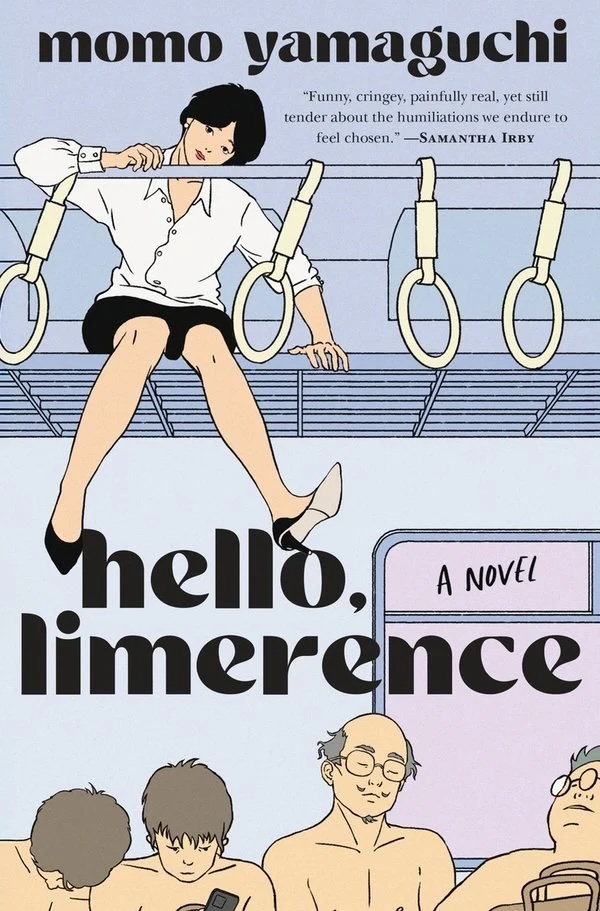
From Hello, Limerence by Momo Yamaguchi. Used with permission of the publisher, Mariner Books. Copyright © 2026 by Momo Yamaguchi.
