
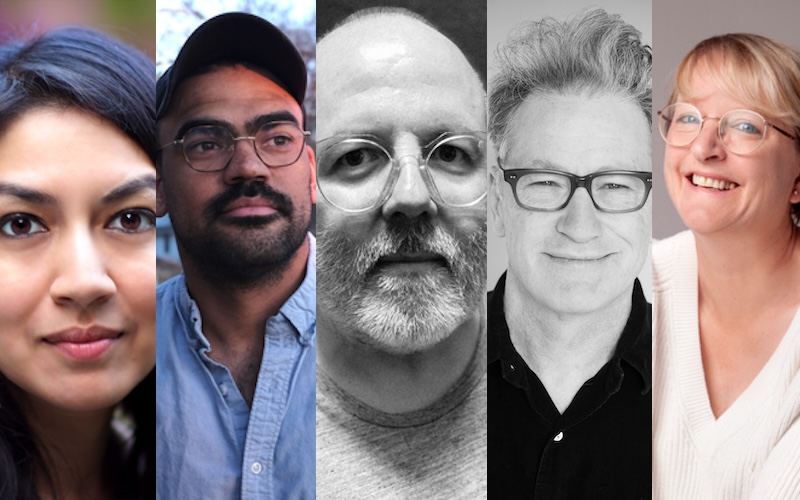
The Lit Hub Author Questionnaire appears on a monthly cadence, presenting seven inquiries to five writers who have new books out in the world. In this installment, we chat with:
Tahmima Anam (Uprising)
Gabriel Bump (Don’t Stop Snowing)
Siân Hughes (No Such Thing as Monday)
Matt Kish (Moby-Dick in Pictures: One Drawing for Every Page)
Nick Paumgarten (The Intangibles: Friendship, Fatherhood, and the Love of the Game)
*
Without summarizing it in any way, how would you describe your book?
Tahmima Anam: The portrayal of female fury.
Gabriel Bump: Intergenerational ties—fathers and sons—alongside moments of growth, friendship, literature, Buffalo, and the Great Lakes region.
Siân Hughes: The work examines trauma, focusing on how survivors of childhood abuse carry gaps in memory and the varied ways these gaps influence their journeys across a lifetime.
Matt Kish: The experience of language, the act of reading pictures, living inside a narrative, the myths we believed as children, the stark truths we confront with age, the enchantment of a story that remains both familiar and startlingly new with every reread, and, above all, the indispensable power of imagination.
Nick Paumgarten: Hockey as a throughline in life and time, complemented by other themes—the roughhousing of youth, marriage, camaraderie, fathers and sons, the body, love, the flow of time, and New York.
Without explaining why and without naming other authors or books, can you discuss the various influences on your book?
Gabriel Bump: A blue-sky stretch over the blue water at the Mackinac Bridge. Independent bookstores dotting the Great Lakes region. Buffalo in winter. The daily work of waking up and trying to become better.
Matt Kish: The scent of used bookstores, winter afternoons spent watching monster movies at Nana’s, comic books, the Golden Age of Illustration, late-night chats during college, America in its good and bad, fear, and the sea.
Nick Paumgarten: The Charlestown Chiefs, Chico’s Bail Bonds, Combray, Ishmael, and the sensory world of the rink and the room. I suspect my struggle isn’t so much with influence anxiety as with memory loss, perhaps a byproduct of a scattered mind—or even a concussion.
Tahmima Anam: The Irish Republican dirty protests, Fakir Lalon’s folk songs, and the demon Bon Bibi, guardian of the Sundarbans mangrove forest.
Siân Hughes: The book draws heavy from other literary works, which makes this tricky. It originated from a short piece written in the voice of a boy who can’t see the abuse his brother endures openly; he has been trained not to notice it. The story, titled “My Brother’s Dog,” features no actual dog—the brother doesn’t have one. The piece never fully worked because it was essentially a tale the narrator could not tell about things the narrator cannot perceive. It was a story about a dog that wasn’t there. The challenge was to expand that into a full novel in which the narrative voice remains intact, yet the narrator cannot reveal the essential things about who they are and how they became that person.
Without using complete sentences, can you describe what was going on in your life as you wrote this book?
Siân Hughes: Oh, the usual—the care of family, adjusting to my father’s passing, keeping a bookstore alive in a non-profitable venture, preventing the building we all live in from collapsing, enduring a breakup, trying not to turn into a grumpy old lady—often with mixed results in each area.
Nick Paumgarten: An empty nest, aging arcs in motion, some deaths among close acquaintances, on-and-off work with The New Yorker, small efforts at self-improvement amid the world’s general decline. The familiar ebb and flow of worry and contentment.
Tahmima Anam: I was engulfed by a rising flame within.
Gabriel Bump: A sunrise after a long night; beauty appearing unexpectedly; a fresh realization; all of it magnificent. Can you believe it?
Matt Kish: Growing older, milestone birthdays, regrets, bouts of depression, a restless seeking, loneliness, and an almost obsessive fixation.
What are some words you despise that have been used to describe your writing by readers and/or reviewers?
Matt Kish: Naive, childish, nearly competent.
Siân Hughes: Despise is an overly strong term. In character-driven fiction, if someone does not adore the character, that is their own sentiment and not a fault of the writer. You can’t help who you love.
Gabriel Bump: Pointless. Horrible. Terrible. People on Goodreads can be cruel!
Nick Paumgarten: It wounds me when someone says my writing is bad. Being labeled a “stylist” has stung; commas are a favorite of mine, and some folks get odd about them.
Tahmima Anam: Triggering.
If you could choose a career besides writing (regardless of schooling or talent), what would it be?
Nick Paumgarten: A river guide. Or a bassist.
Tahmima Anam: A creator of novel ice-cream flavors.
Matt Kish: Printmaking. I love the idea that art should be accessible to everyone, shareable, and capable of mass production rather than being worshipped as rarefied object.
Siân Hughes: I’ve tried many jobs, some I loved. I worked for a choir aiding homeless people, and if I were more musical I’d pursue more music-related work instead of merely organizing meals and spaces. I admire choir leaders. I’d also like to lead creative textile workshops in mental-health centers where I’ve run writing programs, though I’m not skilled enough in that craft, despite loving it.
Gabriel Bump: An attacking midfielder for a seventh-division Norwegian club. Knausgaard does something similar in My Struggle, and it sounds like a blast.
What craft elements do you think are your strong suit, and what would you like to be better at?
Tahmima Anam: I’m strong at endings, though I’d love to improve immensely at describing trees.
Nick Paumgarten: I wish I could simply articulate clever or honest statements. Critical writing—assessments, framing—poses a challenge. I think I’ve grown decent at conveying or arousing feeling without tipping into sentimentality, perhaps.
Siân Hughes: My stories increasingly grow from a beloved setting, and the characters appear once that setting is clear, but I never know ahead of time what the characters will do, so plotting remains difficult. The characters linger after the book ends, as if they’re still alive somewhere, which doesn’t help me build a tight plot. This makes writing inefficient; I often draft ten times as much as ends up useful, but I’ve accepted that as my method.
Gabriel Bump: I feel capable of capturing complex emotions through sentences, and I’d like to be better at crafting introspective, film-like works that become runaway hits.
Matt Kish: I think I have a good eye for color and a knack for shaping images through texture and repetition. I’d love to improve my understanding of anatomy and more intricate compositions.
How do you contend with the hubris of thinking anyone has or should have any interest in what you have to say about anything?
Gabriel Bump: I’m drawn to a lot of small, self-indulgent curiosities. Why shouldn’t other quirky people be curious about them too?
Matt Kish: I don’t permit myself that kind of self-aggrandizing anxiety. I create the art I want to see, for stories that matter to me, and explore my relationship with storytelling. I hope it resonates and connects with others, and I am grateful when it does. But I don’t feel owed that resonance, nor do I view my work as wasted when it doesn’t.
Nick Paumgarten: I’ll crack open a drink or sweat a bit, or dive into something someone else made—film, book, music, you name it—or simply wait for the ego’s tide to return, which it always does. Writing can be pretty gross for that reason, but that’s part of the life we chose.
Siân Hughes: I don’t think I suffer from that particular affliction. I’m always touched when someone asks questions. My favorite thing is when a reader feels the book spoke to them personally and connected with their life; that’s when I feel I’ve achieved something meaningful.
Tahmima Anam: By writing what we both would rather not face.
