
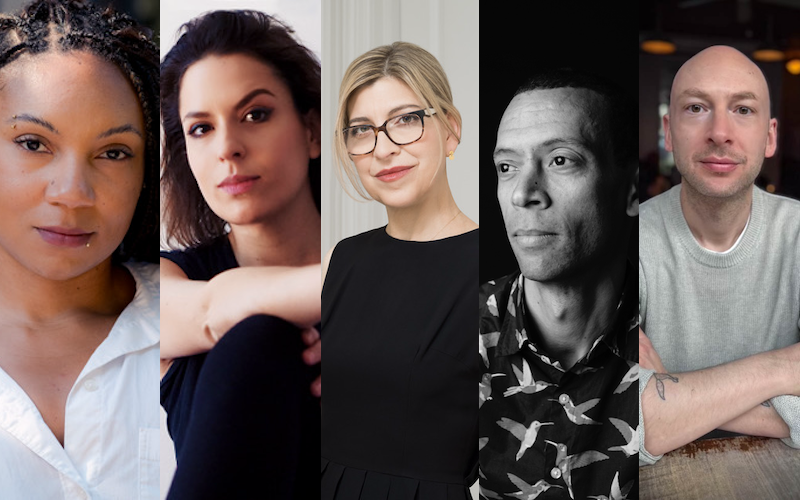
The Lit Hub Author Questionnaire is a monthly interview featuring seven questions for five authors with new books. This month we talk to:
Lauren Michele Jackson (Back: Essays on the Soul and Spine of America)
Natasha Lennard (On Un/Certainty: The Uses of Doubt in Dangerous Times)
Julie Orringer (Luna, Phoenix, Queen)
Kawai Strong Washburn (The Names of the New World)
Adam Wilson (Fail Sons)
*
Without summarizing it in any way, what would you say your book is about?
Lauren Michele Jackson: Form as a guiding force—though isn’t form the underpinning of everything? The way appearances steer our perception of a thing. A kind of audacious, wandering humanism. The United States as an object that demands attention without being obviously defined.
Natasha Lennard: Let’s stop dwelling on the phrase “these uncertain times.”
Julie Orringer: Artistic and marital betrayal; a love triangle; a manuscript that has vanished; an injured dog that prompts confessions; grief and healing; a deer and a hedgehog in love; forests and rivers; invasive ivy; a clarinet in the snow; parents and children; siblings; authorship and identity; how we remain ourselves as our lives shift shape.
Kawai Strong Washburn: Courage; political and cultural growth; the grandeur of the Pacific islands; climate instability; race and transcendence; Minnesota; combat and its opposite.
Adam Wilson: The allure of living forever; mortality; fathers, sons, and brothers; failure; grief; midlife for Millennials; reflections on America.
*
Without explaining why and without naming other authors or books, can you discuss the various influences on your book?
Natasha Lennard: The constant chatter about uncertain times, linguistic games, hinge points and riverbeds, uprisings, mass strikes, and the impossibility of doubting everything.
Adam Wilson: Twenty years of talk therapy, two years of physical therapy, a fear of death, career misalignment, becoming a parent, grief, and a nod to the film Speed.
Kawai Strong Washburn: The landscapes of Hawai‘i and Minnesota; storytellers who embrace the political; a multiracial, multicultural personal history spanning continents and resisting neat labels; writers who push their prose to the breaking point; climate-visionaries focused on a brighter future; hip-hop.
Lauren Michele Jackson: Digressive criticism; weariness with hot takes and timeliness; casual film-watching; gym culture; black-and-white photography.
Julie Orringer: This book drew on many dogs I’ve known; wandering in the woods; the feeling of loving someone amid illness; betrayals of women’s authorship by men; a luna moth visiting my studio window during a MacDowell residency; therianthropy; fairy tales; desire; floods and tornadoes; the Russian short story; air travel; jet lag; and the nerve-wracking insecurity of being a novelist.
*
Without using complete sentences, can you describe what was going on in your life as you wrote this book?
Julie Orringer: My grandmother passed away; Covid arrived; five months spent in Maine; a favorable election; late-night writing sessions; bouncing on a trampoline with my kids; adopting a dog; loving my husband; teaching graduate students; a tumultuous election; tearing my MCL; ocean swims; misplacing my glasses in the woods; thirty-two revisions; hundreds of late nights; support from my editor; a writers’ group; owls; breakfast for dinner on occasion.
Lauren Michele Jackson: Social distancing; a dream job; bursts of acclaim and viral moments I didn’t seek; returning to blonde hair; airline status; vaccines; an engagement that didn’t last.
Natasha Lennard: The same refrain about uncertain times; involvement in movements against genocide; living in New York or nowhere; Berlin; fascism and anti-fascism; the dismantling of my university; being in love.
Adam Wilson: A birth; a pandemic; another birth; hospital stays; dropping kids at school; travel chess tournaments; a kitchen renovation; herniated discs.
Kawai Strong Washburn: Laughter; soccer; love; hockey; fear; frozen lakes; resistance; unemployment and reemployment; all kinds of physical pleasures (even sexual); heat waves; anger; the deterioration of American politics; snow sledding; rainstorms; aches and pains; early mornings; school; depression; evolution.
*
What are some words you despise that have been used to describe your writing by readers and/or reviewers?
Kawai Strong Washburn: It’s all love. I’m grateful that people are reading and engaging with my work.
Julie Orringer: For my first book, critics labeled it “Little. Competent. Snapshots.” Like someone who learned to shoot Instax in poor light.
Adam Wilson: Oversexed.
Lauren Michele Jackson: Any label implying passion or intensity; I don’t write “hot,” and “powerful” feels lazy and insulting.
Natasha Lennard: Dense, academic flapdoodle.
*
If you could choose a career besides writing (regardless of schooling or talent), what would you pick?
Adam Wilson: I could imagine myself as a mentor/producer-type figure for Gen Z bands, in a Rick Rubin vein.
Kawai Strong Washburn: A doctor, particularly in a place that desperately needs one.
Natasha Lennard: An heiress.
Julie Orringer: A NICU babysitter; a croissant connoisseur; a nineteenth-century explorer; a climate-change reverser.
Lauren Michele Jackson: As a literary critic, I’ve lately fantasized about a life in divinity or law school—yet staying true to the prompt, I’d be a professional dancer, perhaps a soloist or principal with a strong company.
*
What craft elements do you think are your strong suit, and what would you like to improve?
Lauren Michele Jackson: I excel at lingering with cultural detritus long enough to extract a meaningful idea; I wish I had a sharper historical sense, since every topic I tackle—even within my wheelhouse—feels like relearning the sequence of events and who did what when.
Adam Wilson: Rhythm.
Kawai Strong Washburn: I have a pronounced lyrical instinct and a basic sense of plot; I’d like to produce more nuanced psychological observations.
Julie Orringer: If lifting heavy things makes you strong, revision is my strength; I’d like to better interpret the cryptic messages my unconscious sends, rather than letting them come out as ransom-note fragments.
Natasha Lennard: I can clarify complex ideas for nonacademic readers; I’m concise and concrete; I’m not particularly stylish; I’d welcome more poetry in my sentences.
*
How do you cope with the hubris of believing anyone would care about what you have to say about anything?
Natasha Lennard: By surrounding myself with many writer friends who also participate in and normalize this hubris; by recognizing that, in truth, very few people care about my thoughts. There’s a Pomeranian with over 10 million Instagram followers. As Ludwig Wittgenstein notes in On Certainty, “The difficulty is realizing the groundlessness of our beliefs.”
Julie Orringer: I remind myself that silencing other writers would deprive us all of things to read.
Lauren Michele Jackson: So far, no respected person has begged me to stop; I’ll delay the dilemma until that ever happens.
Kawai Strong Washburn: Dedication to the craft and the discipline to keep pushing, always; I never approach a page casually. I don’t think hubris fuels my storytelling impulse; I write to fend off loneliness and to achieve a sense of freedom. I feel less alone when I make art.
Adam Wilson: I balance it with periods of crushing despair.
