
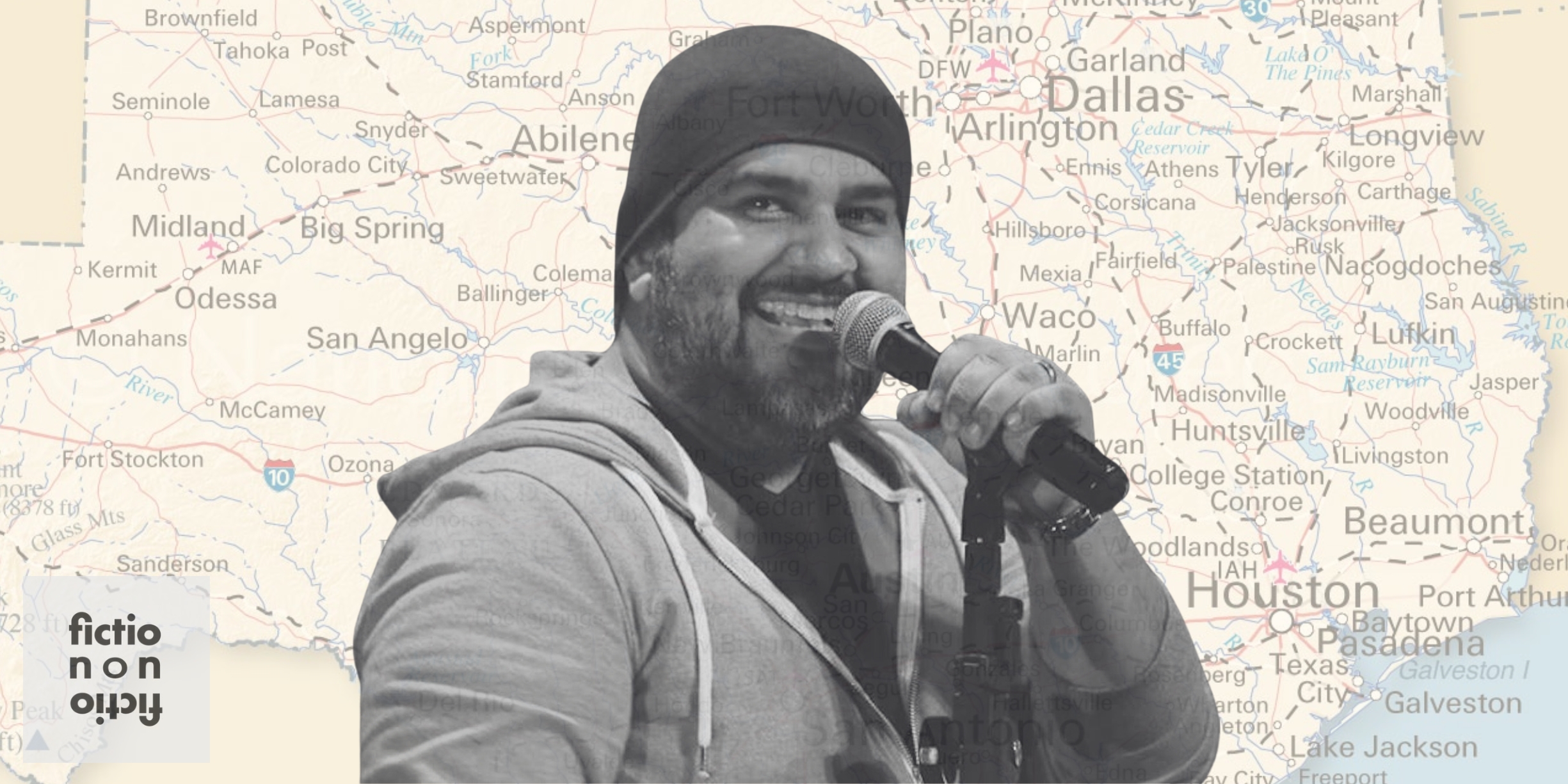
Houston-based poet Lupe Mendez joins co-hosts Whitney Terrell and Jennifer Maritza McCauley to examine ICE raids, the killing of Lorenzo Salgado Araujo, and Texas’s political mood as the midterm votes approach. Mendez recounts the final moments of Araujo’s life and challenges the government’s later version of how he died. He also explains why he chose to address the Mexican community’s boycott of racist integration practices in Houston during the 1970s and what drives him to write poetry in both Spanish and English. Motivated by Ebony Stewart, Mendez discusses how his form of “artivism” intersects with his duties as Texas Poet Laureate. He performs excerpts from We Exist in the Whisper: Huelga School Verses and Prayer Holding Night: New & Selected Works.
To hear the full episode, subscribe through iTunes, Google Play, Stitcher, Spotify, or your preferred podcast app (remember to include the slashes when searching). You can also listen by streaming from the player below. Check out video versions of our interviews on the Fiction/Non/Fiction Instagram account, the Fiction/Non/Fiction YouTube Channel, and our show website: https://www.fnfpodcast.net/ This podcast is produced by Jennifer Maritza McCauley and Whitney Terrell.
Lupe Mendez
We Exist in the Whisper: Huelga School Verses • Prayer Holding Night: New & Selected Works • Why I Am Like Tequila
Others
Ebony Stewart • Jasminne Mendez • Librotraficante • Tintero Projects • Lorenzo Salgado Araujo Chased the American Dream for 35 Years
From the conversation with Lupe Mendez
Whitney Terrell: Before he ever encountered ICE, Lorenzo Salgado Araujo seemed to lead a fairly ordinary life. I want to begin with that slice of his world. Who was he? Where did he reside? What was his family like?
Lupe Mendez: Salgado Araujo lived here in the Houston area as an undocumented resident for more than three decades. He was 52 when he passed. I’m almost fifty, so we share a similar age. He ran a construction business, employed other workers, and moved between jobs on a regular basis. He was the main breadwinner for his household. He had a wonderful wife and three sons, one of whom was in college while the other two had already completed their schooling. One son became an engineer, the other a high school teacher in the Houston area. This pattern—this blend of intelligence, ambition, and familial responsibility—embodies the enduring brilliance of many Texas Latino families. We are deeply connected to immigrant stories and to families that, in some way, mirror our own. Each of us, in one way or another, represents first-generation children translating their worlds for family members in tow.
He yearned for a quiet life, according to his sons. He did not crave drama or disruption. He simply wanted to work, return home, share a hearty meal, cheer for his favorite soccer team—the one I also root for, Chivas Guadalajara—and contend with the bittersweet reality that our team frequently falls short. This was a man whose everyday routine reflected normalcy. The tragedy lies in the fact that being Brown and pursuing work can come with an intolerable cost.
Salgado was halted by two unmarked ICE patrol vehicles. There were no sirens and no announcements. To all appearances, it felt like a calculated move to seize his gear. ICE initially alleged that he backed his van into their vehicle, which did not happen. There is no video evidence supporting that claim. Later, the public narrative claimed that Salgado Araujo and the three men in the van weren’t the target of the operation; the agency said they were seeking two Guatemalan individuals. The three men in the van—Salgado and his companions—were Mexican day laborers on their way to a job site, late for the morning’s start.
And then the sons learned what had happened to their father through Facebook. That is not how you learn the most consequential fact of a parent’s life. That is what they had to live with. Beyond the unimaginable burden of continuing his legacy, this also affects every family member who might have a Lorenzo somewhere in their realm—a brother, a father, or a son. The unsettling truth remains: could this have happened to someone else we know? And when will the next such incident occur?
Jennifer Maritza McCauley: Lupe, your depiction was so powerful that it brought tears to my eyes. According to the Texas Tribune, ICE issued a statement after the shooting claiming that their agent interrupted Araujo’s vehicle as part of an unspecified targeted enforcement operation, that Araujo attempted to evade capture, allegedly tried to ram an ICE vehicle, refused multiple verbal commands, and tried to drive over the federal agent before the officer fired in self-defense. Was that account accurate?
LM: Absolutely not. In fact, the three men in the van have spoken, through attorneys, but the government is moving quickly to prevent their testimony from reaching the public. They say they were being tailed almost immediately, which led to a pursuit. Araujo slowed to roughly five miles per hour because the street where this happened was under construction—pavement had been removed for blocks, leaving a single lane. As two ICE vehicles bore down, they struck him. An ICE officer stepped out firing, blasting at the van, firing through the passenger side and striking Araujo in the abdomen. He nonetheless steered the vehicle to a stop, was pulled from the van, handcuffed, and allowed to bleed out on the street.
The FBI later opened a file to determine whether drugs were present in the car. The workers insisted that the small bags were electrolyte packets—things used to replenish salts in hot Texas heat, not narcotics. The FBI suggested methamphetamine in those bags, but subsequent tests confirmed that the contents matched the electrolytes the workers described. In other words, the attempt to smear the victims’ reputations by casting them as carriers of illegal substances was shown to be unfounded.
WT: And, importantly, he wasn’t the person they had been seeking in the first place.
LM: Exactly. So we’re left with a tangled, evolving picture of the justification they offered and the reality on the ground.
Transcribed by Otter.ai. Condensed and edited by Rebecca Kilroy.