
The woman first noticed the stranded pilgrim, babe in arms, on a poster pinned inside the Medieval Center at the University of Bordeaux—the moment she finally spent a semester abroad. The grayscale illustration captured a mother braced on the heaving surf, gazing into her naked infant’s face as the Virgin Mary loomed above them, angels circling her head. On the shore, bystanders fell to their knees in reverent awe. The Norman abbey of Mont Saint-Michel, a tidal island reachable only at certain hours, extended from the lapping waters as if grasping toward the sky. Mary’s gown billowed in the wind; indeed, the whole scene portrayed the storm, from waves breaking against the monastery to the bundled pilgrims waiting out the rain by the shore.
During that year in Bordeaux, the young woman ate her lunch beneath this poster between courses on French medieval women, which explored Marie de France’s lais and the scornful letters Heloise sent Abelard, and an afternoon seminar on manuscript lore. Day after day she studied the image, not quite understanding what exactly she endured looking at, until they read a copy of a manuscript titled Miracula Beatae Mariae Virginis, or Miracles of the Virgin. This Marian hagiography was assembled by two English monks, Dominic of Evesham and William of Malmesbury, sometime in the early twelfth century.
“Medieval pilgrims trudging along the perilous Norman-Breton coast toward Mont Saint-Michel would have seen a large stone cross rising from the sands at low tide, the croix des grèves,” Professor Compère explained to the class.
Because the girl was still learning the language and history of the place she inhabited, she grasped the legend’s core yet missed many of its specifics. The tale’s centerpiece was the Peril: a young pilgrim, returning from her journey to Mont Saint-Michel, was overtaken by a sudden squall as she crossed back to the mainland. The tides rose, sealing her path as she raced the sea. She went into labor, and according to the manuscript, the Virgin Mary appeared to rescue the laboring woman from the surging water. “[The Blessed Virgin] rolled up her sleeves over her, thereby keeping the woman] untouched (intacta),” the manuscript stated. Her sleeves were like “a bridal chamber” for the woman to lie in, “perfumed with the sweet scent of balsam.” The mother named her baby boy “Peril” and vowed him to the priesthood in gratitude for this miraculous birth.
Professor Compère walked them through each line. “Medieval readers,” he noted, “who understood the double meaning of ‘intacta’ as shielding the pilgrim from the sea and as someone who had never known intercourse—someone like the Virgin herself—would also interpret the Virgin’s sleeves as signaling a safeguarded womb in which the woman could labor. The Virgin acts as both midwife and priest, sheltering the pregnant traveler from the storm and washing away her sins so that she too can be delivered.”
“It was one of the Mont’s most celebrated miracles,” he added, “but it was a theft.” He argued that English monks rewrote the Roman du Mont-Saint-Michel into the text they studied, stealing Saint Michael’s miracle and attributing it to the Virgin Mary.
The postscript to the legend read, “Although some report that Saint Michael the archangel protected a certain female pilgrim from danger amid the waves, it is the Mistress of the World [the Virgin] who saved this woman from certain death in the surf.” It stood as a nearly explicit confession that the English monks knew the original tale yet chose to rewrite it. Why did they replace Saint Michael’s miracle with Mary’s, or had they believed the Virgin’s role all along and Saint Michael merely usurped it in the first telling? The young woman listened, scribbling what she could decipher, struck by how medieval audiences would call this a miracle while modern readers would label it a legend.
Later that day, she wandered into the campus bookstore and bought a copy of Le Roman du Mont-Saint-Michel. It sat among a substantial medieval literature shelf—likely assigned in classes—but she was mainly chasing the Peril’s voice, hoping to discover how the tale altered when the savior was a male saint rather than the Mary they had studied. Some plot beats shifted—the pilgrim’s less-devout husband, for instance, emerged a sturdier character. The miracles of Saint Michael’s aid during labor differed markedly from the Virgin’s version.
When the pilgrim reunited with her companions after the curious delivery, she recounted the event and claimed she had been blessed by God to receive direct help from an archangel. But her companions had no visual witness of the angel, so it remained only the woman’s claim. The young woman wondered why that had been enough—why a woman’s testimony seldom sufficed in her own world? She began to suspect that perhaps all miracles could be claimed by saints and angels if the believer believed strongly enough.
The manuscripts the young woman studied during that year in Bordeaux began to shape her dreams. She felt a rare harmony each time Professor Compère translated Latin terms into French—effortlessly—softening the rift she had sensed since Catholic high school days, between the communion of saints and the sins she’d been warned would bar her from worldly pleasures—art, literature, and music created by people who were not priests, yet who seemed as holy and miraculous in their ways as any saint she had read about. Here in Bordeaux, surrounded by church-made art—its music, frescoes, manuscripts, and its history—she found herself collapsing the binary she hadn’t known she held between what was sacred and what was scholarly. Every translation brought a sense of lightness, as if she could relinquish the need to choose sides.
For the first time in her life, she began skipping church regularly, because even though she could recite the Mass in order, it felt habitual rather than holy. Over the preceding years, she had grown anxious about cherry-picking what she could believe, what she could ignore. Here, away from home and its language barrier, her attention wandered during the readings and the consecration. One Sunday she stayed home, and realizing no one would notice, she repeated the choice the next week, and the next. The ease of defiance, coupled with evenings spent with American peers in Bordeaux—late nights, cheap wine, long conversations at their host families’ tables—allowed her to experiment with a different life.
A young man in her program, dark-eyed and olive-skinned, tall enough to bend when he walked, once guided her to the doorway of his small apartment and kissed her. It startled her at first, though in retrospect she recognized it had occurred for months in small, almost-not-there gestures. She remembered the way he let his knees brush hers under a cafe table, the way he brushed her hair from her face in the crypt beneath the basilica, where she had been spellbound by a sign describing it as a stop on the modern pilgrimage to Santiago de Compostela. And how, when he realized she was absorbed in a book, he stepped back and left her to it. He asked what she wanted once she finished college, what she drank and ate in cafes. Yet because she had never learned to name her desires, it took him kissing her for her to recognize what she wanted. As she leaned into him and took his hand to lead him upstairs, the realization arrived with a sense of relief. She longed for what many bodies crave, a longing she pursued for the next six months before she had to depart for the United States.
Leaving Bordeaux meant leaving the other American students she had bonded with in that unfamiliar culture, a rapid but deeply meaningful connection that sustained them. It also meant bidding farewell to the medieval towns, the city walls, the rhythms of the ancient university she had immersed herself in with such strenuous devotion.
Back at her California campus in late summer, the city felt humid and intoxicatingly new. She felt disoriented by the familiar milk in the fridge at her parents’ house, a product that contrasted with the tiny containers she had grown used to in France. She recognized a new confidence whenever she walked into a shop or a classroom and realized she could speak without translating first. An exhilarating relief arrived, along with a sharpened sense that she could no longer rely on the limbo between languages. On her first day back in the French and Italian department, she asked the advisor to add a medieval studies emphasis to her French major, and she began exploring PhD programs in medieval literature, hoping to recapture the thrill of linguistic uncertainty and the sheer reverence she felt upon encountering a manuscript for the first time—the way margins held tiny drawings, the elegant scrawl of marginal notes. The thought of pursuing these studies formally, something she hadn’t known existed before her year in Bordeaux, kept her awake with anticipation.
Her favorite mentor in the new medieval studies track, Professor Brown, studied medieval women and spoke with expressive, expansive gestures. She made her presence felt, and the young woman grew bolder in sharing her past year abroad and her desire to keep exploring. Professor Brown’s office walls overflowed with enlarged manuscript pages, conference posters, and shelves packed with books. The space and Brown’s obvious devotion to female figures of the past shaped the young woman’s aspirations. She allowed herself to imagine a life crowded with the particulars of Brown’s passion and confessed her wish to translate Le Roman du Mont-Saint-Michel. When she disclosed the literary and saintly theft—the monks who took Saint Michael’s miracle and credited it to the Virgin—Brown attributed the piracy to the medieval cult that developed around Mary. “To medieval minds, Mary stood as the flawless woman,” Brown told her one day, with the windows flung wide to the warm California breeze. “They tied devotion to childbirth to ritual, so it’s not surprising that some hagiographers stole a miracle for their own saint. It happened often. Mary was always getting credit for miracles she didn’t perform.”
“That seems so strange,” the young woman said. “To credit a woman for someone else’s work.”
“Well, it is, in contemporary eyes,” Brown replied, leaning closer as if sharing a secret. “The Catholic Church did little for women, but for a time Mary was almost a rival deity, a merciful force as well as a source of power.”
The idea of mercy consumed the young woman, guiding her through a season of translation that left little room for wandering thoughts. In that focused mood she prepared applications, polished personal statements, and gathered letters of recommendation. Late at night, after the day’s assignments and applications were archived, she worked on Le Roman du Mont-Saint-Michel, underlining unclear sentences, correcting tangled sections, and confirming the precision of her word choices. Hours later she would rise, stiff and bleary, and notice the tea bag lingering in her dorm kitchen cup since dinnertime. It always seemed to be past midnight when she finally allowed herself to sleep.
The winter of her senior year brought Ted into view. She was cycling to a Catholic-school-themed party at their public university, where few attended who shared that background. He was adorned with purple balloons, his face peering out from between them. She considered attending as Saint Lucy, eyes gouged and painted with red, but she knew what the party culture demanded in that setting and preferred the possibility of a different self. And even though the spectacle felt familiar, she was trying on a life in which saints weren’t the center of attention.
As she rode by, the balloon-clad young man drew her eye, and she wondered what kind of party he was headed to that night and what role he played there. Minutes later, he appeared at the gathering, greeted by strangers, while she lingered in the kitchen with friends. She had already downed a couple of shots and could sense a heady buoyancy in the air. When the balloons finally burst, either by a casual nudge or by someone’s inadvertent touch, he and she flinched in tandem, sharing a moment of laughter as they talked into the early hours. When he finally bid her goodnight at two in the morning, she popped the last balloon by leaning in to kiss his cheek. She hoped to go with him, but he didn’t extend an invitation, and the sting of that paused moment lingered. Yet before she biked away, he asked for her number, and two days later he phoned to arrange another meeting after classes.
The first time they slept together, a few weeks later, she experienced a fierce, unapologetic hunger for him—bodily, independent of her thoughts. He appeared to care about her pleasure as if it mattered to him too. He moved slowly, and grew earnest as they kissed. She felt spellbound, as if nothing else could satisfy her but being with him. The way he rode his bike to see her after his classes, and the weekends they spent entwined in one another’s beds, led her to believe he felt the same way, though neither spoke of it yet.
By spring, when graduate acceptance letters arrived, she believed she was in love, a realization that forced her to confront the future they might share. Ted earned admission to a data-science master’s program at Columbia, while she was accepted at UC Berkeley for a PhD. She knew she would regret choosing him over the doctorate more than the opposite, and so, when he asked her to move to New York, she decided to go with him. They visited the campus as a couple, a package deal in their own eyes. On the plane they held hands during takeoff and landing, sharing headphones to watch a film. They stayed in a dorm, and she tried the life on for size. While he attended meetings and lectures, she rode the subway to the northern tip of Manhattan to explore the medieval Cloisters. She wandered the herb garden and walked beneath the shrine of the Poor Clares, the sun warming her bare arms. A distant chant filled the air, and when she rounded a corner to draw closer, she found nothing but a cloaked woman in black, praying with her gaze lifted to the light. When the two other visitors appeared, she briefly warned them with her look, but the saint vanished, replaced by a red-tailed hawk that perched and then took flight. The moment left her breathless.
That early spring, the quiet of the Cloisters felt like home, and later, the bustling café where they shared a meal, the city’s rhythm felt right as she lay with him. “I love it here,” Ted whispered into her hair that night, his body pressed against hers. “I love you here.” She answered with urgency, kissing his shoulder and guiding his hand closer. Her gaze lifted, following the same arc as the saint’s in her memory, and she felt a private euphoria wash over her.
When they returned to California after their visit, she found herself glancing at the cracked spine of Le Roman du Mont-Saint-Michel on her shelf, uncertain whether she could reconcile the growing fracture within herself. In the quiet of their bedroom, she watched Ted sleep and saw in him younger versions of himself she might have imagined for their future. The possibility of what their children would look like crossed her mind unbidden, and though the thought frightened her, she resolved to remember the thrill of that imagined child in his resting face.
They moved to New York that autumn.
How many lives hinge on what we surrender when love enters? She knew she might reapply to PhD programs after Ted completed his studies, and she could always return to the man she loved—someone who made her laugh, who shared many opinions with her, who carried some of the same wounds and understood many of the causes behind them.
She found it easy to erase parts of herself in that way, even as Ted occasionally pressed her to pursue the life she had once envisioned. Yet she had convinced herself to be practical, to pursue a master’s and a credential program that would allow her to use French daily and secure a job wherever Ted might land. Months stretched into years with little thought given to the PhD she had rejected. When destiny called for starting a family, she realized there were only two things she truly desired: the PhD she hadn’t obtained, and her husband. Unwittingly, she had begun to erase herself from the person she had become.
__________________________________
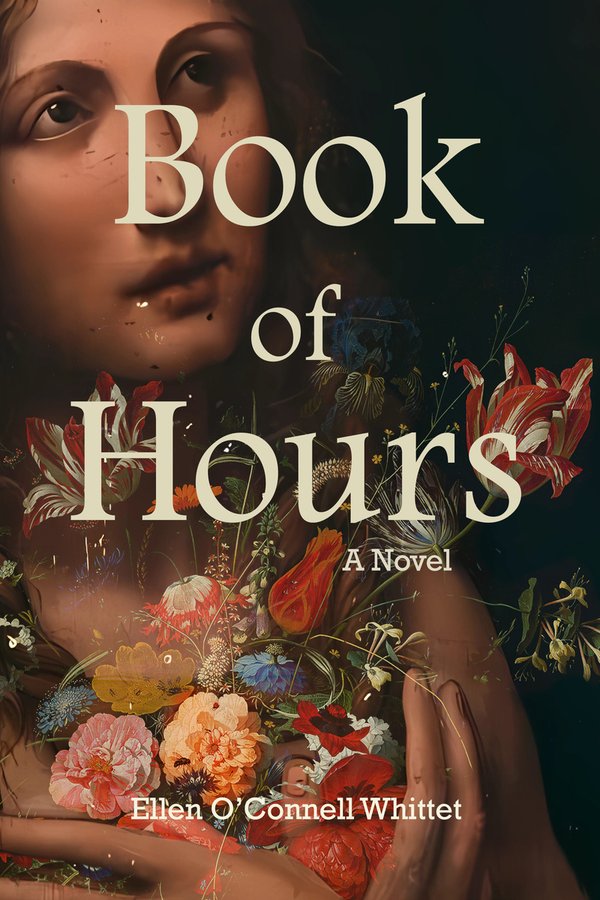
From Book of Hours by Ellen O’Connell Whittet. Used with permission of the publisher, Dzanc Books. Copyright © 2026 by Ellen O’Connell Whittet.