
In my living room a framed photograph adorns the wall. A man wearing balloon-leg trousers and a torn white shirt tosses a wooden pitchfork brimming with straw into the air with athletic ease. He is threshing. Behind him, a green valley stretches out, uncluttered by cars, roads, or electrical lines. At the edge of the field, two small children crouch. One watches the threshers, while the other faces the camera, his white robe torn and his bare feet visible. That boy grew up to be my husband. The photograph, taken in 1971, could just as well depict a much earlier era—a century, perhaps, or two centuries prior. What makes the world captured in that image feel like a strange country—is it distance, or is it time itself? To whom does this landscape truly belong? To my husband, to me, to our children? Or can anyone secure a visa to the vast nation that is the past?
I first met my future husband Ali in the cramped supply room of the public high school in Tinghir, Morocco, where we both worked as teachers. Our formal introduction came when the custodian of the old mimeograph machine teased, “Be careful with that one; he might steal your pen.” He possessed a boy-band charm, a head full of tousled black curls, and a smile that could light a room. I had just turned twenty-two. Such is the ardor of youth. The contrasts—language, faith, and cultural upbringing—seemed minor. Our shared youth created a wide, common ground between us.
As I imagined the story, I realized I could draw upon memory—mine, my husband’s, and of the life we had shared.
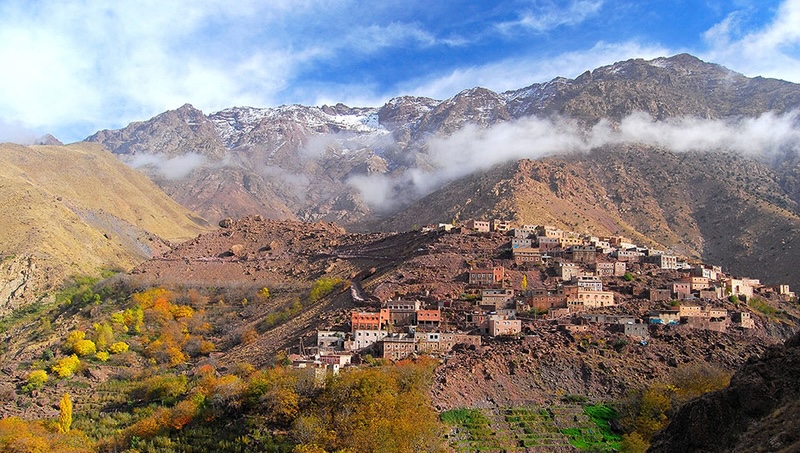
Later that year, I visited his family for the first time. We climbed high into the mountains along a single-lane, unpaved road that wound perilous switchbacks beside sheer cliffs. At six thousand feet we entered a narrow valley where a ribbon of greenery threaded its way between towering, barren peaks. Ali’s father tilled tiny ancestral plots using an irrigation system developed in the era of the Romans. His mother spent long hours gathering kindling, which she carried on her back. His parents could neither read nor write and spoke only Tamazight (Berber), the indigenous language of Morocco. One could characterize this life by what it lacked—electricity, running water, proper sanitation, navigable roads. Or one could describe it by what it preserved—an intact agrarian-pastoral culture with ancient customs—seasonal herd migrations, news carried by singing poets, communal celebrations, deep tribal and extended family ties.
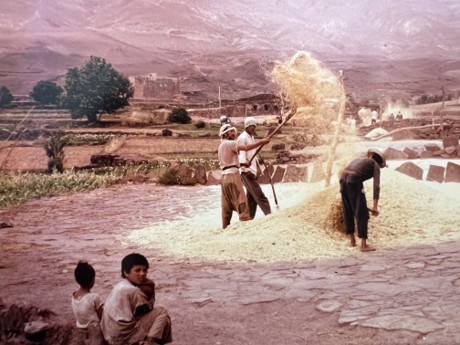 Ali at the threshing field, circa 1974.
By the time we began our life together, Ali had already started the gradual departure from his homeland—the journey that began when he left home at ten to pursue schooling and became complete when we moved to America so he could enroll in a doctoral program. In those early days, the only way to contact his family was through in-person visits, which were expensive and thus rare. Yet the village gradually opened to the wider world: paved roads, electricity, cell phones, satellite TV, and eventually the internet. His family still lives there, though not in the village of Ali’s youth.
Living in America, cut off from visits and calls, Ali and I shared the memory of his homeland. Its contours persisted between us, forming a deep, intimate reservoir of stories that even our children could not fully grasp—the wall his father had dreamed of building around their house, the shrines his mother visited to heal his brother who was born with malformed legs, his uncle who served in the French colonial Army and returned with tales of battles that nobody believed.
That final tale—about the uncle—stayed with me. I pictured Moroccan soldiers who had fought for France in World War I. How could one articulate what they had endured and witnessed in a language that had words for horses, hedgehogs, and threshing fields, but none for cannon, machine guns, or steel? What would it be like to leave the High Atlas and travel by boat and train to the Western Front, where European powers had spent centuries wielding industrial force to construct weapons of war?
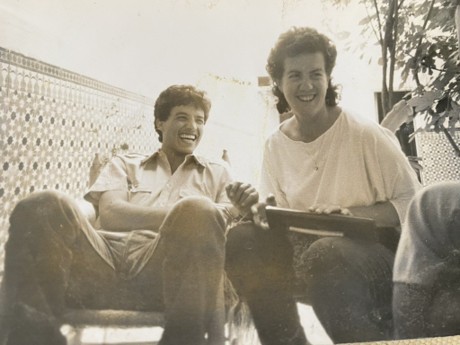 Elizabeth and Ali, 1985.
It seems almost inevitable that a narrative would reach me—one about a boy born in the High Atlas and a horse born within the Sultan’s palace. The distinct circumstances of their births pale beside the inexorable modern forces drawing them into the great churn of the First World War.
The past is not so much foreign as free, free to anyone who is willing to do the work, to enter the past with a spirit of curiosity and a willingness to conjure a living world out of the detritus that history leaves behind.
It required audacity to imagine the world through the eyes of a boy leaving his Atlas homeland in 1899, to step into the shoes of a colonial soldier who lands in the Western Front, to inhabit a young French woman who meets this Moroccan soldier and offers help, and to march alongside a French soldier born in Algeria who has never set foot in France until the day he fights there. Yet as I pictured the tale, I realized I could draw on memory—my own, my husband’s, and the life we had shared. It took me four decades to reach that level of assurance, but when I finally did, I leapt in without hesitation.
Because the truth is this: the past belongs to no single person, and for that reason it belongs to all of us. The craft of historical fiction hinges on the author’s authority, and there are many routes to that authority. My path lay in lived experience, shared stories, and above all, the corridors of memory. My authority sprang from encountering life in the High Atlas before the present edged in, gradually erasing what came before and leaving only memory and story in its wake.
The writer L.P. Hartley famously claimed that “the past is a foreign country; they do things differently there.” I don’t fully accept that. A foreign country is a real place you can visit, learn about, and with time and openness, eventually stop perceiving as foreign.
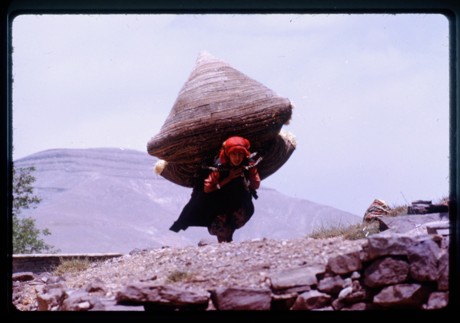 A woman carrying threshed wheat.
The past is a different realm—difficult to reach, as imaginary as Narnia or the Land of Oz. It is a space we construct from whatever we think we know, and we invite readers to follow along.
Which brings me back to the challenge that rests on every author of historical fiction. Anyone who seeks to travel into the past must cross the most formidable distance—the span of time itself—and contend with the present’s persistent urge to warp perception. “The past,” as one of my characters, Hassan, a Moroccan soldier, says, “is a country you cannot visit except in your mind.” I would argue that the past is not so much foreign as liberating, accessible to anyone ready to put in the work, to approach the past with earnest curiosity and a willingness to conjure a living world from the remnants that history leaves behind.
_______________________________
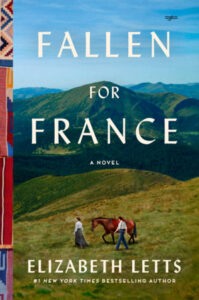
Fallen for France by Elizabeth Letts is available from Ballantine Books, an imprint of Random House, a division of Penguin Random House, LLC.