This first appeared in Lit Hub’s Craft of Writing newsletter—sign up here.
I don’t operate on a grand, epic scale, even though my ambitions tilt toward the heroic more than I’m willing to admit.
It comes down to where my focus lands. I don’t truly perceive events on a vast, epic scale, not in the manner of Tolstoy, Morrison, or García Márquez.
I’m wired differently. I notice the locomotive before the continent it traverses. I even notice the passengers before the train itself. I perceive the whole as a sum of its particulars. I can’t envision it any other way.
When I was younger, I reproached myself for that. I fretted (why miss any opportunity to worry?) that I was, and would always be, a minor writer.
I don’t spend a lot of time worrying about it anymore. Writing is hard enough without adding the pressure to become the writer you imagine you should be.
It helps that, for a long while now, I’ve believed that labeling works as major versus minor isn’t the most revealing way to tell these books apart from those books.
If, for example, you wanted to understand late-nineteenth-century Russia, you’d consult histories and biographies, but you’d also turn to Chekhov, Turgenev, and others. You’d seek to understand the divorce laws that push Anna Karenina to accompany Vronsky to the opera, and you’d watch Akaky Akakievich’s poverty-shame seal his fate in Gogol’s “The Overcoat.”
These are all, of course, prominent writers, but to some extent their significance stems from how they attend to the people who did not rule, reign, or command.
Historians recount Napoleon’s retreat from Moscow in October 1812, during which at least five hundred thousand French soldiers perished from exposure and starvation. Picture a soldier, crouched in the blizzard, still clinging to the possibility that he might—might—return home. Without fiction, we’d lack knowledge of the personal home he longs for. We wouldn’t know that his father, anxiously awaiting news, regrets every blow he ever gave his son and would do all he could to ensure the boy knows he is loved. We wouldn’t know that the soldier, torn about his girlfriend, plans to propose to her as soon as he steps through the door.
The soldier will not survive. We should understand his death, huddled in the snow under a star-splashed night sky nearly too bright to bear. We should grasp how his demise reshapes the lives of his father, his girlfriend, and all the others whose fates were tethered to his. We should be reminded that each of the half-million dead left a void that cannot be filled.
We do imagine those lives, but we know enough about them to trust our own intuition.
Someone must chart new continents. Someone else must uncover the unfathomable flora and fauna native to those lands.
During a season as an aspiring painter, I learned that the arm and hand travel in arcs of varying sizes. You may sweep broad strokes across a canvas, or you may work with your hand and wrist. The former yields large paintings, the latter smaller ones.
It’s instinctive. If you’re a grand painter and you attempt to work small, your paintings may feel stifling. If you’re a small-scale painter and you try to work large, your paintings may feel stretched, thin.
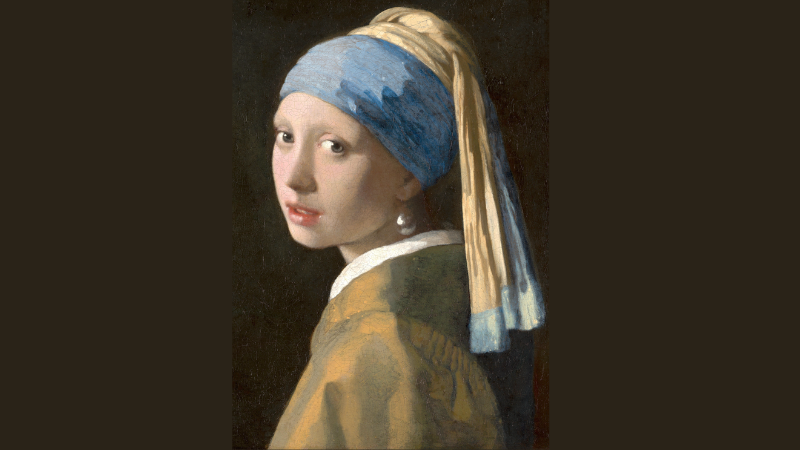
I wouldn’t want to argue that Vermeer’s Girl with a Pearl Earring outruns Vermeer’s The Night Watch, though the girl with the earring is a simple portrait of an unnamed girl, while The Night Watch portrays a historical scene with nineteen figures, a dog, and a chicken (yes, a chicken).
I’ve come to see that I was drawn to Virginia Woolf because she was among the first writers to insist there is no such thing as an unimportant life; one of the first to imply that the movements of the galaxies are no more or less meaningful than the movements of subatomic particles. It’s simply a question of whether you’re looking through a telescope or a microscope.
If there are no unimportant lives, then there are only incomplete ways of looking at them. From Emma Bovary to Clarissa Dalloway to Macon Dead, we as readers have learned that scale matters little. In Woolf’s hands, a single day in the life of a society wife can stand beside Napoleon’s retreat from Moscow. For Woolf, the lives of “ordinary” people are neither more nor less significant than the lives of world leaders and great artists.
There’s more to it still.
I was instantly drawn to Woolf’s insistence on the relativity of human affairs. As she wrote, “For [Clarissa] was a child,… and at the same time a grown woman coming to her parents who stood by the lake, holding her life in her arms which, as she neared them, grew larger and larger in her arms, until it became a whole life, a complete life, which she put down by them and said, ‘This is what I have made of it!’”
We are, as writers, readers, and people, whether we love our lives or not, compelled to watch time blow it all away. It’s the beauty and tragedy of us. We strive to glimpse the horizon beyond the horizon. We do our work, we fall in love, we make plans and harbor the grandest hopes even as we know where everything is headed.
We are such stuff as dreams are made on, and our little life is rounded with a sleep.
I for one am not going to argue with Shakespeare.
Like any writer, I’ve spent my life seeking to preserve time, so that readers may open a book and not only see but feel what rises from the page; to smell and taste; to hear, if only faintly, songs that have not been sung for a century or more.
We persist in the effort, even as we know that almost all our efforts will fail to some degree or another.
It’s like trying to drive a nail into a pool of mercury.
I wish I could tell you why we continue to push ahead. It seems tied to clarifying the world for myself by clarifying it for others. Different writers pursue this for different reasons, but I suspect a romantic bond with reality is common to us all. I do it because you, as you read this sentence, are listening to me as I try to listen to you, to imagine you, no matter how far apart we are in time and space.
___________________________________________________
From the book Unsayable by Michael Cunningham. Copyright © 2026 by Mare Vaporum Corporation. Published by Random House, an imprint and division of Penguin Random House LLC. All rights reserved.