
What’s something you think national conversations get wrong about rural attitudes or rural people? This is the somewhat dreadful question the publicist for my book asked. She lives in Brooklyn and struggles with what to make of me, what to say to sell what I have made. With her question, she hoped to spur me to produce an eye-catching thinkpiece or article we could place in a national paper or magazine, something that could then gin up interest in my book.
My initial reaction to the publicist’s prompt was to recall the JD Vance discourse on “blood and soil” nationalism with a sharpened edge. My irritation wasn’t aimed at the accusation itself but at how some commentators leaned on Vance’s stated wish to lie among his ancestors in the family graves as if that settled the matter. I, too, have such a burial plot, waiting for the day when my remains will lie next to my stubborn great-great-great grandmother, the one who endured four husbands. And my great-great-grandmother, widowed early with seven children, once took in other people’s laundry to keep us fed. Those women are mine, my kin. They rest on a country acre I mow and tend, just as my mother did before me. So, when it comes to graveyards, I do understand what Vance is after here. And I flinch at seeing his longing wielded as proof of menace.
There is forsythia growing on a rocky hill at our easternmost bit of land, and more forsythia down the hill some 300 yards west.[/pullquote[
Some people—I expect people not just rural but of all sorts—have a deep sense of place and rootedness. This sentiment becomes stronger for some of us when the dead who belong to us are laid to rest. We’re not inherently strange or cruel or coarse about it. A broad acknowledgment of this as a fairly ordinary human value is why we leave burial grounds undisturbed. Whatever evidence must be marshaled to prove that the charge of blood and soil nationalism attaches to Vance, let it reside elsewhere, not in his wish to be laid to rest beside those he calls his own.
If I were urban, publicly defending JD Vance—even in a mild, restrained fashion—would feel like stepping onto the public’s third rail. Since I’m here to speak from a rural vantage, I’ll describe it as if grabbing an electric fence on purpose—a move that can only end in pain for the one who makes it. It might accomplish the publicity job—after all, publicity thrives on attention and on luring you to read what I’ve written in hopes you’ll buy my book. Braving the current of JD Vance could yield favorable returns in that sense. But it would be misleading. My book does include a rural graveyard scene, yet you won’t find JD Vance or any explicit rural opinion about him within it. I mostly endeavor to avoid it.
The bigger complication with the publicist’s question—What’s something you think national conversations get wrong about rural attitudes or people?—is that I’m not the person most likely to answer it. The book—the one she wants me to convince you to purchase—was written by me, yet I’m not what you’d call a “typical rural person.” Yes, I own and maintain a tractor, can effectively swing a chainsaw, and find humor in pieces that joke about mailing ticks to determine what illnesses one might harbor, as if the dozens we collect on a rough day could be sorted out so.
But alongside these kinds of facts, there are others that don’t always fit neatly into a talking point about The Rural. I hold a Ph.D. in philosophy, and nowhere in that training did I acquire the toolkit of a sociologist. In fact, the upshot of all that formal study is often a crippling self-doubt. I am keenly aware of how vast the domain of what I do not know really is. Farming has only broadened that boundary, stretching the territories beyond my immediate comprehension.
Again, there is forsythia blooming on a rocky hill at our easternmost bit of land, and more forsythia down the hill some 300 yards west. That eastern forsythia reliably turns its spring color a week or more before its western, lower neighbor. It’s the same plant in both places, but the climate up the hill nudges its timing, and this shows up not just in bloom but in a suite of other subtle differences. It’s evident in how fog lingers on certain days, and in the heavier dew that clusters in the low-lying fields. I take lessons from that forsythia and from what its color signals. If the same plant variety across a single farm can’t even display uniform spring coloration, why pretend that “rural culture” or “rural people” can be distilled into a single, all-encompassing essence? I can only speak to what is genuinely local—and by local I mean the precise local here, on my family’s fourth-generation, 200-acre farm.
There are a number of familiar stereotypes that tend to pop up when one reads about rural life, and not all of them suit our small slice of country. Here I’m drawn to a detour—a story I like to recount—about how stereotypes can be deployed to serve ostensibly important ends.
Many years ago, a cohort of college students visited our farm as part of a research project, setting up hair traps to help track bear movements in our region. When they arrived, I had been out at work and came back covered in dirt, my overalls caked with grime and my boots heavy with toil. I probably looked rough rather than dangerous. Yet the students moved with caution, staying off the yard and addressing me from the road, politely asking permission to explore our land.
When I told them I’m a professor, a change overtook them in an instant. As if they’d been holding their breath, they exhaled and spoke more freely, shedding a coached formality. It turned out that the northern urban landscape their campus had trained them with had taught them to expect we’d be ornery and suspicious; to fear bears and, as a rule, to fear the locals. That training showed itself, and our conversation stalled. Then my brother emerged from the woods with a chainsaw, looking exhausted and rough from work, which made the students tense again. To ease the moment, I cheerfully exclaimed, “Don’t mind him, he’s just an algebraist!” That did little to calm things down.
In the end, I don’t begrudge the students’ training. The danger they anticipated isn’t entirely unfounded. I can’t approve of it, but I must admit it can occasionally be effective. In many places, a woman alone in the wilderness, where a call for help might travel no further than your own ears, might feel vulnerable when encountering a stranger. Out here, that isn’t often the case. When people trespass on our land, I simply tell them to leave, and they do. For you never know who might be armed in these parts, and that risk includes women as well. It can compel men who wouldn’t ordinarily listen to heed cautions and defer to reason. In short, I sometimes enjoy being mistaken for a menace, even relish it at times. Does that mean I fulfill or defy the stereotype? I’m never entirely sure, but I do know that stereotypes rarely align with how things actually unfold.
Sometimes government can really fuck you up, and even fuck you over.
On our farm, we maintain several man-made ponds, dug to keep cattle supplied with water across their grazing cycles. One of these is known as the Government Pond, but to pronounce it correctly you have to elongate the word with a tinge of contempt, as a kind of jab. Anyone hearing us mention this pond might decide we belong to a Certain Rural Type—those supposed backward folks who don’t know how to appreciate who keeps them afloat, who reject “gubmint” even as they rely on it for essential needs like aid to farmers and a nearby hospital that’s barely holding on as Medicaid funding wanes. When I talk about our pond, I sound as if I’m ignorant of all that. But I’m not, nor are my people.
All of my relatives would be described as FDR Democrats. In my grandfather’s succinct refrain: “I remember poverty before FDR, and I didn’t like it.” Yet the pond and the fight to secure it still cut deeply and left a wound. It was a dispute that my uncle lost.
In the 1980s, the USDA offered grants to help farmers establish water sources, and my grandfather wanted to apply. My uncle opposed the idea, unwilling to accept any form of federal money, not even for something as beneficial as a pond, such was his animosity. My grandfather won the argument. My uncle could not prevent his father from obtaining federal funds for that pond, but he could name it and he did.
The difference between my grandfather and uncle could be read as a generational gap. Both served in the U.S. Army: my grandfather in World War II and my uncle in Vietnam. Grandfather spoke warmly of his years of service, and veterans from his era traveled from across the country to attend a grand celebration for their parents’ fiftieth wedding anniversary in 1991. My uncle came back from Vietnam haunted and permanently altered. He talked little about his experiences, his silence lasting as a constant reminder of how his ways—reclusiveness and solitary Fourth of July retreats—were shaped by what he endured. The wars were not identical in their impact on those who lived through them. Sometimes government can really mess you up, and even harm you. So I also pronounce “Gubmint Pond” with a hint of hostility. There are many ways to honor veterans, and this is mine.
I am drifting too far from the question I was meant to answer: What’s something you think national conversations get wrong about rural attitudes or rural people? My sense is that, like all people, we are frequently reduced to stereotypes. And that reduction can feel deeply unpleasant. Stereotypes are, at their core, mental shortcuts—schemes to grasp quickly what feels unfamiliar. We all rely on them; living is exhausting, so we conserve energy. But the price of efficiency is a loss of nuance and depth.
I circle back to my brother and me, both gritty in the woods—he the mathematician, I the philosopher, both of us dusted with ticks and gripping chainsaws. I’m not certain what to make of us. I suspect there aren’t actual national conversations of the kind that would split us into two camps—the “elite” professor faction and the “rural” farm faction. The best corrective I can offer is to insist that it need not be so. There remain spaces where both sensibilities can still flourish side by side.
__________________________________
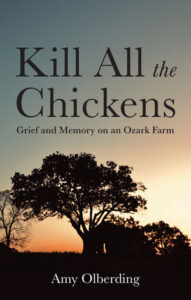
Kill All the Chickens, by Amy Olberding is published by Polity Books.
