
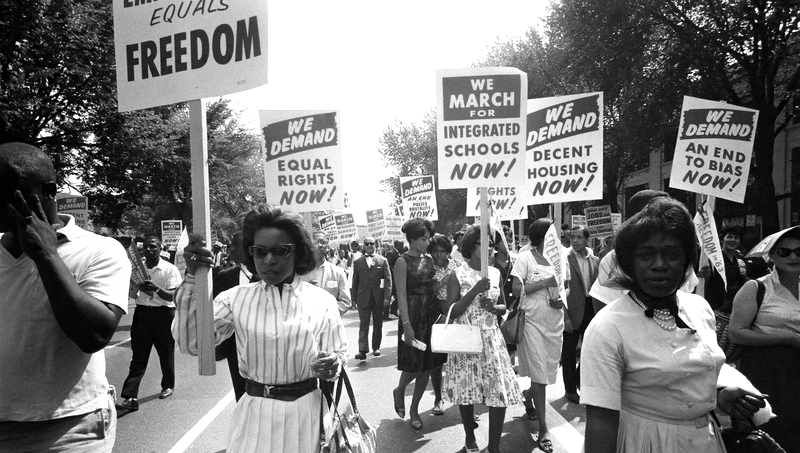
Even though the Civil Rights Movement of the 1950s and 1960s is widely acknowledged in American memory, many people still know little about the decades that came before it. And while figures like Martin Luther King, Jr. and Malcolm X, among a handful of others, are celebrated as heroes, the women who resisted Jim Crow often disappear from the record, leaving countless Southern Black and white heroines unsung. Long before organized boycotts and large-scale marches, these women forged local networks, built organizations with millions of members, and devised plans to dismantle the legal structures that upheld white supremacy. They came from fields as diverse as the arts, law, activism, and education, laying the groundwork for the era that later textbooks discuss.
From Mary McLeod Bethune, Mary Church Terrell, Jesse Ames Daniels, and Pauli Murray to Ida B. Wells, Septima Clark, Audley Moore, and Lillian Smith, women were some of the foremost engines of direct action in the post-World War II era. Intentionally collaborating across racial and class boundaries, these organizers helped to create and sustain groups like the National Association for the Advancement of Colored People (NAACP) and the pacifist Congress of Racial Equality (CORE), and they made notable gains for labor and economic improvements in the region.
As I learned first-hand while writing my biography of Lillian Smith—one of these overlooked women—expanding our view of the post-Depression South reveals the true origins of the long civil rights movement. This chapter of American history reminds us that the struggle for justice is lengthy and often painful, yet small, steady advances can ultimately transform the world. And women have played a significant role for many decades.
*
Patricia Bell-Scott, The Firebrand and the First Lady: Portrait of a Friendship. Pauli Murray, Eleanor Roosevelt, and the Struggle for Social Justice
Patricia Bell-Scott’s 2016 dual biography investigates a long, occasionally turbulent, twenty-five-year friendship between First Lady Eleanor Roosevelt and writer-scholar-activist Pauli Murray. Through letters, diaries, and journals, Bell-Scott illustrates how their intellectual partnership flourished. Roosevelt’s aristocratic upbringing, coupled with ties to her husband’s political circle, created frictions, while Murray continually urged the First Lady to champion the causes of Black Americans and other oppressed groups. From labor struggles and lynching to desegregation, Murray acted as the ethical voice guiding Roosevelt to wield her influential position for just causes. The Firebrand and the First Lady demonstrates that the early civil rights movement rested on deeply intricate, long-standing relationships that crossed both racial and class divides.
Jacqueline Dowd Hall, Revolt Against Chivalry: Jessie Daniel Ames and the Women’s Campaign Against Lynching
First published in 1979, Revolt Against Chivalry challenged long-held ideas about upper- and upper-middle-class white Southern women during the Jim Crow era. Linking suffrage to early civil rights action, Dowd Hall demonstrates how a substantial network of churchgoing white women rose up against the white patriarchy and contributed to the decline of lynching in the South. Led by the Texan businesswoman Jesse Daniel Ames and initially rooted in Atlanta, the Association of Southern Women for the Prevention of Lynching (ASWPL) reached four million members by the early 1940s. Ames propelled expansion by leveraging already established organizations: Methodist and Baptist church groups. Dowd Hall shows how the ASWPL punctured the myth of white Southern chivalry, arguing that lynchings could not be justified by claims of protecting white female honor. They asserted that they did not need white men to defend their virtue, stripping lynch mobs of any moral legitimacy. These women pressed local judges and sheriffs and would even gather at courthouses, shielding prospective lynching victims with their own bodies.
John Egerton, Speak Now Against the Day: The Generation Before the Civil Rights Movement in the South
Speak Now Against the Day argues that the decade spanning 1938 to 1948 represented a missed opportunity in the South, when a cross-racial coalition of Southern liberals attempted—yet failed—to dismantle Jim Crow. Winner of the Robert F. Kennedy Book Award, John Egerton chronicles the radical partnership between Black and white Southerners from diverse backgrounds and classes. He points to World War II as the onset of a more radical era, with Black soldiers returning home fueling a burgeoning Southern labor movement and a surge of organized efforts, especially through the Southern Conference for Human Welfare (SCHW). Even with considerable progress, white supremacist backlash, including the emergence of the Dixiecrats, eventually stymied the movement. Yet, Egerton emphasizes that the gains of the 1950s and 1960s rested on the groundwork laid by this earlier generation of activists.
Ashley Farmer, Queen Mother: Black Nationalism, Reparations, and the Untold Story of Audley Moore
Ashley Farmer’s carefully researched new biography sets out to challenge the male-centric narrative of the Civil Rights Movement. Born in 1898 in New Iberia, Louisiana, Audley Moore rose to prominence as a pivotal Black nationalist and civil rights activist—yet most Americans remain unfamiliar with her. Moore’s mother died when she was six, leaving her in the care of a grandmother who had been born during slavery. While helping raise her two younger sisters, Moore became politically active in her teens, and by 1920 she had aligned with Marcus Garvey. Although she harbored ambitions of moving to Africa, she and her family settled in Harlem, joined the Communist Party and the Civil Rights Congress, among many other organizations. Over a long life devoted to reparations, Audley “Queen Mother” Moore worked tirelessly for Black Americans, Africans, and particularly Black women. Using government surveillance files, community records, and family interviews (Moore passed away at 98 in 1997), Farmer interweaves Moore’s life with the broader Black nationalist movement and the longer civil rights struggle, highlighting its complexity and slow evolution.
Barbara Ransby, Eslanda: The Large and Unconventional Life of Mrs. Paul Robeson
For far too long Eslanda “Essie” Goode Robeson was defined primarily as Paul Robeson’s wife. Barbara Ransby sets the historical record straight. Born in Washington, DC, in 1895 to a distinguished family, Eslanda earned a Columbia University education and became the first Black head histological chemist at New York Presbyterian. She married Paul in 1921 and subsequently paused her science career four years later to manage his career. Eslanda introduced Paul to acting and spent much of the 1920s traveling across Europe. Paul’s numerous infidelities strained the marriage, yet they remained together for life. Ransby traces Eslanda’s later work as an anthropologist, showing how her research intersected with her politics, spanning pan-Africanism and anti-colonialism to feminism, linking Black American equality to anti-colonial struggles in Asia and Africa. Targeted during McCarthyism, both Robesons had their passports revoked for five years. Eslanda continued working until her death from breast cancer in 1965 and stood as a central figure in the early civil rights movement.
______________________________
An Inconvenient Woman: The Extraordinary Life of Lillian Smith, the Southerner Who Defied Jim Crow America by Keri Leigh Merritt is available from St. Martin’s Press, an imprint of St. Martin’s Publishing Group, a division of Macmillan.