
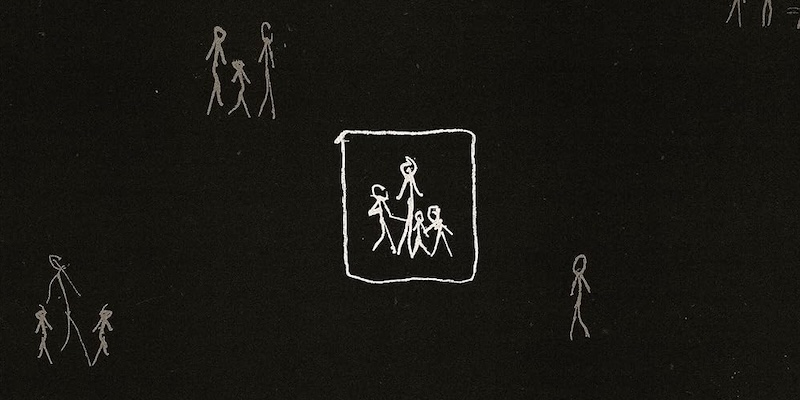
When NAZA‘s chilling final frame turned black and the sound of moviegoers crying became audible, I experienced something I have never experienced in a movie theater in my life.
Nobody in the sold-out screening got up. Not a single person.
The entire audience sat, without speaking, through the credits. The only sounds were muffled sobs.
And then, wordlessly, the entire Brooklyn audience rose from their seats and left the cinema in total silence.
NAZA is an unusual film with a provocative premise: co-directors Yuval Abraham and Rachel Szor (No Other Land) conducted interviews with 24 current and former members of the Israeli military about how the IDF killed roughly one in thirty Gazans over the past three years. (To date, at least 75,000 people have perished in Gaza since October 7th, most of whom—per Israel’s own admission—were civilian men, women, and children.) All 24 had served in Israeli military intelligence and offered stark, often shocking testimonies of war crimes. While the title may evoke a mash-up of “Nazi” and “Gaza,” a “NAZA” is actually a unit of collateral damage—a civilian killed while attempting to neutralize a Hamas operative. Each Palestinian death in an Israeli airstrike is tallied as “one NAZA,” ranging from a day-old infant to a 92-year-old elder.
NAZA is a cold, calculating term. It achieves a form of dehumanization quite distinct from equating a stigmatized group with vermin or pests (as the Nazis did with Jewish people). Rather, NAZA echoes the logic in Errol Morris’s The Fog of War, where Robert McNamara described applying industrial assembly-line thinking to the orchestration of mass slaughter in Southeast Asia. The aim of the term NAZA isn’t to reduce Palestinians to animals, but to render the killings as numbers—so removed, so digitized—that they seem beyond scrutiny. (In fact, one participant notes that the people who operate the remote strikes often feel as if they’re playing a video game, much like Buster Bluth during drone missions on Arrested Development.) The figure of 15 NAZA per strike was once acceptable, but after October 7th it climbed to 50, then 100, and at times even 500. Most speakers, though not all, appear to show little remorse or personal accountability; akin to Eichmann at his Jerusalem trial, many insist they were merely following orders. They blame the NAZA for not evacuating, or for loving a “terrorist” husband, or for being children fated to become terrorists, or simply for having bad luck.
NAZA presents something far more sinister than Israelis who feel guilt for killing people: Israelis who don’t seem to feel remorse at all.
NAZA’s premise instantly raises two questions, the first being: is there a moral justification for a Gaza-focused film created by two Israeli filmmakers? (In the press notes, the directors state they “took on this project out of a duty to use our position as Israeli filmmakers and journalists to examine the systems behind the mass killing of Palestinian civilians for which our country bears responsibility.”) I carried preconceptions on this point after reading comments from Palestinian writers I deeply respect, who understandably wondered why the world should care about what Israeli filmmakers have to say about Gaza, especially those who have spent the last three years conducting operations from behind the Iron Dome. After Palestinian witnesses have been shouting about the events since 2023. After nearly 300 Palestinian journalists have been killed. Such concerns are legitimate—and I would never fault a Palestinian for feeling them.
Nevertheless, even while acknowledging that resistance to NAZA’s premise was reasonable, I value that the film exists. It centers on Israeli soldiers, yet it doesn’t prompt viewers to empathize with them. Unlike Waltz with Bashir (2008) or Lebanon (2009), the narration in NAZA avoids the trap described by Gil Hochberg as “shooting and crying” (yorim ve bochim). Hochberg noted that those films amounted to “non-apologetic apologies.” NAZA instead reveals something far more unsettling: Israelis who appear untroubled by their actions rather than wracked by guilt.
It isn’t simply inaccurate to claim NAZA omits Palestinian voices; it’s also not entirely true. A Palestinian voice does emerge in the film’s closing moments, and that moment moved many viewers to tears, including me. Yet the bulk of the film concentrates on the perpetrators rather than the victims. Eichmann In Jerusalem or The Zone of Interest aren’t about Jews; they’re about the Nazis who killed them. NAZA, in the same spirit, isn’t about Palestinians but about the Israelis who kill them. As the directors explain, NAZA concentrates not on sporadic war crimes committed by rogue soldiers who disobeyed orders but on the orders themselves, the policies, the accepted practices, the language and logic that enable those practices, and the people who operate within them—the system and its cogs.
In terms of facts, little in NAZA surprised me. Even so, I found the film hypnotic.
NAZA also faces another hurdle. Despite concerted efforts by Zionist politicians and legacy media, the Gaza catastrophe has remained one of the era’s defining stories. Would NAZA offer anything genuinely new? The screening drew audiences adorned with keffiyehs, and many attendees appeared well-versed in Gaza’s news. Would these viewers find NAZA dull or self-indulgent?
In its compact 80-minute frame, NAZA answers that question with a definite yes. The film uses title cards to mark distinct segments—“Lavender” (an “AI” system used to kill in Gaza) or “Daddy’s Home” (a program that listens to family members of Hamas operatives and, upon the father’s return, kills them all). When these cards flashed, I not only recognized them but also recalled the original reporting the co-director Abraham had detailed in +972 Magazine and The Guardian. In terms of factual content, little in NAZA surprised me. Yet I remained captivated by the experience. It was nauseating, but informative, to hear how those who killed in anonymity and with impunity carried out their acts.
From a visual standpoint, NAZA is a striking piece of cinema, even as it disturbs. Abraham conducts interviews with the perpetrators atop Tel Aviv’s rooftops in late 2023, not long after the onslaught began. Szor’s cinematography haunts and seduces: she frames her partner in a clean, half-lit silhouette, while those being interviewed appear as nearly pitch-black silhouettes. In fact, at the film’s outset, it’s revealed that all interviewees’ voices and faces have been digitally altered. (It’s a disquieting technique, which left me queasy as I wondered whether AI—an engine behind the Gaza catastrophe—had been used to shield the criminals’ identities.)
NAZA revolves around surveillance. The speakers discuss listening in on Palestinians using avant-garde tools, yet—as historical footage demonstrates—high-tech espionage against Gaza has a long history, dating back to the first telephone lines. Beyond what the speakers say, Szor’s imagery intensifies the unease: towering high-rises, their windows framing the resting bodies of Tel Aviv residents, looming above occupied Palestine. A building under construction reaches seventy floors, a stark counterpoint to Gaza’s urban devastation, which the interviewees describe flattening with unsettling calm.
I watched NAZA beside the filmmaker Adam Baran, and it brought to mind his acclaimed 2021 short Trade Center. Baran’s piece, drawing on Billy Miller’s essay in Petite Mort: Recollections of a Queer Public, layers five men’s voices about sex and desire within the old World Trade Center while Baran’s camera surveys the new building in stark, dystopian clarity. We glimpse Calatrava’s white Oculus, pristine boutiques, and omnipresent security cameras, yet we see none of the bodies or faces the narrators describe. In Trade Center, the visuals feel as antiseptic as the audio is lurid—much as Jonathan Glazer’s 2023 film The Zone of Interest juxtaposes a gleaming corporate life on one side of Auschwitz’s walls with the executions happening on the other. A different cinematic dialogue unfolds across the soundscape and images of NAZA (though this balance shifts notably in the final moments of the concluding chapter).
What is the ethical responsibility here? Does journalistic duty trump the moral imperative to bring these people to justice?
Leaving the NAZA screening in near-total hush, I found myself mulling over the moral implications of how far the filmmakers went to safeguard their sources’ identities.
Abraham and Szor interrogate “the system and its cogs” with precision. But when it comes to “the people who operate within them” who carry out the killings, they mute voices, mask appearances, and even blur handwriting. As a journalist, I rarely quote anonymously, yet I grasp the impulse to shield the people who entrust you with their narratives. In this instance, however, the anonymous speakers are the very perpetrators of perhaps the greatest mass atrocity in living memory. They’ve confessed to crimes against humanity. To reducing apartments full of young children to rubble. To hacking a little girl’s phone so that they could strike her family as soon as she called out “Daddy’s home.”
What is the ethical duty here? Does reporting obligation take precedence over the moral imperative to see these people held to account? As I recently wrote about Akbar Ahmed Shahid’s book Crossing the Red Line, it’s essential for journalists to do the difficult work of speaking with officials in the U.S. State Department or the Israeli military—but that duty does not absolve action, either during or after. The NAZA filmmakers are barely into their thirties; if they exposed their subjects, they would likely lose the ability to interview anyone again. Their careers could end, but 24 mass murderers would stand before the Hague. There are many who would regard that as a fair exchange.
Yet, on the other hand, NAZA achieves what strong documentary art aspires to: it unsettles you. Not merely about the filmmakers’ ethics or about the ongoing freedom of those depicted, but also about your own stance. All of us who have allowed the Palestinian catastrophe to persist share some guilt. American and European taxpayers whose funds help finance weaponry? Complicit. Students whose tuition aids bullets? Complicit. Professors whose research is financed by the so‑called philanthropy of warmongers? Complicit. Filmmakers who live relatively safely while their subjects suffer? Complicit.
NAZA is a film about Palestinians, but not for them. Palestinians, whether in Gaza, the West Bank, or the diaspora, do not need this movie—they are living it daily. This is a piece aimed at the rest of us who must confront the architects and accomplices of the violence. It is for our examination that NAZA matters. Even as it allows some of the culpable to evade immediate accountability, NAZA preserves confessions of these crimes for the record. And for those who bear the responsibility of ending the conflict and ensuring that “never again” is more than a slogan, it could prove a valuable instrument.
For, as James Baldwin observed, “Not everything that is faced can be changed, but nothing can be changed until it is faced.”
