

There is nothing writers love more than talking about how hard it is to write. Stephen King described the writing process as “like crossing the Atlantic Ocean in a bathtub.” Sportswriter Red Smith, in a quote often erroneously attributed to Ernest Hemingway, compared it to sitting down at a typewriter and bleeding. Gwendolyn Brooks: “Delicious agony.” George Orwell: “Like a long bout of some painful illness.”
That is also what it feels like to watch the Buffalo Bills.
Like most Bills fans, I was born into this servitude with no real escape hatch. There exists a photograph of my father, donned in Bills gear, cradling me as a newborn; just outside the frame sits the Miller Lite cooler he’d brought to the hospital so we could watch the Bills on the room’s television. It was Western New York in the very late eighties. The Bills boasted Jim Kelly, Thurman Thomas, and Bruce Smith and were about to begin a run that would end in four straight appearances in the Super Bowl; it was a period when bringing beer to the hospital was the norm.
But here is where being a Bills fan works to my advantage: who cares about humiliation!
But the hospital beers couldn’t endure. Those four consecutive Super Bowl trips became four straight losses, a milestone never before achieved in the NFL and one that hasn’t been matched since. The Bills belong to history’s most infamous losers—loud and unrepentant about it. Their seventeen-season playoff drought ranks among the league’s longest, spanning my middle school, high school, and college years, and most of my early adulthood. My earliest vivid football memory is the Bills’ playoff collapse in the Music City Miracle, when Tennessee’s kickoff return for a touchdown in the final moments—with a controversial lateral—snatched away the game in fifth grade. The team wouldn’t make the playoffs again until 2017, and wouldn’t win another postseason game until 2020, when I was past thirty and living with my parents during the Covid-19 lockdown.
The Bills may have posted more wins in the last six seasons than any other franchise, yet the stench of defeat clings to them with the persistence of a stubborn barroom smear. They have been blamed for both the Oklahoma City bombing and the presidency of Donald Trump. Bills safety Damar Hamlin collapsed on the field during a 2022 game, medically dying for a moment before being revived. Just weeks ago, the Atlantic ran a piece calling the Buffalo Bills “The Most Cursed Team in American Sports.”
With a devotion like that, it’s no wonder I became a writer. Before I had any idea how to craft a sentence, I understood the inescapable ache of a particular kind of suffering: pouring your heart into something beyond your control and letting it have the last word in your life. A critic, a cataclysmically tight publishing market, a hostile defense with a negative DV0A—none of it matters. If you want to participate, you must be ready to endure pain. That’s the bargain.
To write requires a certain tolerance for humiliation and disappointment. Bills fans know humiliation well, and perhaps that’s why we, in a poet’s mood, christened ourselves Bills Mafia and even named many of the team’s misfortunes—the minor heartbreaks like the Hail Murray and the Twelve Men, and the crushing misfortunes—Wide Right, the Music City Miracle, and the one that struck me most, Thirteen Seconds. Watching Josh Allen, my beloved, bumbling favorite, stand aside as his team squandered a late lead with thirteen seconds to go in the 2022 divisional playoff felt like a perpetual kick to the head from a horse over and over.
Well, that’s a lot like publishing a book.
Writing a manuscript is a joy. Even the rough patches—the writer’s block, the awkward sentences that need decontamination-level edits—almost always feel better than the best days of most desk jobs. If you’ve ever, even briefly, wrestled with a spreadsheet while the pinging of Microsoft Teams echoes in the background, you know the blessed hush of an empty page. You are perusing this essay on lit hub dot com; you already understand the quiet bliss of finishing a sentence you love and savoring it on a reread, of voicing your truth and approving of your own phrasing. You don’t need me to persuade you.
But to publish a book is a different ordeal. Countless humiliations await: the ceaseless rejections, the endless silences that so easily become a rejection in disguise, the perpetual comparisons of your advance and sales to someone else’s, the attempts to compress an entire novel into a neat snack-size clip for social media, ideally narrated in a talking-head video. You may begin publication day without a single endorsement, or you might encounter a one-star review from someone who thought the “trial” in your title referred to deadly trials like ACOTAR.
But here is where being a Bills fan helps me again: who cares about humiliation! I know exactly what it feels like to be diminished and small. I studied in Massachusetts during the peak of the Tom Brady-era Patriots and the nadir of the Bills’ drought. I was the butt of strangers’ jokes while downing Rubinoff vodka from an unmarked cup in a freshman dorm room for wearing Bills gear—it was about as low as it gets. I know the deal I struck with myself.
I know all about being embarrassed and feeling small.
I have already mastered the art of the lost cause; I’m the Wagner of the lost cause. I was forced into optimism, believing that a better world lay ahead—that the playoff drought would end, then the AFC Championship drought, and finally the Super Bowl drought. There was no alternative. And I knew I had to shout about it.
I dedicated a great deal of thought to optimism as I crafted this book. The central figure, Magdalena Overmorrow, is a scholar and healer who secretly serves as the city’s sole abortion provider. She begins the story behind bars, and by its end stands on trial for her life. For much of the journey, she’s not enjoying much of anything. Yet no matter the predicament I placed her in, no matter how much I attempted to break her spirit, I could not stop writing her as an optimist.
I didn’t set out to write a hopeful protagonist. The late-2016 world wasn’t fertile ground for hope, and the reproductive rights landscape has only grown more brutal in the last decade. Abortion providers have long faced violence in the United States. As a child, I watched Barnett Slepian fall to gunfire in his kitchen, not far from where I grew up. In the post-Roe era, at least two abortion providers in the U.S. are currently fighting extradition to states where abortion is illegal for prescribing medications, and a recent report estimates that more than 900 women have faced charges related to pregnancy loss since Roe v. Wade was overturned. Several women have died after being denied life-saving abortions because hospitals feared legal repercussions.
The day Roe was officially overturned, I joined a protest in Union Square. It formed part of a larger rally that began in Washington Square Park, then moved north to union and midtown. The crowd wore a heavy, exhausted mood—angry, but quiet. Some older marchers had fought for abortion rights long before Roe, and they vowed to march again. I could not summon any real hope that day. The faintest glimmer of hope came as a stubborn, grim resolve.
I remembered my time as an abortion clinic escort—an exhausting stint I lasted through for less than a year. I have endured many hard experiences by convincing myself that I can mine them for writing, but the hours spent guiding patients past anti-choice protesters in Queens, as they shouted and followed people to the parking lot, attempting to film or harass them to tears, killed any remaining curiosity about the inner lives of anti-choicers. Empathy for them evaporated entirely.
All those emotions surged back at the protest—the impotent rage, the despair, the deep contempt for those who put us in this mess. Yet when I looked at the women beside me, faces weathered but steady, I realized that sometimes a stubborn, grim resolve is enough. Sometimes, that is what hope looks like.
In the novel, Magda’s hope shows up as a persistent openness to the world around her—the people who share her exile and the strangers who cross her path. She could have withdrawn, letting the weight of her persecution close her off, but instead she chooses to live with a sense of dignity, and by doing so, she constructs a life that dignifies her beyond the reach of her oppressors. She builds friendships. She falls in love. When others come to her for help, she lends a hand even if it might jeopardize her standing, because she believes her way of living can and will birth the brighter future she longs for. Despair does catch up with her, the night before she is slated to be executed, but the hope she nurtured grants her extra time and resilience during that period.
I think of it as a series of delusional inoculations against hopelessness, each one increasing in strength and intensity.
Yet optimism isn’t always comfortable. No one enjoys looking foolish, or having it rubbed in their face that they were mistaken about the basic decency of the world, or about a fairness that might not exist, whether from divine or karmic forces or even an NFL sky judge (yes, it actually exists). But those who choose to believe better things are possible, and who stubbornly act on that belief, may be the only people who truly matter.
Getting out of bed in the morning requires a certain measure of naive trust in the unlikely. Writing a book is, at heart, a delusional act—it’s hard to conjure something from nothing, and even harder to persuade someone else to pay for it. It’s difficult to believe a team can win a championship it has never won, never even reached the final in more than thirty years. It’s hard to believe that a loosely connected group of activists, medical professionals, and policy-makers can restore reproductive rights in an era dominated by Trumpism and the manosphere’s wealth.
But I’d argue that it’s hard to begin with the grand impossibilities (that a government can recognize the humanity of half its population) without first practicing belief in the smaller possibilities (that the Bills can reach a Super Bowl and that I can write and publish a novel). I view it as a chain of delusional inoculations against hopelessness, each dose stronger than the last.
My best friend and I share a tradition: every season one of us buys two Bills-themed candles, one for each of us, and we light them with the seriousness of clergy before kickoff. Over time, the candles have grown more desperate. The first batch wore jaunty red and blue buffalo shapes that claimed they smelled like “a Bills victory.” Then arrived the Josh Allen prayer candles. This season’s candle, emblazoned in blue, red, and white, declares, This Has Got to Be the Season, So Help Me God. So far, so good: the Bills have started 7-1. And so, so far, so good for my writing career as well: my debut novel lands this week. And if the landslide the Democrats delivered to the Republicans in the midterms doesn’t stir even a morsel of hope inside you, nothing will.
And if this year isn’t the year? I’ll still be here. It’s the only option left.
There’s always next year.
__________________________________
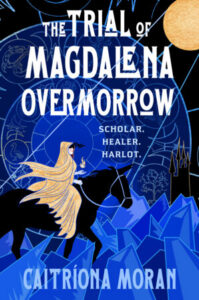
The Trial of Magdalena Overmorrow by Caitríona Moran is available from G.P. Putnam’s Sons.
