
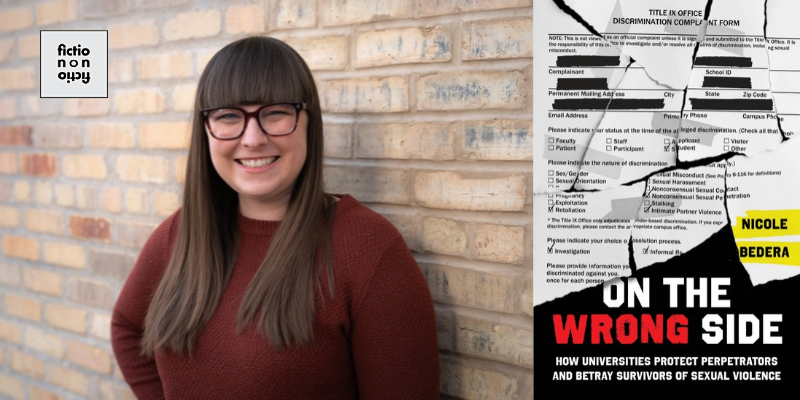
Sociologist Nicole Bedera joins co-hosts V.V Ganeshananthan and Whitney Terrell to talk about the Cornell 7 and her book, On the Wrong Side: How Universites Protect Perpetrators and Betray Survivors of Sexual Violence. She explains how the Cornell case, in which a student said she was gang-raped at a fraternity party at the Ivy League institution, falls into a long tradition of universities mishandling reports of sexual violence. Bedera describes the history of Title IX, which forbids discrimination on the basis of sex, and pinpoints how sexual violence came to fall under its framework. She considers how Title IX’s effectiveness has fluctuated since its establishment in 1972, and especially under the Trump administration, which during its first stint shifted regulations in a way that made it easier for universities to avoid accountability. Bedera discusses what universities stand to gain from improper handling of sexual violence cases and why administrators insist on referring to such cases as isolated, rather than representing systemic problems. She also addresses common misconceptions about sexual violence and Title IX investigations. Bedera reflects on her time as a victim advocate, using her experience to conduct fieldwork at an anonymized Title IX office, and how Title IX could be reimagined as a state agency to be more effective. She reads from On the Wrong Side.
To hear the full episode, subscribe through iTunes, Google Play, Stitcher, Spotify, or your favorite podcast app (include the forward slashes when searching). You can also listen by streaming from the player below. Check out video versions of our interviews on the Fiction/Non/Fiction Instagram account, the Fiction/Non/Fiction YouTube Channel, and our show website: https://www.fnfpodcast.net/ This podcast is produced by V.V. Ganeshananthan, Whitney Terrell, Emily Farris, and Sydney Perkins.
Nicole Bedera
On the Wrong Side: How Universities Protect Perpatrators and Betray Survivors of Sexual Violence • “A New Title IX Rule Essentially Allows Accused Sexual Assailants to Hide Evidence Against Them”
Others
Jane Doe says she did not feel supported by Cornell’s president.
EXCERPT FROM A CONVERSATION WITH NICOLE BEDERA
V. V. Ganeshananthan: We want to begin by discussing the case that has become known as the Cornell 7. It’s drawn substantial attention, partly because no one accused has been charged criminally, and because the institutions involved have issued little in the way of real sanctions. I’m also noting how this story echoes in conversations at other campuses, like the University of Chicago, which has gained momentum in the wake of the Cornell case.
In the opening section of On the Wrong Side, you describe how women who report assault encounter Title IX officers who tell them there’s nothing to be done. The paperwork is shuffled, and they’re discouraged from filing complaints; do you think the attention on Cornell can shift the landscape? Is this a typical scenario or an outlier? Could it be a turning point?
Nicole Bedera: It ought to be transformative, but that depends on collective will. This situation is, in many ways, representative of a university response—behind closed doors, administrators defend their processes, insisting that they performed well. I say this partly because the same dynamic emerged during a period when Cornell faced intense scrutiny after a public campus tragedy—the year a woman was killed on campus, among other violent incidents that drew local alarm.
When I spoke with administrators and asked whether they considered changes in light of that fatal event, their reply was that the process was fine. They even blamed the victim, suggesting that if only she had navigated the system differently, everything would have worked out. That tendency—to view the fault as lying with the survivor—has been a recurring pattern across institutions. Cornell’s stance, echoed by police and the district attorney’s office, reflected the same sentiment: if Jane Doe had reported more effectively, the outcome would have been different. That narrative is precisely what we should challenge.
As to whether this is typical, I’d say it is in many respects. What’s unusual here is that Jane Doe actually completed the Title IX process; many survivors don’t finish because the investigation is too discouraging or disrupts their education too severely. That persistence is what makes this case stand out. Yet beyond that, the way Cornell responded is something I could imagine happening at many schools. A number of readers have told me, “This sounds like my campus,” even though I never studied there directly. The broader pattern is strikingly widespread.
Whitney Terrell: We’ll be centering Title IX in this discussion because it serves as the core framework through which universities address sexual discrimination and violence on campuses. The law was enacted in 1972, and you note that in 1980, in Alexander v. Yale, sexual violence was recognized as a form of sexual discrimination—placing it squarely under Title IX. Could you give our listeners a concise background on how Title IX came to be the scaffolding for addressing campus sexual violence as we move forward?
NB: Title IX is part of the broader Civil Rights Act, one of the educational amendments to that law. At the time, schools discriminated on the basis of gender and race. The statute itself is a single sentence, declaring that institutions may not discriminate on sex. The specifics of enforcement, what counts as compliance, and how to measure it had to be determined via regulations or court decisions. In shaping Title IX and the framing of sexual violence as sex discrimination, the pivotal moment was the 1980 Alexander v. Yale case. It established that widespread sexual violence on campus could impair a student’s ability to participate fully in education, not just through direct harm but through the pervasive climate of fear and avoidance that followed. Women who hadn’t even experienced violence still faced a compromised educational environment because they were forced to navigate fear, avoid late classes, and skip opportunities like office hours for fear of danger.
Under Title IX, the lens is systemic rather than criminal: as long as a school’s environment disadvantages women, it constitutes discrimination. For years, many institutions resisted this shift, partly because enforcement mechanisms were unclear and weak. Initially, gender integration was resisted, and some colleges remained male-only or hesitant about fully embracing Title IX. It wasn’t until around 2001 that a president acknowledged that Title IX required schools to respond and provide avenues for reporting sex discrimination—yet many institutions still fell short. The repetition of “you must fix this” would surface in official communications, but meaningful changes lagged behind the rhetoric.
The Obama era marked a turning point when the Department of Education began investigating universities to ensure they provided the essentials required by the courts and Title IX regulations. This shift punctured the aura of compliance among many schools, especially as several prestigious institutions found themselves under scrutiny. The era also highlighted the distance between outward appearances of compliance and the lived experiences of survivors. The Jane Doe case at Cornell epitomizes this tension: the external mechanisms may look robust, yet the internal experience of people who have endured sexual violence can reveal a very different reality.
I observed, through my fieldwork, that universities constructed elaborate apparatuses designed to demonstrate compliance with Title IX, creating a façade that masked ongoing discrimination from the outside. The contrast with how survivors experience the process—from the moment they come forward through the investigation—was stark. The system can appear orderly and professional in public, while internally it remains fraught and inconsistent for those who seek justice.
VVG:One of the most striking elements you discuss is the rationale for having internal disciplinary processes within universities and the broader aims of a university justice system. The prevailing argument is that universities must act quickly to prevent discrimination from shaping students’ educational experiences, and thus avoid sending cases straight to criminal courts. People often ask why a campus doesn’t rely on the criminal system, and your explanation makes the case for internal mechanisms clearer. Jane Doe’s lawsuit against Cornell—alleging the school failed to stop her assault and noting that some perpetrators were merely assigned to write essays—has become a focal point. You also highlight Betsy DeVos’s actions in the early Trump years, which shifted the landscape in ways that made accountability harder to enforce. To many, this seems as momentous as the initial Title IX revision itself. Could you explain what changed and how it contributed to cases like Cornell becoming more feasible?
NB: My answer evolves with time. A few years ago, I would have focused on the regulation changes under the Trump administration as the primary force shaping things. At that point, many experts, myself included, argued that the new rules would deter victims from coming forward, complicate investigations, and shield perpetrators. I even wrote about a provision allowing accused students to scrub confessions from evidence merely by skipping a hearing. In practice, though, the effects proved more consequential than the text alone suggested. Even before the rules were in effect, many colleges anticipated the changes and started adapting—often taking minimal steps to adjust—and once enforcement waned, more extreme practices emerged. It wasn’t just the formal regulation; it was the broader atmosphere of diminished scrutiny. The real issue isn’t simply Trump’s policies; it’s that institutions have engaged in discrimination for a long time, and having a sympathetic political ally in the White House only amplified what they were already doing. As a result, some campuses have pushed protections for due process and fairness into a corner, evoking a halting interpretation of Title IX that favors the accused and, in some cases, privileges the perpetrators. In other words, this isn’t solely about regulatory shifts; it’s about long-standing patterns of discrimination that have found an easier conduit under these political winds.
Transcribed by Otter.ai. Condensed and edited by AJ Abernathy, Sienna Hoopingarner, and Grace Workman.
