
I like my fiction the way I like my reality TV: full of rich people behaving badly, all of whom are one wrong move away from total exposure. Fortunately for me, Rich People Behaving Badly is a whole supergenre—spanning thrillers, romance, literary fiction. I find this a little surprising, given the ultra-rich aren’t enjoying peak popularity (have they ever?). So why do we keep coming back to RPBB?
It’s not the vicarious thrill of peeking into a secret world, because we are only clicks away from access. I can track Taylor Swift’s jet crossing the Atlantic in real time, and if I want a proper look behind the pearly gates of wealth, there’s an entire economy of maybe-centimillionaires on TikTok who apparently have nothing better to do than walk me through their closets. Whatever else is scarce right now, access is not.
Scrolling is contact without consequence; the novel puts you in the room, where a wrong move gets you escorted out. Which raises the real question: what does that kind of wealth cost?
This is why the protagonist is almost never the rich person; it’s the guest. Nick Carraway, renting the small house next door. Rachel Chu. Tom and Cousin Greg. Suspense isn’t caused by the size of the estate; it’s not knowing which fork to use.
That’s the book I wanted to write. The Rally sends an ousted entrepreneur on a two-week trip across Europe with people for whom the entry fee is a rounding error. She has the invitation—not the money. The credentials—not the standing. And every mile is a chance for her to be exposed as someone who doesn’t belong—which, conveniently, is also how it feels to be pushed out of something you built.
These are the books that taught me how that anxiety works on the page, the definitive starter pack of Rich People Behaving Badly.
*
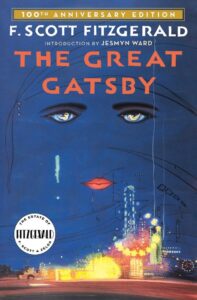
The Great Gatsby, F. Scott Fitzgerald
The O.G., Tom and Daisy are the original rich people behaving badly (literally: they “smashed up things”). Fitzgerald draws the whole class map into the geography—East Egg, where the old money summers, and West Egg across the bay, where Gatsby’s new fortune buys a mansion but never quite buys in. Fitzgerald gives us both halves of the guest position at once: Nick Carraway, Yale-educated and tolerated, and Gatsby, fabulously wealthy and being investigated. The guests in Gatsby have just enough standing to be in the room and not nearly enough to survive it.
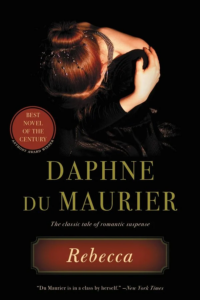
Rebecca, Daphne du Maurier
Three weeks ago she was a paid companion to a wealthy American bore in Monte Carlo. Now she’s the mistress of Manderley, unable to live up to the legacy of the first Mrs. de Winter. Du Maurier never gives her a first name; her whole identity is a position she’s borrowing. It’s the ultimate class-anxiety novel, dressed as a gothic romance: the wrong dress, the housekeeper’s flat politeness, the creeping certainty that the furniture is judging you and finding you common.
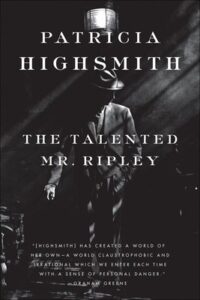
The Talented Mr. Ripley, Patricia Highsmith
The purest expression of the form, also to be enjoyed in the sublime film adaptation that clarified my life’s ambition to grow up and marry Jude Law. Tom Ripley is a small-time forger, hired by a shipbuilding magnate to go to Italy and retrieve his son, but the moment he sees Dickie Greenleaf’s life, he decides he’d rather have it than visit. Highsmith writes his class envy with total sensory precision: the rings, the shoes, the boredom of people who never have to convert money into anything. Read it, and you’ll notice how much of the anxiety is administrative—letters, signatures, hotel registers. Being found out, it turns out, is mostly a paperwork risk.

The Secret History, Donna Tartt
We’ve all encountered a version of the scholarship kid who fabricates a place among the elite, yet Tartt writes it so deftly you might believe she invented the premise. Richard Papen, a working-class student from California, yearns to belong with five well-endowed peers at Hampden College. We learn early that his desire to fit in will involve complicity in a murder, which frees the novel to probe something beyond a simple mystery: the ongoing price of sustaining a fabricated origin. Richard’s real dread isn’t the murder itself; no one has captured how intoxicating it is to be chosen by people who are worse than you.
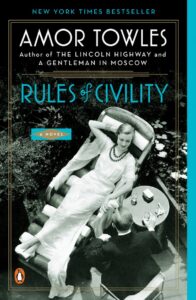
Rules of Civility, Amor Towles
A sharp-witted Brooklyn girl from a working-class immigrant background, stationed in a Wall Street typing pool, encounters a suave banker named Tinker Grey at a Greenwich Village jazz club on the final night of 1937. That chance meeting thrusts her into Manhattan's upper strata. What makes it more than a simple ascent tale is that Tinker turns out to be a guest too—his refined air is quietly sustained by a generous patron. The setting is the most vivid version of Manhattan in this list: a city that has always been the arena for newcomers, where everyone is arriving and reinventing themselves.
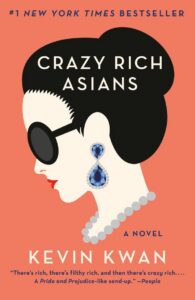
Crazy Rich Asians, Kevin Kwan
Pure joy, and it lands so convincingly that the book invites a sense of documentary realism. The footnotes reveal facts an outsider wouldn’t ordinarily access (such as mattresses that cost more than most people’s homes). Rachel Chu is an economics professor from a single-mother household who boards a flight to Singapore for her boyfriend’s wedding without being told that his family owns a substantial slice of the country. Kwan drives the guest-plot at full throttle and adds a twist: Rachel isn’t merely at risk of seeming unimpressive; she becomes the subject of a real inquiry because Nick’s mother hires someone to uncover a disqualifying secret.
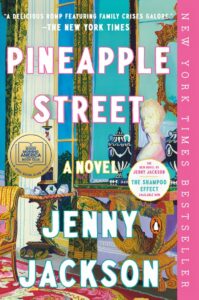
Pineapple Street, Jenny Jackson
The RPBB subgenre sits inside a very distinct microcosm. Jackson populates a clan of old-money Brooklyn Heights Stocktons, but the central figure is Sasha, the middle-class New Englander who marries in and is instantly and decisively branded as the arriviste. It reads like a breezy page-turner with a sharp eye for how wealth is transmitted through inheritance: tennis, trust funds, and the particular cruelty of people who have never had to consider money toward the one person in the room who does. Witty, incisive, and a revealing examination of money’s functioning within a family.
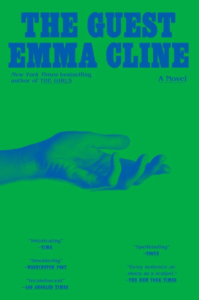
The Guest, Emma Cline
The Guest is the contemporary restatement, pared to its bones. Alex—age twenty-two, adrift, and casually tied to prosperous men—gets dumped by the older man she’s been staying with on Long Island’s East End. Instead of leaving, she spends a week wandering between other people’s pools, houses, and parties on borrowed plausibility, convinced she’ll be forgiven if she can merely endure until his Labor Day celebration. The entire book functions as a held breath, and you’ll keep turning pages to learn whether you ever get permission to exhale.
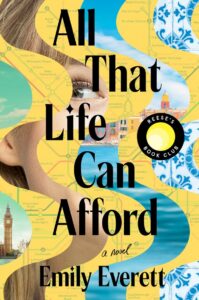
All That Life Can Afford, Emily Everett
The newest entry on this roster, and proof that the guest-centric narrative remains vibrant in Saint-Tropez. Anna grew up in the lower-middle-class ranks and imagined London through Jane Austen, but what she actually encounters is a moldy apartment and a paycheck-to-paycheck grind, until a wealthy family brings her south to tutor their teenage daughter. She is absorbed into a world where confidence is a birthright and no one ever has to ask what anything costs. Everett articulates the precise vertigo of this ascent: borrowed glamour, a formidable elder sister who sees through her, and two men—one who wants to fold her into a particular version of his world, the other who discerns exactly where she came from. A Cinderella tale that keeps its gaze fixed on the price of the slipper.
______________________________
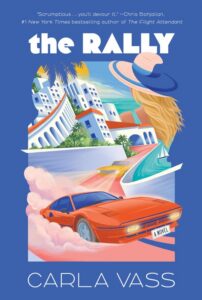
The Rally by Carla Vass is available from Union Square & Co., an imprint of Hachette Book Group.