

Bennie Bosley, the protagonist of my new queer YA holiday romance, Pining for You, is living for Christmas magic and Grand Gesture Romance the way Tiny Tim once did for that goose—and I love that for her. But I did worry those qualities would make her a pariah in an Antihero culture bought into the idea that cynicism and irony are key ingredients to complexity.
But while there are plenty of hills I can do without dying on, I’m happy to get comfortable up here on Mount Earnest and stand by my own beliefs—that sincerity doesn’t mean toothless storytelling; that a hopeful protagonist invites high drama and big questions; that refusing to be bitter or performative is a reason for readers to read on—and when they do, they’ll be rewarded.
Fortunately, I’m in good company up here, and on the shoulders of giants—not to mention a hobbit, a pro wrestler, and a robot. And the following books represent a rich range of literary earnestness.
*

Amor Towles, A Gentleman in Moscow
Earnestness as dignity.
We encounter Count Rostov as he begins a term of confinement. The sentence—immurement within the Metropol Hotel—appears designed to strip him of rank and luxuries, perhaps to coax him toward surrender. Yet he does not bend. Instead, he quietly chooses a form of defiance—to stay himself. He turns his room into a sanctuary for contemplation, a private citadel of thought. He continues to savor the rituals of meals and wine even when there is no audience to impress. Eventually, he embraces waiting tables with the same pride he once reserved for a cravat. By insisting on dignity for himself, he protects his own essence and extends that dignity to those around him. Across the decades we accompany the Count, his steadfast devotion to curiosity, civility, elegance, and beauty remains a sustaining force for him and for others.

Tayari Jones, Kin
Earnestness as grace.
Annie exudes earnestness in the face of repeated, profound personal devastation. Abandoned by her mother as a child, she spends her life possessed by the hope of finding her again. She doesn’t naively believe her mother is perfect; she’s driven instead by her determination to understand. And because she doesn’t have the means to avoid reality or live in some dream world, Annie’s decisions—to hold a place for the benefit of the doubt, to choose openness and curiosity, to seek the capacity for love in others along the way—is even more powerful. The grace she has adopted in her hopefulness regarding her mother is extended to others in her life as well: when Lulabelle is prickly and puts Annie off, Annie refuses to give up on her, too—and in the safety of her earnest grace, they loosen and lighten in subtle, heartrending ways.

Xochitl Gonzalez, Olga Dies Dreaming
Earnestness as authenticity.
At the outset of this tale Olga runs a high-end wedding-planning business that might signal success. Yet she soon discovers she longs for something more. As she interrogates this inner restlessness, she also questions the world around her, and a troubling throughline comes into focus: artifice. Wedding clients pretend to love rather than truly live it; her brother, a congressman, conceals his LGBTQ identity to make his politics more palatable; the gentrifiers in her neighborhood trumpet their changes as progress. The looming shadow is her mother’s abandonment, wrapped in righteous revolution. Across the journey, these realizations sharpen Olga’s true dreams—people who say what they mean and mean what they say.
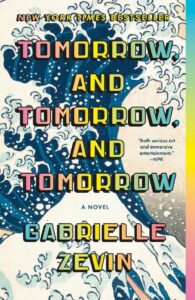
Gabrielle Zevin, Tomorrow, and Tomorrow, and Tomorrow
Earnestness as presence.
“Friendship…is kind of like having a Tamagotchi.” When a friend of Sam’s struggles with depression and he suspects she doesn’t want him nearby, Marx understands that he must transform his original advice—“It isn’t about you. Just show up every day to check in with her.”—into a code that Sam can interpret. Marx does show up every day, but he never treats his friends as if they were digital pets—there isn’t a one-size-fits-all approach in his toolkit. He recognizes what motivates or unsettles them, and meets them exactly where they are with precisely what they require. Marx isn’t the novel’s sole hero, yet his gift may be the strongest: the ability to amplify our protagonists by quietly slipping them the shortcuts they need to grow, then watching them level up.

Rufi Thorpe, Margo’s Got Money Troubles
Earnestness as a repeat performance.
A recovering addict, a professional wrestler, and a father who wasn’t present in her life for long, Jinx doesn’t begin to feel at home on Mount Earnest. Yet once he commits to being there, his resolve remains unwavering. And while his fatherly guidance may be unconventional (often wresting-themed), it lands because he speaks to Margo in a way that comes from constant presence rather than perfection. He consistently shows up in her corner, backing choices that would worry most dads. Jinx proves you don’t need money, flawless credentials, or a spotless past to be a dependable father and grandfather, and that even when the bell seems to ring for the last time, there’s still time to arrive.

Becky Chambers, A Psalm for the Wild-Built
Earnestness as being all-ears.
A blunt question starts this novel: “What do people need?” Across its pages, Becky Chambers poses existential questions like this and dares us to take a step further: listen. The dialogue between Dex and Mosscap shows that the route to understanding, compassion, and genuine connection isn’t simply curiosity about another’s life but feeling what they feel. When their talk ends, you too are moved to seek the marvel that comes from listening with more than your ears—listening with your heart.

J.R.R. Tolkien, The Lord of the Rings
Earnestness as extraordinary.
In tranquil times, Sam’s sincerity shows in quiet, modest acts: reverence for small pleasures (even the humble potato), an eye for the beauty of the world, and a dream rooted in Rosie’s affection. Yet when danger looms in the form of Orcs, those same traits morph him into a fearless guardian. His remarkable resilience against the One Ring arises from valuing simple joys over power. For Sam, friendship eclipses sovereignty, keeping promises outshines gold, and there is no grand kingdom beyond the one he calls home.

Ann Patchett, Whistler
Earnestness as devotion.
Queer narratives frequently celebrate families formed by choice. For many within the LGBTQ+ community, unconditional love can feel like a legend; meaningful bonds demand effort, care, and protection, and thus aren’t taken for granted. On the page, Daphne and Eddie’s bond may seem brief and lacking DNA or legal documents to certify it. After four decades apart, their history feels both ancient and current. Yet upon reuniting, Eddie introduces Daphne as his daughter with pride and without irony. He includes her in his life without questioning where she belongs. His affection is unpretentious. If time can affirm a connection that was true, then Eddie demonstrates a truth that transcends sexuality: devotion makes a family, not biology.

Patricia Highsmith, The Price of Salt
Earnestness as instinct.
Therese, in many respects, embodies earnestness (down to the way she’s portrayed in Rooney Mara’s film adaptation—her eyes widening beyond the rims of Carol’s martini glasses). When we first meet her, she seems utterly captivated by the world, as if nearly anything could spark her curiosity. Yet something inside Therese keeps her tracing the breadcrumbs Carol lays out. Her desires are intricate, almost mystical even to Therese herself, and she does not dismiss them. Curiously, she isn’t guided by hope—that would require knowing what she hopes for. Instead, her feelings tug at her, and she follows, trusting the pull without overthinking—until instinct becomes choice.
__________________________________

Pining For You by Stef Ferrari is available from Simon and Schuster’s Books for Young Readers.