
Pinpointing the exact origin of a manuscript is seldom something I can manage. Patricia Highsmith once observed that inspiration arrives “like birds in the corner of my eye.” Until recently, that description felt like an accurate sketch of my own creative process. An idea would surface, unsolicited, hovering at the edge of attention for months or even years, making it nearly impossible to focus on anything else. Worn down and strained, I would finally open my laptop and begin to write.
My latest work, Few and Far Between, arrived as something markedly different in both tone and origin. Its spark was sudden and precise. While on a residency in eastern France, feeling isolated and blocked, a friend sent me a message along the lines of, “this sounds like something you’d write about.” People constantly offer plot seeds, mostly small anecdotes. This message carried a Belfast Telegraph piece about former prime minister Terence O’Neill’s 1958 plan to drain Lough Neagh, the largest freshwater lake on these islands. O’Neill hoped to transform it into Northern Ireland’s seventh county. The notion struck me as wonderfully absurd, the sort of idea I’m instinctively drawn to—my friend knew me well enough to pick exactly what would push my imagination onward.
That evening, with a glass of good French red warming me, I plunged into research, flipping through maps and searching online for “could Lough Neagh really be drained?” In principle, O’Neill’s plan might have been feasible, but the moment the skies opened and rain poured down—this region is no stranger to rain—the water would creep back up. It seemed my project might stall before it started. Then I found a topographical map revealing an archipelago of islands just beneath the lake’s surface. I had been unaware of their existence, and many Northern Irish people are still in the dark about them. The second I read their evocative names—Tom’s Hard, Eglish Flat and Connolly’s Hard (the latter inspiring the names of my protagonists, the eminent anthropologist RJ Connolly and his troubled kin)—the novel began to surge forward in a flood of ideas.
I’d be tethering the fantastical to the factual.
I pictured O’Neill’s failed drainage attempt as the water receded, bringing the islands to light. A group of people would seek refuge there, hoping to escape the violence and intimidation of the Troubles. They would attempt to form a utopian community. It wouldn’t endure. (Literary utopias rarely do.) I could even imagine a handful of haunted isles, lingering on the Far Side of the archipelago. One island would swallow up shameful and unwanted things, another would house the nearly dead, caught in a limbo between life and death, and a third would hold trauma victims in a state of perpetual sleep; each island serving as an extended metaphor for aspects of life in post‑conflict Northern Ireland.
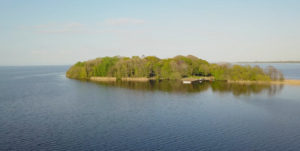
Two days later I had maps, a rough plot, character outlines and the daunting realisation that I was embarking on something more intricate than a standard alternative history. I would be binding the fantastical to the factual. In Northern Ireland, where uncontested facts are rarely a given, this would be a delicate enterprise, akin to pinning down a Lough Neagh eel.
I sought guidance from my favorite alternative histories. I began with Catherine Lacey’s Biography of X. In an interview with The Chicago Review of Books, Lacey remarked, “when I’m reading history, I often think, it didn’t have to go this way, did it? … Once you start nudging one thing, it becomes easy to nudge anything.” I deeply admire the way Biography of X stitches contemporary American history into the protagonist’s arc. It feels as though bricks from one building are repurposed to construct a wholly different structure. In this way, historical fact takes on an alternative flavor and invites self-scrutiny. I’m in awe of Lacey’s vision, but it didn’t seem like the right path for my novel.
I kept revisiting a question a student once asked me. “As a writer of non-realist fiction, how do you conceive history?” Much of my work grapples with the Northern Irish conflict and its lingering aftershocks. It’s a wound that remains raw and in many respects unsettled. Did I worry about bending the history of the Troubles to serve my own narrative aims? Ultimately, I decided that I did.
I explored more traditional examples of alternate history. Curtis Sittenfeld’s Rodham and Philip Roth’s The Plot Against America offered forms that are simpler than Lacey’s, yet no less powerful. A single, perhaps small, event diverts American history from its expected track. Consequences ripple outward, and before readers realize it, they arrive at a moment in American history that is not merely alternative but unrecognizable. (In Roth’s case, what he imagined then reads as eerily prophetic today.)
I hope the distance afforded by fiction might offer a fresh perspective on the history we are all still living through.
For a while, I toyed with a domino‑like model for the book. Could I begin with O’Neill’s drainage scheme and follow the alternative path wherever it led—reunified Ireland, something utopian, or a realm haunted by its own ghosts? I’m afraid my imagination balked; the Northern Irish temperament tends to be stoic to the point of stubbornness. We cling to familiar grooves and cannot easily picture vast change.
Yet Roth’s opening idea—“History is everything that happens everywhere… even what happens in this house to an ordinary man.”—captured my imagination. The concept of an alternative history explored within a smaller, perhaps more domestic theater felt more manageable. In fact, I already have a track record with such spaces—caravans, cars, hotel rooms—places that function as microcosms for broader social and political dynamics. It’s usually easier and more effective for me to examine how the Conflict touches an individual rather than a whole society.
Thus I discovered the form for my alternative history. On the Mainland of Northern Ireland, the conflict unfolds as the history books describe. (A caveat is due: I’m not a historian, and anyone who grows up here carries their own biases and blind spots about what happened.) The “real” history runs in parallel with the fictional tale of the Neagh Archipelago.
In the middle of the lake, an archipelago materializes—an odd constellation of islands that form a community, fracture, and then drift back toward the Mainland with the signing of the Good Friday Peace Agreement in 1998, reintegrating with conventional history. The haunted Far Side islands become a repository for all the unresolved rubbish—the stuff that was meant to be fixed but never was. The Archipelago clings to life for fifty years, until an ecological crisis strikes the Lough. Then, the boundary between reality and fiction collapses in the form of a devastating blue‑green algae outbreak.
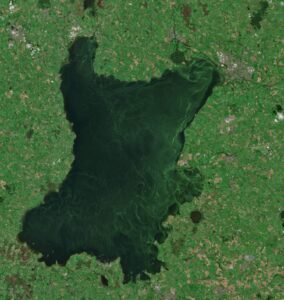
Ultimately, the world of Few and Far Between sits to the side of history, like a lay-by along a longer road. If anything, it’s an attempt to isolate a small slice of reality and speculate about what might have been. I hope the distance that fiction affords might offer a new vantage point on the history we are still living through.
__________________________________
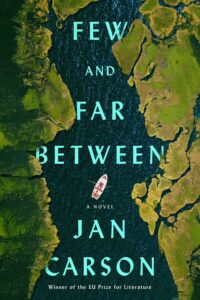
Few and Far Between by Jan Carson is available from Scribner.