

One of the clearest gauges of Americans’ tolerance for a social hierarchy is their quiet acceptance of entrenched nepotism that remains a fixture of contemporary life. Our fascination with lineage reaches its peak in the public obsession with “nepo babies,” the offspring of famous performers who ride their parents’ fame toward becoming heirs and rising stars. From the Barrymores of early cinema to the Hustons; Henry Fonda’s progeny; Kirk and Michael Douglas; the Downeys; Goldie Hawn and Kate Hudson; Blythe Danner and Gwyneth Paltrow; Jerry and Ben Stiller—the family tree of celebrity offspring keeps growing longer.
Their skill set seems almost incidental: these individuals were not plucked from the general pool of hopeful actors. The Ochs‑Sulzberger family‑owned New York Times had to admit that the phenomenon isn’t new, that “children born into rich, famous and otherwise powerful families have had a leg up in life, inheriting monarchies, business empires, wealth and star power.”
Nepotism, despite its insular pattern of marriages within exclusive circles, goes far beyond Hollywood. It has spread into network news, the publishing world, and the realm of politics. NFL coaches bring their sons onto their staffs. Chris Wallace, the son of 60 Minutes anchor Mike Wallace, obtained his slot through old‑fashioned connections; this isn’t to deny his competence, but the inside track is hard to miss. Other “media legacies” include CNN’s Andrea Koppel (daughter of Ted), legal analyst Jeffrey Toobin (son of a TV producer), and former anchor Chris Cuomo (son and brother of New York governors).
As one critic slyly observed, greed may be “natural” too, but that doesn’t mean we should tolerate it.
At Fox, Douglas Harriman Kennedy, a son of Robert F. Kennedy, and Peter Doocy, son of Steve Doocy, carry the torch. NBC earned the nickname “Nepotism Broadcasting Company” thanks to hires like Mika Brzezinski, Ronan Farrow, Willie Geist—and, for a brief, bright moment, Chelsea Clinton. One of NBC’s quirkiest signings was Luke Russert, just twenty‑two and fresh out of college in 2008. He joined as an election correspondent two months after the untimely death of his beloved Meet the Press host father Tim. In this case, the heir apparent assumed the throne before he had any television experience or substantial evidence of value as a political analyst.
In 2003, Adam Bellow, the son of Nobel laureate Saul Bellow, published a self‑advocacy book, In Praise of Nepotism. While he admitted that the prestige of his lineage helped him secure an editor’s post at Doubleday—the house that published his book—he nonetheless unabashedly argued in favor of what he called the “new nepotism.” He framed it as less a top‑down arrangement and more a meritocratic system in which children of privilege must prove themselves to earn their place, insisting that nepotism is so ingrained in human nature that it cannot be eradicated. As one observer commented, greed is “natural” too, but that doesn’t justify tolerating it.
Bellow could not demonstrate that modern nepotism yielded a true meritocracy, since there was no clear basis to justify why children of privilege should remain on the payroll. The power of a person’s “brand” can seem worth more than plain competence. Gaining a foothold in the door often proves to be the defining achievement in the media landscape. The film industry and American television have long thrived on notions of beauty and the ability to promote a familiar face. Where else could a twentysomething model be deemed suitable to star as a city detective?
Politics has always been a family enterprise. George Washington’s nephew Bushrod was named to the Supreme Court by John Adams, setting an early tone. Dynasties among presidents followed: John and John Quincy Adams; William Henry Harrison and his grandson Benjamin Harrison; Theodore Roosevelt and his fifth‑cousin Franklin D. Roosevelt (whose wife, Eleanor, was Teddy’s niece). More recently, the administrations of George H. W. Bush and George W. Bush were separated by only a single presidency.
The nineteenth‑century spoils system made nepotism explicit, even if it was not universally approved. Candidates openly defended such favoritism as “taking care of their family.” President Benjamin Harrison rode on the strength of his grandfather’s name and appointed his brother to a federal post. He faced public critique for treating this advantage as a “personal privilege” that came uncomfortably close to royal prerogative. When The Washington Post coined the term “limousine aristocracy” in the 1950s, it did more than describe wealth; it described lineage—the modern day equivalent of carriages bearing family crests pulling up at the Capitol.
The first woman to serve as a state governor, Nellie Tayloe Ross of Wyoming, obtained the position in 1924 after her husband died in office. For decades, up until 1976, of the ninety‑five women who served in Congress, three‑quarters of those who were senators and half of those in the House were widows stepping into office—often not replacing their own husbands. A political woman who had been widowed could not be readily dismissed as merely “too ambitious.”
Do they really work twice as hard? The Camelot spell had cast a spell over journalists’ eyes.
That dynamic helps explain why Hillary Clinton faced scrutiny for leaning on a family surname. First Ladies were expected to embrace a “helpmeet” role, focusing on beautification and domestic duties, placing family above personal ambition until their husband’s term ended. During her 2016 campaign, she was occasionally caricatured as “Her Royal Clintoness”—a veiled insinuation of entitlement.
As of 2024, eleven nepo babies held seats in Congress, six Democrats and five Republicans. Seven of them occupied the same seat once held by their fathers, and two directly succeeded them. Donald Payne Jr. won a special election in New Jersey after his father’s passing. Al Gore and Mitt Romney were sons of former senators. Before becoming Wyoming’s senator, Liz Cheney had served as deputy assistant secretary of state (and her husband as chief counsel for the Office of Management and Budget) during her father’s vice presidency. In 2002, Lisa Murkowski was appointed by her father to fill his former Senate seat when he became Alaska’s governor. At that moment, five other U.S. senators were sons of former senators. Shelley Moore Capito, the U.S. senator from West Virginia, is the daughter of three‑term Governor Arch Moore, whose later federal conviction for corruption did not erode her dynastic advantage. The enumeration continues.
Donald Trump brought his daughter Ivanka and son‑in‑law Jared Kushner into the White House, where they wielded considerable influence despite their lack of preparation for many of the tasks they undertook. Less frequently criticized, yet equally striking, were the nepotistic gestures associated with the Kennedy dynasty, where appointing relatives was treated as a family obligation. John F. Kennedy appointed his brother Robert to the cabinet as attorney general; he then helped orchestrate his youngest brother Ted’s ascent to the Senate seat he vacated, installing a placeholder until Ted turned thirty and became eligible for the office.
Although a 1967 law was enacted to curb such favoritism, and a long line of statutes has sought to curb nepotism in government contracts, supervisory roles, and appointments, the phenomenon has hardly vanished. Politicians routinely hire relatives of colleagues to secure allies and skirt restrictions. When Hillary relinquished her Senate seat to become Secretary of State, Caroline Kennedy—who had not previously sought political office—was floated as a possible successor.
Many in the press corps were, unsurprisingly, enthralled by her. Caroline was praised for her upbringing, charisma, and “an infusion of class,” according to New York Times columnist Maureen Dowd. Ignoring the glaring hypocrisy, Dowd excused family privilege in Caroline’s case, even as she had previously lambasted both the Bush and Clinton families: “Without nepotism, Hillary would be running for the presidency of Vassar. But then, without nepotism, W. [George W. Bush] would be pumping gas in Midland—and not from the ground.” After reading the stream of effusive endorsements of Caroline, a letter to the editor in the Times quipped, “Why not rename the United States Senate the United States House of Peers?”
Others hailed Caroline as “our tragic national princess,” a debutante, and they lauded the Kennedy name’s enchantment. On National Public Radio, Adam Bellow likened her tale to Arthurian legend, claiming “She has drawn her father’s sword from the stone,” offering New York a chance for a “new queen, and her name is Caroline.” Part of her appeal lay in the Kennedy heritage she carried, seen as a symbolic relay to take the torch from her ailing uncle Ted. Rationalizing further, Bellow contended that dynastic ambition is common in such families and can drive successors to surpass expectations; in his view, dynastic successors are often motivated to work twice as hard to earn their advantage. Do they really work twice as hard? The Camelot spell continued to blind journalists with wonder.
In the end, Caroline Kennedy’s bid did not prevail, and she went on to serve as a capable U.S. ambassador. Yet the broader issue runs deeper than Hollywood glamour or Kennedy nostalgia. Nepotism is rooted in the powerful patronage gains the state has granted—namely, the rollback of inheritance taxes and the creation of dynastic trusts. Law professor Ray Madoff argued in “America Builds an Aristocracy,” published by The Times in 2010, that the 1990s witnessed a strengthening of dynasty trusts across multiple states. Legal changes had ended the long‑standing “rule against perpetuities,” which previously limited how long wealth could be controlled by a family. With rising estate tax exemptions and these trusts, a new hereditary aristocracy found itself subsidized by the state.
One notable privilege of these dynastic trusts is the “spendthrift clause.” This provision shields trust assets from creditors and ex‑spouses, ensuring that wealth survives across generations. Much like corporate personhood shields owners from a company’s debts, the trust endures even when future heirs owe money. This mechanism allowed ancestors to collude with the living to perpetuate wealth and lineage at once. A scholar of law recently described this as a “bizarre twist in history.” Although the English still retain the perpetuities rule, it has largely disappeared in America, rendering the United States, in effect, “a more feudal society than the British.”
Here lies the darker facet of nepotism. Nepo babies live off their parents’ largesse, benefiting from the belief that pedigree signals destiny. It should surprise no one that a reviewer of Adam Bellow’s book praised the author for inheriting his father’s aristocratic aura. The newest forms of nepotism reaffirm that the feudal remnants of patrimony and lineage are openly flourishing.
__________________________________
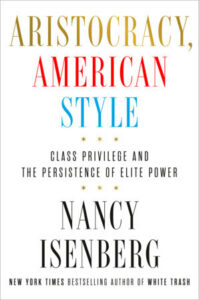
From Aristocracy, American Style. Used with the permission of the publisher, Viking. Copyright © 2026 by Nancy Isenberg
