
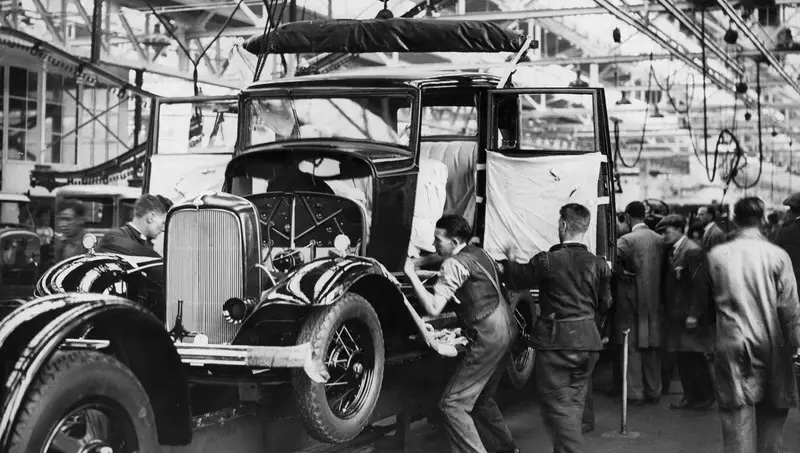
In 1934, from the confines of his prison cell, Antonio Gramsci contemplated the sweeping shifts reshaping industrial production in the United States. He argued that the rise of the automobile and the broader Fordist factory signaled a novel economic and ethical order, one that disciplined workers, infused wages with moral weight, and blurred the boundary between production and daily life. Among the industrial innovations shaping this regime, the assembly line and vertical integration emerged as the most consequential.
Ford introduced the moving assembly line in 1913, compelling workers to repeat the same simple, learnable tasks again and again—lifted productivity and tightened discipline in the workforce. At the same time, direct control of inputs and distribution—from rubber plantations to rail networks—enabled lower production costs, translating not only into cheaper goods but also into higher-than-average wages. Since the internal combustion engine’s invention in 1885, the automobile sector had consisted of skilled artisans producing a handful of bespoke vehicles—accessible only to the upper echelons of society. Fordist methods, however, expanded car accessibility and began to organize the “whole life of the nation” around the act of production.
If “the history of industrialism has always been a continuing struggle against the element of ‘animality’ in man,” as Gramsci suggested, it is notable that Ford drew his inspiration for worker discipline from industrial slaughterhouses. Visiting butchering facilities in Chicago and Cincinnati, he observed animal carcasses moving between cutters on overhead conveyors. Translating this logic to automobiles, Ford devised an assembly line in which components moved to stationary workers, “taking the work to the men rather than the men to the work.” This mirrored Frederick Winslow Taylor’s concept of scientific management, which pursued efficiency through control and standardization of labor. Also intent on taming animal spirits, Taylor sought to remove the “human content” from work, replacing it with what he infamously described as a “trained gorilla.” With labor made interchangeable, it was common to hear fifty different languages spoken on Detroit’s shop floors. Migrants to the auto plants came largely from the American South and various European countries, with many hailing from the Middle East to Ford’s Dearborn factories.
The formulation “industry of industries” thus draws attention to the raw materials the car is made from and the myriad economic practices it enables.
Fordism extended beyond the factory walls. The vertically integrated, rationalized production was complemented, in Gramsci’s terms, by “extremely subtle ideological and political propaganda” in which workers were rewarded not only for labor but also for their conduct: temperance, thrift and domesticity. Ford and his inspectors in the company’s Sociological Department tracked his employees’ private lives—what they ate and drank and how they lived. Though eventually abandoned for cost reasons, this surveillance system aimed to equate producers with virtue. More than a disciplined laborer, Ford sought a moral industrial citizen—a “master in industrial method” who would volunteer “for the mines and the railroads” should “the fires of a hundred industries threaten to go out for lack of coal.” His ambition, then, was to “mold the political, social, industrial and moral mass into a sound and shapely whole.”
Such expectations were sustained by comparatively generous wages. Before the five-dollar day in 1914, Ford’s worker turnover was so high that the company needed to hire nearly a thousand employees merely to retain a hundred. This new wage, deemed a “family wage,” formed the basis for the male-breadwinner model, or the “Fordist family,” spotlighting the wage’s moral dimension while granting a degree of bourgeois respectability to parts of the working class. It also supported emergent norms of working-class consumption. “I’m not saying our workers will sing Caruso or govern the state. No, we can leave such ravings to the European socialists. But the workers will buy automobiles,” Ford announced. The separation from the means of production was redeemed through consumption; embedding the working class more deeply in the relations of production.
While controlling inputs and distribution helped reduce costs, there was also an ideological motive behind Ford’s drive for vertical integration: to limit dependence on others. Ford owned and financed his projects internally, as he “loathed banks and outside investors and was determined to maintain total control of his company.” His disdain for finance capital was inseparable from his virulent anti-Semitism. He openly propagated Jew-hatred, acting as a major conduit for anti-Semitic conspiracy theories, distributing The Protocols of the Elders of Zion and The International Jew, a serial pamphlet of conspiracies, through his newspaper, the Dearborn Independent. Throughout the 1920s and 1930s, the paper circulated across the company’s dealership network, with many dealers placing a copy of the Independent in the glove box of every new car.
Ideologically, these practices and beliefs coalesced into what Stefan Link has termed an “industrial moral economy,” wherein a community of producers fought against financiers and idle profiteers. Ford praised the man who “earned his bread” and rebuked those who “gamble with the fruits of other men’s labors.” His rhetoric echoed late nineteenth-century Midwestern populism, in which the producer contributed to the nation’s wealth while the rentier and financier siphoned from it. “The negation of the industrial idea is the effort to make a profit out of speculation instead of work,” Ford wrote. The logic behind this moral economy aligns with the core tenets of “producerism”: a belief system that distinguished those who contribute to the community’s prosperity from those who live off resources they did not generate—the virtuous maker versus the parasitic taker.
The industrial moral economy of Fordism became especially appealing in Italy, Germany, Russia and Japan—all nations seeking to break free from British and American financiers. Throughout the 1930s, specialists from this “transnational illiberal modernist network” visited Detroit, spending “weeks, months, even years at River Rouge to learn the American secret of mass production.” “Only a single great man, to the chagrin of the Jews,” Adolf Hitler wrote admiringly of Ford in Mein Kampf. He hung Ford’s portrait in his office, and in 1938 the Nazi regime awarded him the Grand Cross of the German Eagle. Another senior Nazi on trial in Nuremberg—Baldur von Schirach—credited a collected volume, The International Jew, as the source of his bigotry. The flowering of nationalist imaginations, it seems, often has cosmopolitan roots.
Both Hitler and Mussolini conceived grand schemes for mass auto production with VW at Wolfsburg and Fiat at Mirafiori. For Hitler, cars were “mankind’s most marvelous means of transport”; his ambition was to create “a people’s car” priced at under a thousand reichsmarks. Originally it bore the name “Kraft durch Freude Wagen” (the “strength-through-joy car”), later shortened to “Volkswagen.” For Propaganda Minister Joseph Goebbels, Germans would be “a happy people in a country full of blossoming beauty, traversed by the silver ribbons of broad roads, which are open to the modest car for the small man.” This modernization vision, oriented toward the future, never materialized as its authors imagined.
Hampered by fuel and rubber shortages, and reliant on forced labor, not a single finished car reached a civilian as war consumed Europe and millions lost their savings in deposit schemes: the people’s car proved a disastrous flop. Yet portions of the vision did come to be, as Germany and Italy expanded their motorways—the Autobahn and the autostrada—laying the groundwork for the car’s elevated standing in this modern age. When a delegation of British MPs toured the freshly built Autobahnen before the war, they were struck by the road’s “sheer clean beauty” and “vigorous sweeping curves,” which seemed to harmonize with the landscape: a blueprint to emulate.
On the eve of the Second World War, a transnational template for modernity had been established. According to Link, exchanges during the 1930s “laid the groundwork for the infrastructure of global Fordism.” Yet it was the shift to wartime production that accelerated its reach: the principles of mass production found adoption in the armaments factories of Nazi Germany and the Soviet Union alike, even though the latter never developed a substantial automobile industry. Volkswagen’s Wolfsburg factory, funded in part with confiscated union funds, redirected toward military production, and was kept intact by the Allies as they rebuilt West Germany in the war’s aftermath. Meanwhile, in the United States, the war and the lure of lucrative federal contracts dramatically altered the relationship between industrial capital and the New Deal state. Detroit, briefly shedding its identity as Motor City, was renamed the “Arsenal of Democracy” by Roosevelt. The carmakers now “built tanks, airplanes, radar units, field kitchens, amphibious vehicles, jeeps, bombsights, and bullets—billions and billions of bullets.”
*
In 1946, business analyst Peter Drucker identified auto manufacturing as the pinnacle of “modern industry.” It is “to the twentieth century what the Lancashire cotton mills were to the early nineteenth century: the industry of industries.” This suggests a double meaning: the car industry was not only a prototype for the broader industrial economy, given that the production of this single commodity epitomized wider shifts in economic organization, but it also acted as a pace-setter, directing the tempo for related sectors. The notion of the “industry of industries” thus emphasizes the raw materials that compose the car and the wide array of economic practices it enables, situating the automobile as the central node in expanding networks of material and energy flows, a linchpin within broader productive interconnections.
This union of fossil energy and physical resources is consummated in those regions building infrastructure for private mobility, which rapidly escalated after the Second World War.
From this vantage point, automobility emerges as a central force widening the “metabolic rift”—the fracture between humanity and its ecological base. As humanity’s ecological exchanges with nature become subsumed and guided by capital’s endless cycles of accumulation, the exploitation of resources and the accumulation of waste follow. Upstream, the automobile industry exists in productive harmony with steel, oil, glass, rubber, aggregates, concrete, electronics, engineering, and construction, each transforming flows of matter into value and then into waste.
_______________________________
From The Great Driving Right Show: Cars, Crisis, and the Rise of Fossil Fascism by The Zetkin Collective. Copyright © 2026. Available from Verso Books.