
Pa tilled the land and hunted as well. When visitors arrived at their Tzaneen homestead, they were greeted by a mounted head of a bushbuck that hung on the living-room wall. Its eyes bulged, fixed on nothing in particular.
Pa wore his pride openly. He would flash a broad grin at friends, his beard bobbing as he spoke, and he’d let his teeth gleam while recounting how he had sent the buck to the ground with the first shot from his tall hunting rifle. That was Nicolas’s cue that his father was pleased—because Pa rarely revealed his teeth. He never smiled at him or Ma. Only when the topic of hunting came up did Nicolas glimpse those teeth, and they looked yellow and sour in the light.
Nicolas had witnessed the buck’s shot, two years earlier. That moment remained the only time Pa had taken him hunting. The boy cried all afternoon, hearing the buck cry out for its Ma and its Pa as it tumbled to the earth.
In the bakkie, the dead bushbuck in the back, Pa had scolded him: “Jy is ’n Boer, you will always be a Boer—hunting runs in your blood. So stop crying like a little girl. Hoor jy my?”
Nicolas had nodded, tears slipping down his cheeks. “I said stop crying, Nico!” Pa had shouted.
There were also antlers from a young kudu and a rhino horn mounted on Pa’s bedroom wall. Yet he never showed them to others. When farmworkers caused trouble and the police came by, Pa hid the horns away.
On one occasion the workers swiped his oranges. On another, they organized a month-long protest demanding higher wages. Pa draped a sheet over the horns before the police arrived. After they left, he complained about the “stupid government” for making rhino hunting illegal.
*
It was March 22, 1996—the eleventh birthday of Nicolas’s best friend, Kevin. The school week ended early on Fridays, so the boys had extra hours to play. Kevin’s father drove them to Debengeni Waterfall to celebrate, where they swam, then headed to the Spur restaurant, and finally to feed the monkeys at the Monkey Foundation sanctuary, because Kevin adored monkeys.
Nicolas wanted to see Fingers at the shelter—his favourite. He’d named him after the monkey in the film Monkey Trouble. Kevin’s favourite, he insisted, were the baboons. Nicolas thought that was silly, since baboons are monkeys, not apes.
When they were five, Pa wasn’t always angry, and Ma spoke and laughed more often. Kevin’s family had once visited Nicolas’s house. The grown-ups hosted weekend parties, and Nicolas and Kevin would chase each other around the farm when the adults started drinking beer.
One day they’d spotted two monkeys leaping through the banana trees. They disappeared when the boys tried to play with them, and Kevin cried. His mother had to soothe him to sleep in a rocking chair, singing softly until he drifted off. They returned to the same spot for the next three days but couldn’t locate them again.
*
People from nearby Black communities claimed the land belonged to them. Pa once exclaimed, “Who do these people think they are? My grandfather owned this farm. Just because Nelson Mandela is president now, they think they can take everything—land, mines, farms… it’s unbelievable!” He added, “The whole of Natal is owned by the Zulus, but do whites cry out like caged animals about that?”
He also told Ma that he would shoot someone rather than surrender his grandfather’s property. Nicolas was convinced that was why he had decided to sell.
A couple in matching African prints came to view the house. Nicolas was finishing a bowl of Strawberry Pops cereal at the dining table before classes when Pa led them in. The man smiled back, but the woman avoided eye contact, darting her gaze to every corner of the room, seemingly unimpressed.
Before the visitors stepped in, Ma covered the flag in the dining room, as she always did when strangers came to see the house. Nicolas once asked why. She said it symbolized an old South African flag that might offend people. Yet Kevin’s father had the same flag nailed to the back of his garage and never hid it when visitors dropped by.
Nicolas waited for Pa to introduce him, but it never happened. Ma insisted it was rude not to greet guests. “Nico, don’t ignore the visitors—go and say hello.”
Nicolas asked the couple, “Are you interested in buying the house?”
Just then, the man opened his mouth to answer, but Pa muttered, “Shut up, Nico.”
Nicolas tipped his cereal bowl into the sink and grabbed his backpack from his room. He checked that Kevin’s birthday card was still there, tucked inside his math workbook where he’d hidden it the night before.
*
Nicolas had crafted the card a week earlier. He’d first wanted to buy one, but all his friends had already planned to give Kevin a store-bought card. He wanted to stand out because Kevin was his best friend. On the card’s front he’d drawn many monkeys: one banging a drum, another a guitar, a third a flute, while the rest danced. He hoped Kevin would find it amusing, to hear his ticklish little voice say, “Dankie.”
The drawing wasn’t Nicolas’s first monkey depiction. The other featured a black-and-white monkey swinging from a slender branch with one hand. Ma liked it and was so proud of him that she pasted it on his bedroom wall and told Pa he was “gifted.” Pa didn’t seem proud at all, not revealing a single tooth.
Sometimes Nicolas felt Pa despised him. He was harsh with him. Nicolas suspected Pa didn’t love Ma either, because he often threw cruel names at her. The night before, he’d shouted at her during a tiger documentary, calling her a “dumb blonde” until his face burned with anger. Ma simply kept quiet, never shouting back, or grabbing his beard when he struck her in their room. Ma cried softly and stayed silent. Nicolas could only tell from the banging from their bedroom floor and Pa’s rumbling voice that the abuse continued. He would retreat to the yard to play with the ducks in the pond. Maluka, their security guard who slept in the back room, would often knock on the front door when Pa’s volatility escalated. Four days earlier, Nicolas found Maluka smoking by the pond after dark—red corduroy pants, no shirt, exposing a firm belly, and a white bucket hat with a strip cut down the middle showing his wild hair. “Can’t sleep, Nico?” Maluka had asked. “It’s the noise.”
*
“I know.” Maluka drew closer, wrapped an arm around Nicolas’s back, and pressed him against his side. His clothes smelled of smoke and Sunlight soap.
“I’m sorry.” Maluka released him and blew smoke through his nose. “Ma’am is a good woman. It is terribly sad.”
When the noise stopped, Nicolas said goodnight to Maluka and went back inside.
He loathed hearing Pa treat Ma that way. He detested the bruises on her face and neck the next day; they always looked as if a wild animal—the way a cheetah would—had attacked her. He wished he could help. Ma was small as a puppy, while Pa was large as a bulldog.
*
Kevin’s father was a musician, and his fame in town drew everyone to befriend Kevin. His cousins and various friends tagged along to celebrate, including Sherry.
Sherry had joined their group recently and seemed intent on impressing Kevin. Nicolas suspected she wanted him to be her boyfriend, for she kept hovering beside Kevin during lunch, always trying to sit near him in the school cafeteria.
They arrived at Debengeni Waterfall in Kevin’s father’s Mercedes, all wearing swimsuits. Kevin’s father stood with a ranger near the falls to supervise.
When the others leaped in, Sherry stood in the water, shivering in her pink suit. “I can’t swim, Kevin.”
*
The others stared. Sherry’s hot anticipation soured into fear. Nicolas frowned at her audacity.
“Get in, Sherry, I’ll help you learn,” Kevin offered.
Nicolas grew more irritated; instead of enjoying his birthday, Kevin was busy teaching Sherry to swim.
But He wasn’t the only one annoyed—Kevin’s cousin rolled her eyes and swam toward Nicolas. She was talkative, yet Nicolas warmed to her more than to Sherry. She had short blonde hair like Ma and dimples on her round cheeks. She lounged on her back in the water, close to him.
“Are you worried she’ll steal Kevin from you?” she teased. “Huh? No—why should I be worried?” Nicolas splashed his face to clear the water from his eyes.
“Well, you probably should,” she teased, grinning. “She’s a girl.”
“Yes, and you’re a girl too,” he retorted. “What does that prove?”
She didn’t answer. Instead, she ducked beneath the surface and resurfaced with a mischievous smile deeper in her cheeks. “Nico, you can’t hide it. You like him. You might be like my brother—he’s gay and lives with his partner in Australia in a huge house with a tennis court, pines, and a giant pool. It’s massive, Nico.” Her eyes widened. “Ma isn’t happy about it, though. That’s probably why he doesn’t talk to her anymore.”
Nicolas kept silent, weighing her words. He finally admitted, “Kevin is my best friend, of course I like him.”
“That card you made for him? Saying you love him?” She shot him a knowing look, then shrugged. “Anyway, it doesn’t matter.”
They watched Kevin carry Sherry’s arms as he gave her a swimming lesson.
*
The drive home was quiet and heavy. Kevin sobbed uncontrollably, and the car was filled with the sound of his tears. Nicolas had no idea how to comfort him.
When they reached the monkey sanctuary, they learned that the Baboons had died. The kindly Indian woman, who always offered them liquorice, explained that the Baboons had fallen ill suddenly and died a few hours before they arrived. Nicolas felt a deep ache for Kevin; he wished he could restore the moment they had fed the monkeys and not just mourn their loss.
He was more upset because they didn’t even get to see Fingers, his favourite monkey. The bananas sat in the car’s back seat, uneaten. He chose not to go to Fingers either; he didn’t want to upset Kevin further, since one of Kevin’s friends had died on his birthday.
At the shelter, Sherry urged Kevin to pick another monkey and name him Baboons. Kevin roared with sorrow: “I can’t replace him—I loved him!” He didn’t speak to her again, even when they dropped her at her house.
So it became just the two of them in the back seat. They entered a township with a battered, dark-green welcome sign: “Welcome to Levenve”—the Y’s lost their curl, so the name read as Lenyenye. A huge sewage lake not far from the main road fed birds with waste. The main road was full of potholes, and Kevin’s father cursed the mess, “Dammit man, this road is a disaster!” They passed a tavern where a skinny, glossy black dog lapped at a braai-stand, looking almost like a starving goat. They saw merry locals dancing, chatting, and drinking with kwaito music playing—Maluka often played that genre in his room when Pa was away. Nicolas watched Maluka whistle, spin on his toes, lift his arms, then squat and spring as if the floor were a trampoline.
Out of nowhere, four barefooted boys full of dirt chased after the car, waving wildly.
“They’re after something,” Kevin’s father remarked. “They do this when I’m near.”
Kevin leaned forward, “Pa, we still have the bananas.”
Without waiting for an answer, Kevin rolled the window down and offered the fruit to the kids. Nicolas stuck his head out too, feeling a pang as he saw the group—one boy in a torn T-shirt and hole-riddled shorts led the pack. They looked hungry and impoverished, and Nicolas’s heart ached with empathy for them.
They arrived at Nicolas’s home around seven o’clock to find two police vans and an ambulance parked in the yard, their lights flashing. It wasn’t the first time Nicolas had seen a police vehicle in the yard, but it was the first time an ambulance was present. Pa’s workers stood around, shouting and shaking their heads, some clapping in disbelief.
“Stay in the car, Nico,” Kevin’s father urged. “I’ll go see what’s going on. It’s probably just a minor farm issue.”
“No, I want to know,” Nicolas insisted. “Did someone get hurt?”
Kevin’s father closed the door. “Stay in the car, both of you.”
Kevin turned to Nicolas. “It’s okay, Nico. Maybe it’s nothing.” He squeezed Nicolas’s hand gently.
But as Nicolas peered out, he saw two uniformed men dragging a figure from the house on a stretcher. A cold fear gripped him. “Something’s wrong,” he whispered, pulling away and stepping inside.
Pa’s friend Ma watched with a clenched jaw as his father’s grip tightened. Kevin’s father emerged from the house, stopping short when he saw Nicolas, as if he’d seen a ghost. He didn’t speak. His mouth refused to form words, as though they’d frozen mid-sentence in his throat.
Nicolas finally found Ma. She came into his arms with a shaking frame; her small lips were bruised, and red scratches lined her forehead and neck.
A Black police officer stepped out with Pa, their hands cuffed behind their backs. Ma murmured to Nicolas, “I’m so sorry.”
“Ma?”
“I’m so sorry, Nico. It’s Maluka…”
__________________________________
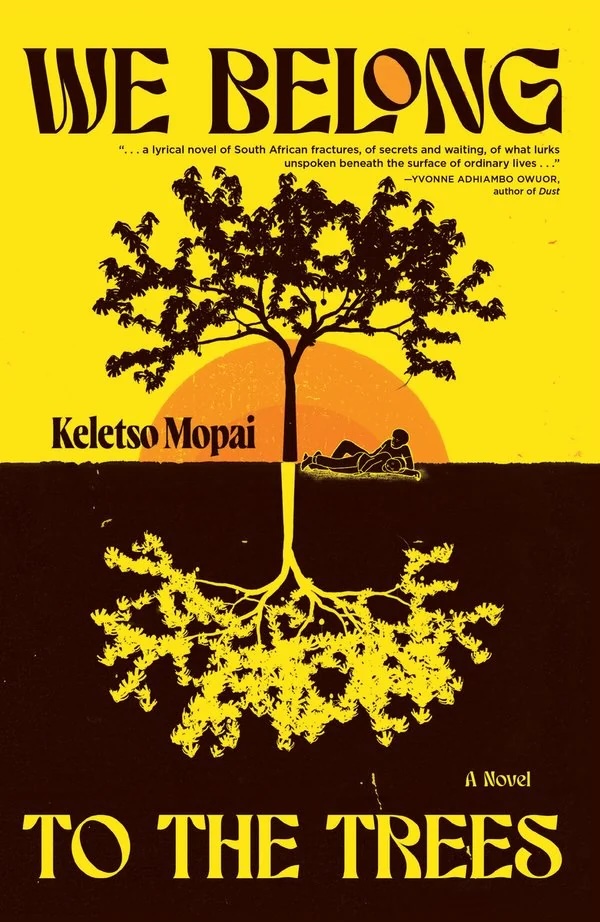
From We Belong to the Trees by Keletso Mopai. Used with permission of the publisher, Seven Stories Press. Copyright © 2026.
