

Let’s be candid about something: the struggle of writing doesn’t hinge on how gifted you are, how many notions you’ve stored, or how keen you are to have your novel finished. The difficulty of putting words on a page stems from this brain we carry, the ancient organ that has run and revised the biological program for human survival for roughly two hundred thousand years, and which sincerely believes that composing sentences could endanger you.
This isn’t metaphorical.
Each time you settle to write, your brain interprets the act as socially precarious. Transferring private thoughts into language means exposing yourself to judgment, and for the vast majority of human history, judgment wasn’t merely uncomfortable—it could be deadly. Naomi I. Eisenberger’s 2004 research explored how our brains evolved to fear social pain. Rejection by the group could mean you wouldn’t eat. Public humiliation in front of the clan could jeopardize making it through winter.
Your nervous system retains all of this, even as you attempt to craft your next chapter. The brain’s mission is to keep you alive, so it does what it does best: identify the threat and steer you away from it.
That’s why, the moment you tackle a challenging scene, you suddenly find yourself reorganizing your sock drawer, taking the dog for a walk, or swapping out your windshield wipers. Anything at all except writing.
Undirected mental energy can (ideally) be a source of creativity, but left to its own devices, the mind does not naturally drift toward gratitude and wonder. It gravitates toward threat.
Now remember that writing requires intense concentration, which means you’re fighting your brain’s natural inclination to daydream, ruminate, and spiral. The regions of the brain responsible for this kind of idle mental activity are called the Default Mode Network, a term coined by Marcus Raichle. For writers, undirected mental energy can (ideally) be a source of creativity, but left to its own devices, the mind does not naturally drift toward gratitude and wonder. It gravitates toward threat. This also brings us to another biological reality that complicates writing: a negativity bias.
Your brain is specially wired to weigh the bad more heavily than the good. Social psychologist Roy F. Baumeister discussed this in his work, Bad is Stronger than Good. An ancestor who forgot about the pretty flowers by the lake? Probably fine. An ancestor who forgot about the lion by the lake? Not so much—likely not an ancestor if they didn’t survive to reproduce. Paying attention to painful or potentially deadly possibilities has helped our species endure as long as it has.
And it’s not only external negatives that cling to us. We possess a remarkable capacity to remember and relive emotional pain. Zhansheng Chen’s 2008 study indicated that social pain is recalled more vividly than physical pain. That explains why you can remember the moment you fractured your arm without reliving the ache, yet a heartbreak can still bring tears. All of this circles back to the plain fact that our brain regards writing as quietly perilous.
So here we are, sitting down to write with brains that scan for danger, utterly convinced that the sentence we just produced is terrible, and fairly sure it could be our undoing.
None of this amounts to pathology. It’s simply part of being human.
Here’s the good news: once you understand why your brain reacts to writing the way it does, you can train your mind to cooperate with you rather than against you. With a bit of practice you can learn to recognize your subconscious responses to supposed threats, consciously remind yourself that you can tackle difficult things, and then proceed with the writing. So how do we achieve that?
As a writing coach, I encourage every client to try a practice called Insight Meditation. And before you dismiss it as fluff, hear me out. It’s remarkably straightforward and can transform your writing life. Sit comfortably, close your eyes if you wish, and pick a focal point for your attention—your breath, the sounds in the room, or a countdown from ten to zero. We call this the anchor. Then notice when your mind wanders, which it will, constantly. When you realize it has wandered, release the thought and return to your anchor. That’s it. That’s the entire practice. (If you’d like some guidance in trying this, you can explore a free collection of meditations I’ve created for writers at ScribblingBuddha.com.)
Each time you dismiss a distraction and return to your anchor, you’re strengthening the mental “muscle” of focus. Scientists are still clarifying the link between focus and creative flow, but anecdotally, cultivating focus seems to be the first step toward slipping into that coveted mental state in which words arrive with ease, hours melt away, and the inner critic grows quiet. It may feel magical, but flow is a predictable outcome of the right conditions. It’s science.
In 1990, the Hungarian-American psychologist Mihaly Csikszentmihalyi popularized the idea of “flow” in his book Flow: The Psychology of Optimal Experience, describing findings from conversations with artists, athletes, and others engaged in demanding, creative work. He found flow emerges when the individual’s skill level aligns perfectly with the task’s difficulty. When the creator is intensely focused on meeting the challenge, time seems to stretch. They report knowing exactly what to do next at every moment and feeling a profound sense of calm and ease, even while performing something clearly challenging.
Further research, including work with Jeanne Nakamura in 2002, suggested the brain has a finite processing capacity of about 120 bits per second. That’s roughly a million times slower than the computer you’re reading this on, and our limited bandwidth gets consumed quickly—half of it can vanish just by listening to someone talk.
Mindfulness doesn’t eliminate fear or self-doubt; I want to be honest about that. What it does is alter your relationship to those experiences.
Consider how focusing on a challenging task (like writing) aggressively taxes processing power, and as that happens, your brain loses some of its usual behind-the-scenes abilities. Timekeeping begins to slip away. The brain recognizes that keeping track of time isn’t of paramount importance, so as processing power dwindles, your internal clock slows for a moment. Soon after, you exhaust the neural resources needed to sustain the inner monologue of your critic. If you stay focused, the portion of your brain that monitors your body’s boundaries begins to soften, which fosters a sense of expansiveness and connectedness. This decline of higher-level brain activity is what neuroscientists call transient hypofrontality, a term coined by Dr. Arne Dietrich. (You can watch his TEDx talk about it here.)
You may have encountered transient hypofrontality when using a substance like LSD or psilocybin. With chemical help, the brain can plunge into this state so intensely that you’re almost useless for anything other than gazing at the stars. But a gentler descent, achieved through practices such as meditation, can yield a softer, immediately reversible altered state in which much of the prefrontal cortex is momentarily offline, yet you can still follow a thought. In this mode you experience diminished self-criticism and heightened creativity (flow).
The best part? You can train yourself to cultivate this mental state and deliberately enter a state of creative flow whenever you sit down to write. Not occasionally, not only when luck favors you, but reliably, on cue, every time you begin. It’s as straightforward as sitting quietly for ten minutes just before you start writing.
If you practice mindfulness meditation before writing, and then transition directly into your task, you’ll carry that sharpened focus straight to the page. Wandering thoughts will pop up (the laundry, the inbox, the fear that your opening scene is a disaster), but in a mindful frame you can observe them for what they are—your brain acting overprotectively—and let them go. Then you can continue writing.
With time, this routine reshapes something fundamental. Mindfulness doesn’t erase fear or self-doubt, I must be candid about that. What it does is alter your relationship to those experiences. The impulse to abandon your work starts to feel less like an order and more like background noise. The inner critic becomes less of an authoritative figure and more like that overly chatty colleague who floods your inbox. You don’t have to answer.
I can’t promise this will render writing effortless, but I can assure you that if you commit to a steady meditation practice, you will write more and suffer less.
You’ll begin to notice that you can harbor doubt and keep writing. You can feel vulnerability and keep writing. You can sense fear and keep writing. The aim isn’t to reach some mythical state of invulnerability; every serious writer I know negotiates with resistance from time to time. Yet when you recognize resistance as a normal, universally human response to undertaking something difficult and you still write anyway, that changes everything.
____________________________
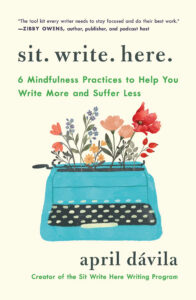
Sit Write Here: 6 Mindfulness Practices to Help You Write More and Suffer Less by April Dávila is available from St. Martin’s Essentials, an imprint of St. Martin’s Publishing Group, a division of Macmillan.