The following first appeared via Rebecca Solnit’s Meditations in an Emergency.
Over the weekend, the premiere of the film The Odyssey coincided with the Florida arrest of the Tate brothers, at the request of the British government that seeks their extradition to answer a long docket of charges. Andrew Tate is accused of “seven additional counts of rape, three counts of arranging or facilitating trafficking for sexual exploitation, three counts of assault occasioning actual bodily harm and 19 additional charges for offences relating to indecent images of a child/extreme pornography.” His sibling Tristan faces “one count of sexual assault, two counts of rape and three counts of arranging or facilitating trafficking for sexual exploitation.”
There are moments when it feels as though violence against women lurks around every corner. The headlines seem weighted with it. On Monday, July 20th, the Tate brothers stood before a judge, and the Guardian ran top stories such as “Experts warn of a rise in sadistic online exploitation of vulnerable children” and “In the dark corners of the internet, men are egging each other on to masturbate in public—and on female shoppers—and posting the footage.” On Tuesday, reports noted that singer-songwriter D4vd appeared in a Los Angeles courtroom as prosecutors seek to show enough evidence for him to stand trial for the murder and sexual abuse of Celeste Rivas Hernandez, a minor whose body was found in his car; she was thirteen, and she was dismembered.
Wednesday continued with four more Guardian stories about sexual abuse of women on the digital front page (I sometimes wonder if anyone else notices how ubiquitous these stories are). Last week, Trump was compelled to pay a civil settlement of $5,625,005.48 in a case in which he was found liable for sexually assaulting E. Jean Carroll and for defaming her. And there was a Guardian piece about gang rapes and the killing of girl children in India that I wish I hadn’t read.
I found myself thinking of Mary Beard’s landmark 2014 essay, “The Public Voice of Women,” when a stranger tagged me in a hate-filled post on Saturday that included these words: “Can someone please tell Rebecca Solnit to stop talking?” The post concluded, “Sit down, shut up, and stop running your bullshit.” Some bits of what he wrote suggest he was unwell, but contemporary mental distress often manifests as a weakened immune system of the psyche: vulnerability to the loud and destructive noise all around us that tells us how to think, live, and act. A great deal of that noise has long targeted women and has done so for centuries, which was Beard’s point.
“Public speaking and oratory were not merely things that ancient women didn’t do: they were exclusive practices and skills that defined masculinity as a gender.”
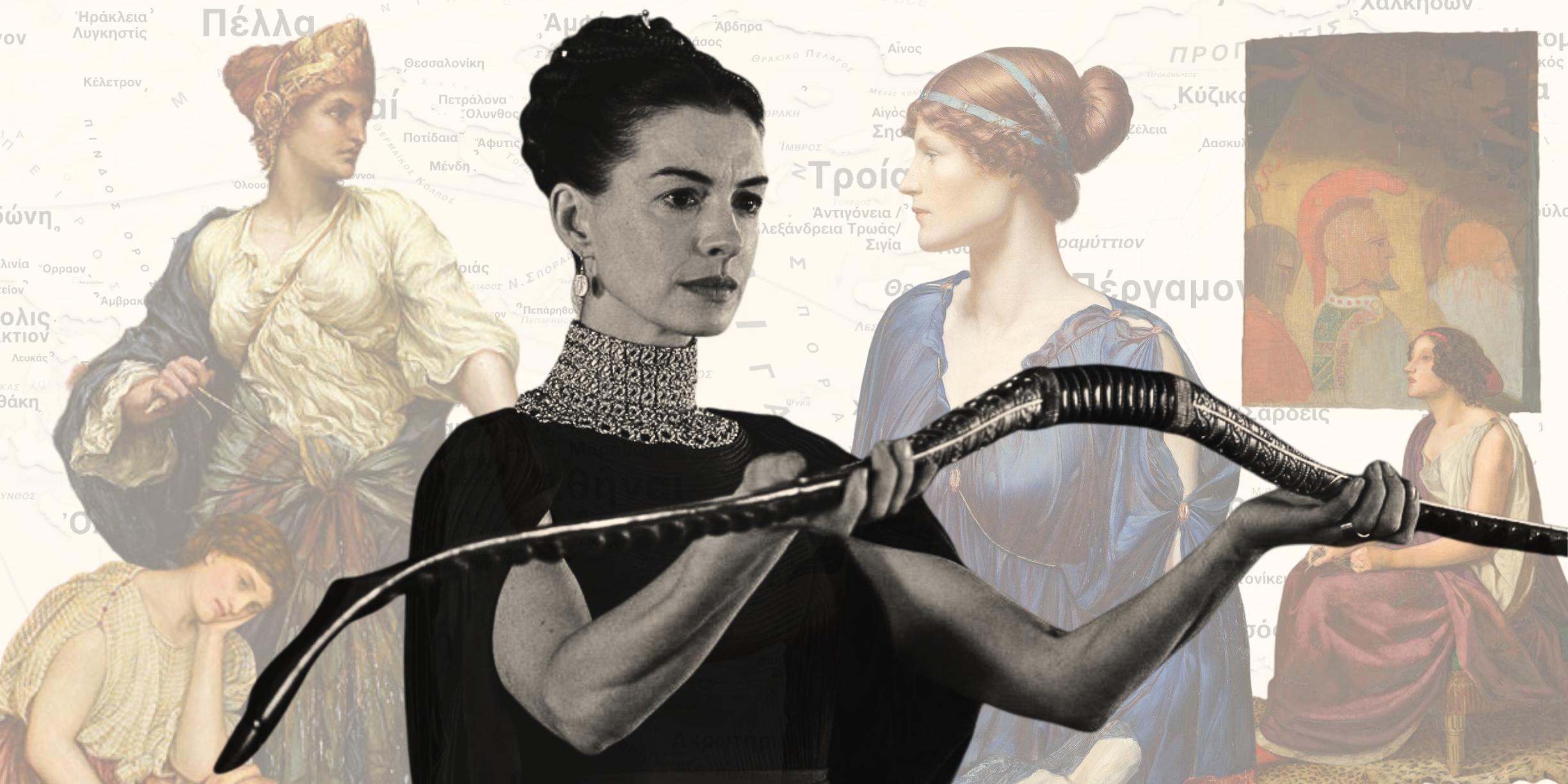
Beard’s essay opens with a look to the very dawn of Western literature, where the earliest recorded instance of a man telling a woman to “shut up” takes stage; he tells her that her voice should not be heard in public. Her example is the Odyssey, where Telemachus scolds his mother Penelope: “Mother,” he says, “retreat to your quarters and resume your own labors—the loom and the distaff … speech will be the business of men, and of me most of all; for mine is the power in this household.” And so Penelope retreats upstairs.
Beard insists that in ancient Greece speech belonged to men; writing, too, bore a gendered bias. She notes that “public speaking and oratory were not merely things that ancient women didn’t do: they were exclusive practices and skills that defined masculinity as a gender. As we saw with Telemachus, to become a man—and we’re talking about elite men—was to claim the right to speak. Public speech was a—if not the—defining attribute of maleness. A woman speaking in public was, in most circumstances, by definition not a woman.” We’ve witnessed the fury and fuss about women in politics speaking—about tones and timbre, about rhetoric and demeanor—treating their words as if their role were to be aesthetically pleasing rather than morally engaged. Beard points out that the Greeks believed a proper voice should be deep, and a higher female pitch disqualified women from public life.
Have we evolved much since Telemachus told his mother to silence herself? Those who have find themselves in conflict, sometimes to the point of confrontation, with those who have not. Like Beard, Emily Wilson is a classics scholar fluent in the Greek of the Odyssey and the Iliad. She translated both epics and was widely described as the first woman to translate the Odyssey into English; and right-wing critics raged, especially on the platform once called Twitter, terrified that a woman handling Homer would upend everything. Many of them expected Homer to sound archaic, perhaps because many translations created ornate, anachronistic English that bore little relation to the poet’s language. An America First social media account labeled her version “unfaithful,” as if she had committed linguistic treachery.
Yet the controversy extended beyond stylistic choices; it carried the overtones of a civilization under threat, as if Homer speaking through a woman, and a woman speaking with the authority to tackle foundational classics, signaled the collapse of something larger. Beard writes, “For a start it doesn’t much matter what line you take as a woman, if you venture into traditional male territory, the abuse comes anyway. It’s not what you say that prompts it, it’s the fact you’re saying it.”
Wilson has continued to explain her choices ever since. For example, she told the Washington Post that there’s a compound in the Odyssey formed from the words for “dog” and “face,” so she rendered it as “dog-face,” noting that “Most other Anglophone translators have made different choices: Richmond Lattimore uses “slut that I am” (and later “whore” in Book 6 when Helen calls herself more literally ‘dog’); Robert Fagles has “whore that I am!”; Robert Fitzgerald, whose Homer often quotes from Shakespeare, has “wanton.” Unlike me, none of these translators uses the same term when Achilles insults Agamemnon. Verbal repetition is always a challenge for a translator. Though she may savor the understatement, she points out that earlier translators have layered misogyny onto the texts, and not abandoning those layers can be read as feminist when the translation is essentially accurate.
Misogyny and the classics, as Mary Beard and many others have pointed out, is a capacious topic.
Misogyny and the classics, as Beard and many others have observed, remains a broad and intricate field. Historian Bettany Hughes notes Helen of Troy’s long career in literature and art, calling her a “fantasy whore” whose reputation has been persistently shaped by gossip about lovers—Theseus, Menelaus, Paris, Deiphobus, and perhaps even Achilles after both were dead—who are cited by ancient and modern writers as if they were the client list of a high‑class courtesan. Euripides calls her a “bitch-whore”; Shakespeare figures her as a “strumpet.” In the Western tradition, beauty was viewed as a lure that could mislead men into a sexual bond. The more beautiful a woman, the more likely she was imagined to wear a duplicitous nature on the surface.
Last night I watched Christopher Nolan’s film adaptation of the Odyssey, and it reminded me, much as his 2024 Oppenheimer did, of how a filmmaker can pile several events from a life into a sprawling epic without fully grasping their meaning. As Richard Brody notes in his New Yorker review, Homer’s schemer appears here as a blunt, practical tactician rather than a figure of morally ambiguous or inventive genius. Like Oppenheimer, the film can nevertheless ignite a far‑reaching conversation about the epic’s relevance to nuclear age anxieties then and to contemporary translations by Wilson and Mendelssohn, which are now widely read.
The women of the Odyssey are gripping figures, and the goddess Athena and the demi‑goddesses Circe and Calypso are themselves genuinely formidable; yet the mortal women are rendered powerless by their society. Penelope cannot simply govern Ithaca on her own, and she is assailed by suitors and treated as a dependent by her son; Helen is abducted by Paris (or presented to him as a prize by Aphrodite, or she runs away with him), thus triggering the war. In the prequel Iliad, Trojan women become sexual slaves to the Greeks encamped outside Troy, and the Trojan priestess Cassandra—blessed with prophecy but cursed to be never believed because she refused the god Apollo’s advances—is raped by Ajax the Lesser after the fall of Troy and later murdered when Agamemnon brings her home as a concubine (the term “concubine” is often used for these captive women).
Judith Thurman, in a piece on Emily Wilson, captures the broader scope of Homer’s other epic, the Iliad, through the tale of Agamemnon angering Apollo by turning the captive Trojan priestess into a sex slave. In response, the god sends a plague upon the Greek army. Thurman writes, “But then he consoles himself by offending his greatest warrior: he confiscates Achilles’ trophy from an earlier looting spree, ‘fresh-faced Briseis.’ And with that childish quarrel between stubborn warlords over who owns and may rape a girl, Western literature begins.”
The women in the Odyssey are compelling characters, and the goddess Athena and demigoddesses Circe and Calypso are genuinely powerful.
Sexual slavery is not a relic of the distant past. In an extraordinary New Yorker investigation from April, Heidi Blake reported on the Tate brothers. She spoke with the Tates themselves, victims, associates, and scoured legal documents and social media to offer a fuller, more frightening portrait of who they are and what they have done to women’s bodies and to men’s worldviews. Blake writes that after the Tates built an online sex enterprise in which dozens of women were effectively held captive, the brothers turned to teaching other men and boys how to replicate this and how to despise and dehumanize women: “Tate presided over an online network called the War Room… Members learned how to recruit women into ‘sexual slavery’ in a series of tutorials Tate called his Ph.D., or ‘Pimping Hoes Degree.’” Blake describes a victim tattooed with “Tate owned,” along with many other women marked as property, and one of Tate’s videos instructing: “That’s how it goes. Slap, slap, grab, choke. Shut up, bitch. Sex.”
I recall my first Odyssey‑related read (besides various versions of Greek myths and Ovid) being Henry Treece’s The Amber Princess, a lurid retelling from Electra’s viewpoint of the Trojan War and the House of Atreus. Only as an adult did I recognize how normalized rape and sexual coercion were in ancient Greek literature (and in much of the art inspired by it for millennia thereafter).
The gods, that mortal beauty chase,
Still in a tree did end their race:
Apollo hunted Daphne so,
Only that she might laurel grow
as Andrew Marvell delicately expressed about another of Apollo’s assaults and another woman’s escape (at the cost of her humanity). Gods and men raped women, and in some cases boys as well (Zeus and Ganymede). Moving to Roman history, one may admire the mythic rape of the Sabine women as depicted in Nicolas Poussin’s version in the Louvre and in Peter Paul Rubens’s expansive rendering; the National Gallery and the Met offer numerous works in response to requests for depictions of “rape.” In the National Gallery of Ireland last year I encountered Lucretia stabbing herself after being raped to preserve her family’s honor, and Europa being abducted by Zeus in the form of a bull.
Violence against women begins and ends with silencing; the two are not separate phenomena; a voice is what a human being has when that human being also has rights and membership in society.
Classical culture encompasses, among other things, a culture of rape. I’ve used one Greek vase image of Ajax assaulting Cassandra as a title photo here; there are many more, and what does it signify that images of rape served as decorative backdrops for two and a half millennia? Treece’s The Amber Princess appeared in 1963. Jean Rhys’s Wide Sargasso Sea (1966) retells Jane Eyre from the perspective of Mr. Rochester’s first wife, a mixed‑race Caribbean woman, who Charlotte Brontë herself portrays as the villainous “madwoman in the attic.” Since Rhys, retellings have become a meta‑genre—a familiar story told from an unfamiliar vantage, often a story once centered on men retold or subverted from a female point of view, or a reframe of dominant narratives by highlighting those of the marginalized. After Rhys came more reinterpretations by women of male‑centered works, including classical stories, and contemporary pieces like Percival Everett’s Pulitzer‑winning James, which reimagines Huckleberry Finn from the perspective of the enslaved Jim.
Expanding retellings even further brings in Tom Stoppard’s play about Hamlet’s minor figures, Rosencrantz and Guildenstern Are Dead, Angela Carter’s feminist revisions of classic fairy tales and Gregory Maguire’s Wicked. Of course, Huckleberry Finn is itself a backwoods variant of the Odyssey, and Jack Kerouac’s On the Road rides in a similar vein, yet Homer deserves credit for showing more interest in his female characters than Kerouac does. For me, an early feminist moment emerged when, partway through On the Road, I found myself identifying with the stationary, grounded women who are left behind, rather than with the male wanderers; Homer appears more invested in women than Kerouac ever was.
In recent years, retellings have surged like a flood, including Margaret Atwood’s Penelopiad, Natalie Haynes’s A Thousand Ships, Madeline Miller’s widely read Circe, and Pat Barker’s Women of Troy trilogy, beginning with The Silence of the Girls, voiced by the Trojan women who are captives in the Greek camp. Much has been said about newer Odyssean adaptations—The Return in 2024 and Nolan’s film—often criticized for treating trauma and PTSD inherited by Odysseus as the main driver, while the enslaved women of Troy bear the brunt of war’s brutality, enslavement, rape, silencing, and lack of freedom. As I noted recently in a piece about Graham Platner, quoting veteran David J. Morris on PTSD: “The science is clear: according to the New England Journal of Medicine, rape is about four times more likely to cause diagnosable PTSD than combat.”
Rather than adding yet another Odyssean narrative centered on Odysseus, a better move would be to tell Penelope’s perspective or—though Barker’s work’s degree of explicit violence may not translate to cinema—adaptations like The Silence of the Girls to illuminate, at least in part, the experiences of the Trojan women. At the close of that novel, Briseis, the queen who becomes Achilles’ and then Agamemnon’s sex slave, declares, “What will they make of us, the people of those unimaginably distant times? They won’t want to be told about the massacres of men and boys, the enslavement of women and girls. They won’t want to know we were living in a rape camp.” Barker certainly wanted us to know it.
Violence against women begins and ends with silencing; the two are inseparable; a voice is what a person has when that person possesses rights and membership in society—the voice that allows participation in life and the ability to determine what is or isn’t consent. Yet some men still insist that women’s bodies exist for men’s use and that consent, if it matters at all, can be reframed in various enduring ways; we are only a few decades removed from recognizing that husbands could rape their wives; prior to that, “I do” often equated to a persistent grant of bodily autonomy that modern law would reject.
Earlier this month, journalist Ryan Grim highlighted a text by Jenny Racicot in which she told Graham Platner that she “needed her glute massaged”—a detail he reportedly treated as a cue—but others have noted that if he had broken into her home and massaged her glute that night, the line of argument might have some weight. Yet Racicot maintains he raped her after she repeatedly said no and resisted physically. Beard writes about the public voice of women, but the private voice of women is not separate when there is a question of whether our words bear weight in the world, whether a woman can use her voice to claim her rights and be believed afterwards. It remains an unanswered question for many.
The Tate brothers were detained in Florida because the Trump Administration had intervened in their case to urge Romania to release them; Romania had barred their departure while they awaited trial there, but allowed them to go once the intervention occurred. Defending the Tates is, in essence, endorsing sexual slavery and the extreme inequality that these men propagate as a lesson for boys and men. Blake writes,
When Tate was arrested on human-trafficking charges, his allies defended him. Donald Trump, Jr., called the case “absolute insanity,” and Musk suggested that authorities were targeting the Tates while ignoring “actual sex trafficking.” Carlson, who had just released a documentary called The End of Men, devoted hours of airtime to proclaiming Tate’s innocence; so did the right-wing podcaster Candace Owens. The activist Charlie Kirk praised him onstage.
White supremacy remains a significant component of the Trumpist right; so too does male supremacy. Inequality was accepted in ancient Greece and it continues to be a matter of debate in the United States and beyond today.