
Tim Curry, who departed this week at eighty, is likely to be remembered most for his portrayal of Dr. Frank-N-Furter in The Rocky Horror Picture Show, and that isn’t an unreasonable memory to cling to. With his snug corset, bold makeup, and the scanty shorts held up by fishnet hosiery, Curry’s flamboyant scientist, who has a habit of crafting male companions in his laboratory, has become one of pop culture’s unlikely icons. Frank-N-Furter exists at the crossroads between counterculture and punk, the offspring of classic musical theatre and 1930s B-movies. The performance strikes as vehemently eccentric, provocative, and extravagant, yet it remains irresistibly charming, and despite all the flamboyance, Curry never slips into excess or losing control. Dressed in gender-fluid attire and savoring an unabashed display of sexuality, Frank-N-Furter stands as an incomparable presence, unashamed. This enigmatic, imploring man who openly rebels against the prudish mores of the mainstream isn’t cast as an outcast: he commands a sizeable, varied entourage of hired help and followers who mostly seem to approve of him. And, in any case, they often break into meticulously coordinated musical numbers without prompting. He’s a mad scientist, but Curry presents him as something more compelling, something stranger than a mere villain.
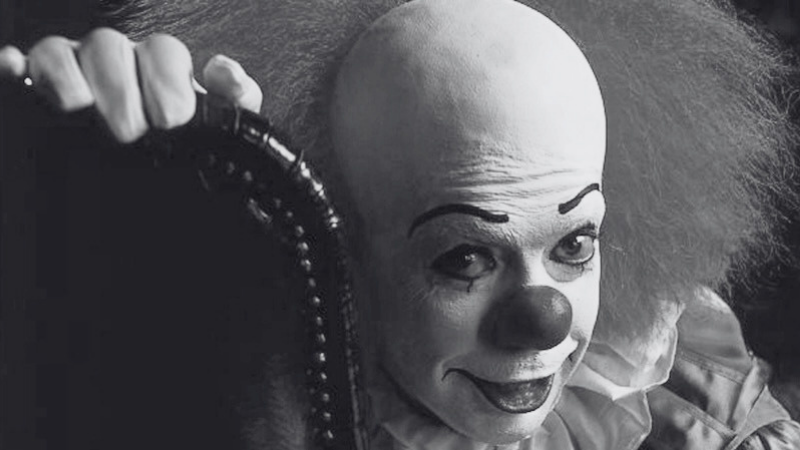
Curry’s genius lies in showing how enjoyable and liberating it can be to embrace the unusual. He admires the way the Transylvanian simply acts as his true self. Yet my personal favorite Tim Curry performance will forever be Pennywise, the clown in Tommy Lee Wallace’s 1990 miniseries adaptation of Stephen King’s It, which, when contrasted with Andy Muschietti’s sprawling, box-office-behemoth films, feels restrained, even a touch quaint. The miniseries runs a tight three hours, so Wallace was compelled to trim King’s colossal novel, cutting scenes and entire characters, and toning the material to satisfy broadcast standards of the era.
Nevertheless, Wallace turns this limitation into a wellspring of inventive approaches for translating King’s prose to television. The clues are visible from the outset. The novel’s opening chapter ranks among King’s most terrifying pages: it’s tightly structured, the descriptive detail is sharp and intense, the prose carries a lyrical, melancholic tone, and it largely sheds King’s fondness for flabby redundancies and casual wording. The two young brothers are drawn with efficiency and empathy, drawing us in quickly, and when the anticipated horror finally arrives, it lands not only as a shock but as a tragedy. The miniseries retains that core resonance.
It’s raining, a boy in a yellow raincoat pursues a boat fashioned from newspaper as it drifts along a gutter slick with rain. The boat slips into a sewer, and as the boy reaches for it, a face emerges from the dark—a clown with pristine, uncanny white skin, a bulbous red nose, and wild red hair. In his Bronx accent, he chats with the boy, returns the boat, and invites him to play. Before long, the clown tears the boy’s arm away and leaves him to die in the gutter. In the miniseries, this is suggested rather than shown, in keeping with the network rules of the time, yet the fear remains potent because Curry convincingly projects a friendly clown’s veneer—someone who could be a friend—while lurking underground. When the mask drops, the tonal shift and the grotesque alteration of his face create a dynamic moment that doesn’t depend on gore or elaborate effects. Throughout the story, we witness how he enjoys betraying a child’s trust and destroying the innocence—a form of violence perhaps more devastating than mere dismemberment. The shape-shifting, unknowable essence delights in tormenting children. He assumes many shapes, but the clown’s form remains his favorite. It’s a cruel irony. As King notes, “The fears of children could often be summoned up in a single face… and if bait were needed, why, what child did not love a clown?”
“The clown may be the source of mirth, but—who shall make the clown laugh?” Angela Carter wrote in Nights at the Circus. Pennywise, naturally, makes himself laugh.
While Muschietti’s films adhere more closely to King’s sprawling narrative, benefiting from an R rating, a substantial budget, and twice the running time compared to the miniseries, they lean on generic eerie imagery and flashy frights, a glossy banality that lacks depth. Bill Skarsgård embodies Pennywise with unyielding menace. The performance offers little nuance and few surprises. In comparison, Curry’s Pennywise carries a tension that makes him feel like a clown you could meet at a child’s birthday party, until the moment he isn’t. That contrast lends Curry’s portrayal a unique fear and exhilaration. Curry understood that scaring youngsters requires first winning their trust, luring them with a sugared pledge of friendship, earning their confidence with warmth and smiles, and speaking in the language they recognize. In Lovecraft’s The Outsider, the line—“Unhappy is he to whom the memories of childhood bring only fear and sadness”—feels apt. This may explain why the adult Losers Club try to forget their childhood terrors: so they can stay alive. If you cannot reclaim your innocence, perhaps you can at least forget what stole it from you.
And unlike Skarsgård’s take, Curry’s Pennywise is clearly enjoying himself. His taunts and psychological torment feel unsettling, yet they carry a defiant, cheeky humor because they’re delivered with the ease of a friend ribbing you. When he materializes in the library, visible only to the lead, he delights in testing out his stand-up routine. “The clown may be the source of mirth, but—who shall make the clown laugh?” Angela Carter wrote in Nights at the Circus. Pennywise, of course, supplies his own laughter.
The image of him—the costume a blasphemous betrayal of the wholesome fun a clown costume promises—and with vivid, gleeful balloons in his grasp, imprints itself on the memory. He appears on screen for less than twenty minutes, yet it feels as if he never leaves. In his absence, the danger lingers. He becomes a constant concern for every character involved.
We can set Curry’s clown beside another supernatural antagonist he portrayed, Darkness in Legend, a towering figure beneath prosthetics, speaking in a deep, demonic timbre that rattles with cryptic proclamations. And yet Darkness possesses a romantic streak as well: he is drawn to the purity of a beautiful young woman and longs to marry her. (He courts her with dark magic, a gesture he treats as a love offering.) When he is finally defeated, he reminds the hero that evil hides in all living things, so while his body may perish, his essence persists.
Pennywise—or It, as the entity is more familiarly known—has tormented the small, unassuming town of Derry, Maine for countless generations, born and dying while he lingers in nightmares, bending fears to his own knowledge of them. King’s strongest writing often carries a sincere, intimate quality. What makes him a towering figure in adolescent literature is the respectful portrayal of the kids’ vulnerable moments, their hopes, their shame, and their fears.
Too many horror productions have come to equate seriousness with austerity, insisting that villains—no matter how monstrous or sadistic, or whatever their motivations—must remain grave and unyielding. Humor is deemed unbecoming. Tim Curry rejected that notion; he understood that fear can be buoyed by amusement, and amusement can amplify fear. When Pennywise delivers a joke, the juxtaposition of his merry mischief with the surrounding horror can carry more weight and personality than a string of scares. Mastery of tonal control, pacing, and cadences is a craft, and when Pennywise savors the horror he generates, his laughter can disturb more deeply and endure longer than a single jump scare or a splash of blood. One doesn’t forget Pennywise murmuring to a child, “Kiss me, fat boy!”—and the boy, conscious of his weight, remembers the humiliation; years later, as a slender, successful adult, the long-suppressed memories of Derry return, and it’s that quip and the clown’s guffaw that come back first.