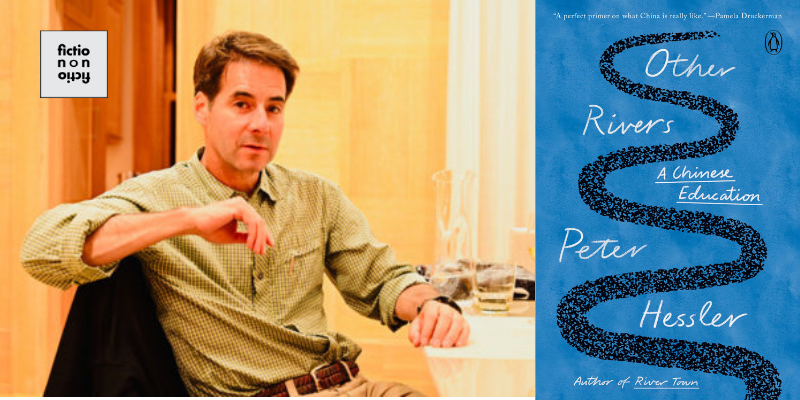
Acclaimed nonfiction writer Peter Hessler joins co-hosts Whitney Terrell and V.V. Ganeshananthan to discuss his new memoir, Other Rivers: A Chinese Education. Hessler, a staff writer at The New Yorker who first traveled to China as a teacher in the 1990s, describes how education there changed between that era and 2019, when he returned to Sichuan Province with his wife and daughters to teach English again. He reflects on how his students’ move from rural to urban settings affected them, contrasts his twins’ schooling in Colorado with their schooling in China, and considers the role of memorization, creativity, and authority in both contexts. He also recounts maintaining connections with his students from the 1990s, many of whom became teachers themselves, across the decades. Hessler reads from Other Rivers.
To hear the full episode, subscribe through iTunes, Google Play, Stitcher, Spotify, or your favorite podcast app (include the forward slashes when searching). You can also listen by streaming from the player below. Check out video versions of our interviews on the Fiction/Non/Fiction Instagram account, the Fiction/Non/Fiction YouTube Channel, and our show website: https://www.fnfpodcast.net/ This podcast is produced by V.V. Ganeshananthan and Whitney Terrell.
Peter Hessler
Other Rivers: A Chinese Education • The Buried: An Archaeology of the Egyptian Revolution • Strange Stones: Dispatches from East and West • Country Driving: A Chinese Road Trip • Oracle Bones: A Journey Through Time in China • River Town • Peter Hessler Latest Articles | The New Yorker • A Teacher in China Learns the Limits of Free Expression • The Double Education of My Twins’ Chinese School • China’s Shifting Relationship to the Countryside • China’s Reform Generation Adapts to Life in the Middle Class
Others
Stoner by John Williams • Gossip Girl • John McPhee • The Grapes of Wrath by John Steinbeck • East of Eden by John Steinbeck • Karoline Leavitt: This Is a Full-Blown Communist Revolution • Factory Girls by Leslie T. Chang
EXCERPT FROM A DISCUSSION WITH PETER HESSLER
V.V. Ganeshananthan: Unlike your earlier stays in China, your 2019 trip included your wife, Leslie T. Chang—former Wall Street Journal reporter and author of Factory Girls—and your daughters, Ariel and Natasha, to whom the book is dedicated. You chose to enroll them in a Chinese public school. How anxious were you about that?
Peter Hessler: In some respects we weren’t as anxious as we might have been, for several reasons. First, Ariel and Natasha are identical twins, outgoing by nature, and they’re pretty strong students, and having two of them together meant they could support one another. We could see they had a natural talent for languages. We had lived in Egypt when they were little, so some of their earliest words were Arabic, which gave us confidence they could handle it. If the children had been shy or not academically inclined, I wouldn’t have made this choice, understanding how demanding it would be.
We had a clear sense of what Chinese education was like, and while we greatly respected it, we also acknowledged there’s a window when it’s most advantageous, since the rigor becomes more intense as students advance. So we aimed to move to China toward the end of elementary school and the start of middle school, because that period is rigorous and exacting but not yet overwhelming. It’s also not as centered on university admissions, which wouldn’t factor into our plans.
Everything was meticulously arranged, and we knew what we were getting into. I had spent considerable time around Chinese schools—my students were teaching, so I visited their classrooms and gained firsthand understanding. Leslie and I even took a preliminary trip to Chengdu to visit many schools, speak with administrators and teachers, and assess whether this would work. The hard part was also political: there were no other Americans in the school. Two thousand students, and we were the only two foreigners who didn’t speak Chinese. Yet the school chose to take a leap of faith, and they did. We left extremely impressed by their willingness to undertake this.
Whitney Terrell: So there are multiple layers of education operating simultaneously in the book: your children’s schooling, the students you teach, and the alumni you keep tabs on. There are also—if we had more time—to discuss ancestors in your family and Leslie’s who had experiences in China long ago. I want to focus on this school and the WeChat threads, which remind me of text exchanges I’ve seen as a parent in the U.S., and your thoughts on elementary-school education in China.
At one point you note that “that semester, the twins spent 30 percent more days in class than they would have at their Colorado public school.” The students in your college courses seem very literate, very well read, often more so than many of my own students; they’ve read more American novels than many of my students have, and that’s striking and encouraging. Yet some Chinese parents critique the system as being too focused on memorization rather than nurturing creative thinking. Could you compare the Chinese educational system with the American one?
PH: It’s considerably more demanding. As you mentioned, they attended more days—roughly an extra day each week, totaling about 30 percent more. The term ran from early September to mid-January with just one major break, a five-day National Day holiday, and they had to make up two days, one on a Saturday and one on a Sunday. During that break they were given 36 pages of math homework. This is not typical in American schools. They were in third grade and faced three to four hours of homework every night.
At the end of the term they sat for final exams: 90 minutes in math, 90 in science, 90 in English, and 100 in Chinese. These are third graders learning to endure hour-and-a-half exams. The ultimate aim is the Gaokao, the college-entrance exam. This is a culture that has always prized examinations, and you could see the way students are trained. In the book I described, it’s like watching endurance training; I’m a distance runner, and you can see how the teaching pushes the kids to stay focused, and I could observe the changes in Ariel and Natasha. The intensity is extraordinary, and it’s grounded in a long-standing tradition. This isn’t something that began recently. The Chinese civil-service exams emerged around 600 CE in the Sui Dynasty, and the idea of an education tied to test-taking has been central to Chinese culture for centuries.
We came away impressed by the rigor, to be honest. Leslie and I have always believed that the ideal educational model lies somewhere between American and Chinese approaches. The main issue with the Chinese system, in our view, is simply its scale and intensity; it can be overwhelming. I’m not convinced there’s a fundamental lack of creativity, at least up to the end of high school, and the results are clearly impressive. Large cross-cultural studies show China leading in several domains—critical thinking, mathematics, and language—and that remains evident today.
PH: No—many Americans do not grasp it. Attacking Harvard or the top universities, which are powerful global brands, as the U.S. government has done would seem misguided. Mao Zedong did dismantle institutions, but for most Chinese people now, that kind of critique feels irrational. I believe this reflects a broader American problem: a growing disrespect for education that concerns me.
You also see this dynamic with teachers. I mentioned my students from Fuling who trained to be teachers between 1996 and 1998. In following up, I’ve surveyed them, and more than 90 percent remain in the profession today. Now, imagine a cohort of Americans who began teaching in 1996—what share would still be teaching today? It would be surprisingly low, because many ended up leaving, as my sister did, overwhelmed by parental pressures. American parents often show little respect for teachers.
When I surveyed those Chinese teachers about their job satisfaction, it averaged around 7.9 out of 10. They were well compensated, respected, and the school environment reflected that, especially in the school our daughters attended. The parents didn’t target teachers the way they do in the U.S.—as if the teacher’s role were uniquely responsible for their child’s outcomes.
Transcribed by Otter.ai. Condensed and edited by Rebecca Kilroy. Photograph of Peter Hessler by Pan Shiyi.