
In this year’s heteropessimist horror movie Obsession, the boyfriend Bear pleads with his possessed girlfriend Nikki, “Stop moving so weird!” It’s a comic, self-aware wink to viewers, openly calling out a familiar cinema trope: when a demonic presence is conveyed through a creature’s unusually deliberate, insect-like motion—making limbs appear both more mechanical and more revolting than they would otherwise be.
The original label for this cinematic trick was “undercranking,” a reference to the old manual crank that controlled a camera’s frame rate. Reducing the number of frames captured per second and then playing the film back at standard speed yields actions that appear slower, heavier, and more jerky. This device was embraced by the Dadaists (think René Clair and Francis Picabia’s exuberant Entr’Acte); and it has shown up in modern horror as well—most famously by Hideo Nakata in The Ring and in dozens of imitators thereafter.
I believe we are irresistibly drawn to motions that feel almost alive yet are altered just enough to feel uncanny. Tiny shifts in tempo can swing our response from admiring to repulsed, from desire to disgust. The same holds for sounds that are altered in unnatural ways: I recall the unsettling moment as a teenager, lying on a carpet and hearing the final vocal line of the Beatles’ A Day in the Life so intensely that I dared not move, afraid some shadowy force might reach up from the Sixties and seize me. In the same summer, on that same carpet, I studied with fascination the garbled refrain in Missy Elliott’s Work It, determined to convince myself that the phrase was not only about flipping it but also about actually reversing it. The border between fear and delight within the realm of the temporally uncanny is razor-thin.
There are many routes to an obsession with the tempo of life, with how quickly or slowly an event unfolds and how time can be sliced or spun as it is shown.
The earliest experiments with moving picture and with sound already knew this, and so have many poets who live close to the gear that measures time—cameras, clocks, calendars. There are parent-poets, poets drafting during lunch breaks from clocked jobs, poet-filmmakers and photographer-poets, poets who have watched the tracing of a fetal heartbeat or a defibrillator’s rhythm—numerous paths to a fascination with life’s frame rate, with the varied speed of a moment and the way time can be pressed, stretched, or rearranged in presentation.
*
I’m writing this essay to explain myself. To account for a stylistic choice I seized with the clumsy determination of a salmon fighting a waterfall, not quite sure why it felt necessary. I began with a chronological, almost diary-like manuscript—poems about my pregnancy and the early days of parenthood—but it only felt coherent to me, perhaps even become art, once I rewrote it in reverse. Questions that once seemed universally clear (Should I have a child? Am I pregnant? Is the pregnancy visible? What is this strange movement inside me? I am in pain, and a baby will come out) could be jolted into unfamiliarity by pressing “rewind” or “pause,” by shifting frame rates, by startling my expectation of what comes next.
Rather than remaining a passenger of cause-and-effect—first this happened, then I felt that way—I could disengage from explicit explanations. I could ornament, remix, extend my tale, enlarge the catch until the subject of the narrative (a baby? or perhaps the baby’s arrival authoring me) became expansive enough to swallow the entire hook, line, and sinker of the lexicon I knew.
*
I recognize a version of this impulse in Frank O’Hara’s celebrated Lunch Poems, such as the piece written in the wake of Jackson Pollock’s death that opens with a wander through a city scene. The prose of those poems is rarely linear or smoothly paced; it presents a linguistic carnival of sights—construction workers, skirts billowing in wind, a stifling dreamlike heat—that collapses into a rush of Times Square imagery. At times it feels as if the poet’s perception slides across the city’s own wandering chronology. The hour of lunch becomes a compressed universe, and the whole bustling Midtown of mid-century life seems to be squeezed into that brief interval, as if time itself could be renegotiated under pressure. O’Hara’s proximity to Pollock’s world—though they were not close friends—shows a shared debt to modernist predecessors and to a sensibility that treats time as something to be manipulated rather than simply endured. It’s a practice that recognizes the clock as both constraint and instrument, a force that can be bent to reveal a richer texture of experience.
I urge my students—the MFA entrants who juggle jobs in wine shops, bookstores, public relations, marketing, or childcare; the medical trainees who spend long shifts in clinics and wards—that having a job outside writing offers an incomparable boost to their creative work. I mean this not as a pious maxim but as a practical truth: a life lived in the company of time’s stubbornness is itself a kind of apprenticeship in poetics. We learn, on micro and macro scales, to shape our meter—the cadence of language—as a response to the world’s tempo.
In 1995, Fanny Howe published the quiet, unexpectedly influential collection O’Clock through a small, exactly named press, Reality Street Editions. The conceit is wonderfully spare: brief poems, most under a single page, every one titled with a time stamp. Each entry feels like a single, luminous minute of perception, with endings that sometimes celebrate speed’s rush and other times seek to evade the strictures of metered life:
…I moved ahead of love in power and mass, yet it impressed me with its strictness: there was enough for everyone depends on how each measured pleasure unfolds. (from “15:47”)
Howe’s speaker appears to be impressed, albeit with a skeptical flavor, by the thought that sufficiency is not fixed but malleable. If you swap hourglasses or rulers, you alter what you call “enough.” A gentle succession of spring forward and autumn back suggests that measurement is a convention that still brands reality, even as it wars with it.
Choose a tempo and you reveal a large part of your voice and your intent. Share your rhythm and you reveal who you are.
*
Many years ago I wandered into a cloister and found myself before a statue of St. Benedict, reading the Latin motto etched on its base: Ora et Labora. I could parse “labora” as labor, but I understood “ora” as either “now” or “the hour.” My Italian was enough to sense a resonance with ora as time itself, and French to sense orage, a storm. Was the saint advising a stance toward work and time, or urging one to work with storm and energy? I later learned that ora can be read as “pray,” and a mischievous impulse arose: perhaps the mission of poetry is to keep time (that steady rhythm) while also inviting lightning (that unpredictable spark), to domesticate the calm of the minute while courting the electric wild at the edge of it. This double charge—to tame time and to rewild it—feels akin to a famous remark by Paul Valéry about how a poem begins. He says a good line is like a fruit torn from a tree, but asks which tree could have borne that fruit. The thought implies a paradox: you are fashioning the prerequisites for something that has already occurred, a practice of beginning at the end and moving backward, turning the order of events inside out.
Life, on occasion, presents itself as though all its fruits have already ripened, and the task becomes tracing their source—the daily puzzle for parents and the poet-parents among us, who inhabit a world where cause and effect bend around the bodies and lives closest to them. Brenda Shaughnessy’s exquisite and aching collection Our Andromeda comes to mind, with its imagined forks in time that could have occurred if a string of misfortunes and missed protections around her son’s birth and illness had not happened.
You’ll have the chance to walk
without pain, as if choosing a song could free you…
Choosing a song signals perhaps one of the mildest, most intimate acts of autonomy. It is, after all, a regulation of tempo—a choice about how a moment should unfold musically. When we request a slow song or a slow dance, we are seeking a degree of closeness beyond ordinary pace. Set a pace, and you reveal a substantial portion of your voice, your intent. Tell me your tempo and I’ll tell you something essential about who you are.
*
Georges Perec’s Species of Spaces offers a related bit of reflection: in French farming speech, a journal is the amount of land a person can cultivate in a single day. You know what your journal is once the day ends and you have worked it through. Over time you learn to gauge how large your own journal can grow, how far you can extend it, and how broad it can be. A poem, however, often defies Perec’s tidy measuring; the poet, especially one who enjoys playing with speed and direction, cannot know the ultimate size of the project or the pace it will require. There is a crucial truth here: the belief that a poem has no fixed boundary or predetermined velocity, and that its momentum can be bent in multiple directions, underpins the idea that creative play remains possible even within the constraints of clocks, meters, calendars, stopwatches, and other devices. There is no universal journal, no universally optimal moment, and the act of stepping away from them unfolds at the rhythm that suits each individual voice. What did I want to say? I will seek it at the end of my own speech. What will I write next? I will discover it in a moment already accomplished, projected forward like a hand-cranked camera or a sensor that monitors a beating heart, always ready to reveal what comes next.
______________________________
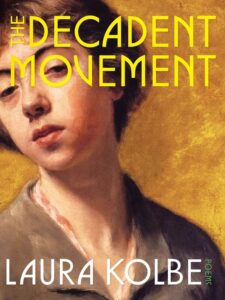
The Decadent Movement by Laura Kolbe is available from University of Pittsburgh Press.