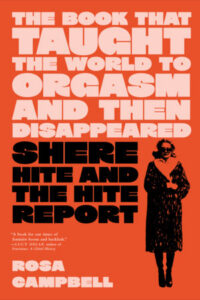
Isaac Butler and Rosa Campbell are both historians and writers whose latest work gravitates toward the culture war epoch of the 1980s and 1990s. Butler’s The Perfect Moment: God, Sex, Art and the Birth of America’s Culture Wars traces how the friction among religious conservatives, the nation’s artists, and the federal government helped forge the political and cultural terrain many Americans inhabit today; Campbell’s The Book that Taught the World to Orgasm and then Disappeared: Shere Hite and the Hite Report retells the story of the era-defining 1970s study on the sexual lives of American women, and what both the study and its subsequent fading can still reveal about sex and culture now. The authors recently connected over zoom to discuss their books, censorship, pornography, capitalism, and art.
*
Isaac Butler: I’d like to begin with a straightforward question, because—frankly—your book genuinely captivates me in a way that feels almost contraband: you’ve resurrected a notably influential, paradigm-shifting work from the dustbin of history. Before diving into your book, I hadn’t encountered Shere Hite or The Hite Report. How did you first come across them, and what inspired you to write about them?
Rosa Campbell: My path was through a PhD in history centered on the global history of Australian women’s liberation. I spoke with women who had been active in feminism during the 60s and 70s. Many cited The Hite Report as a touchstone. For those who pursued formal equality in law yet found that such rights didn’t automatically reshape the sexual politics of intimate life, it mattered deeply. As I read more, I realized Shere Hite remained largely absent from histories of women’s liberation, even though her books moved millions—far more than The Feminist Mystique or The Female Eunuch. That discrepancy drew me in. Then I opened her archive and found it vast—more than 300 boxes.
IB: That’s astonishing.
RC: Then I realized I had actually read the book when I was ten.
IB: You read a study about women’s sex lives and the politics of the bedroom when you were ten?!
RC: Yes—far too young, in hindsight. But my parents were radicals—feminists, trade unionists—and they fostered open access to books. So I simply reached for that Hite volume and read it, and it resurfaced in memory later on. And that was my entry point.
IB: Incredible.
RC: And you?
IB: In a sense, this project feels intensely intimate—my own adolescence was shaped by the Culture Wars, a period I covered in depth. I grew up in Washington, D.C., where my mother was deeply involved in the contemporary art scene, which bore the imprint of these conflicts. I spent my teenage years performing as an actor, which brought me into contact with gay adults and people with AIDS, making the issues tangible rather than abstract news items. As a teenager I cared intensely about three things: LGBTQ rights, ending the AIDS crisis, and state funding for the arts. Those were precisely the focal points of the culture wars during that era.
RC: Exactly.
IB: The immediate impulse behind my book was a sense that we were witnessing an especially extreme version of a familiar arc. The right deployed grievance politics, arguing that the civil rights of others amounted to oppression of them, while on the left there was a curious skepticism about free expression, which sometimes created a permissive atmosphere that enabled the right’s tactics. I wanted to explore that dynamic without making a direct comment on today’s politics, but instead to tell a truthful story from a time I lived through, leaving it to readers to notice what echoes they might recognize.
RC: Right.
IB: The United States has a particular relationship with free speech. In the UK, there is no First Amendment; here, a norm has grown that people should be allowed to speak without automatic material consequences. Yet norms are renegotiated all the time. You might not be fired for protesting a war, but you could be penalized for publishing a newspaper filled with racial slurs. And on the flip side, you can’t imprison someone for either action.
As a teen, I cared deeply about three issues—gay rights, ending the AIDS crisis, and state support for the arts—and those were the core battlegrounds of the era’s culture wars.
And I think these issues are valuable. I was surprised to see skepticism toward them among some friends on the Left—that the entire matter was really about shifting power and controlling the discourse. But the Left doesn’t control everything, and beyond the moral argument, it’s strategically misguided to disengage from these questions.
RC: That’s interesting because there’s a real resurgence of political thought rethinking women’s liberation in relation to pornography today. I was drawn to sex-positive feminism during my first degree in the mid-2000s, with the view that women can discover their desires and negotiate them in the bedroom. And the idea that pornography doesn’t affect people’s sex lives—there were many who argued that it didn’t have an impact, even could be beneficial in helping people discover what they like.
IB: Or it might even reveal what someone is into.
RC: Exactly. People argued that men might watch violent porn yet imagine themselves as the one on the receiving end of violence, which research has shown is not necessarily true. The liberal social contract assumes that if we can’t negotiate rights directly with our employers, there aren’t any power dynamics in sex either. Shere Hite eventually embraced a critical stance toward porn.
IB: She did?
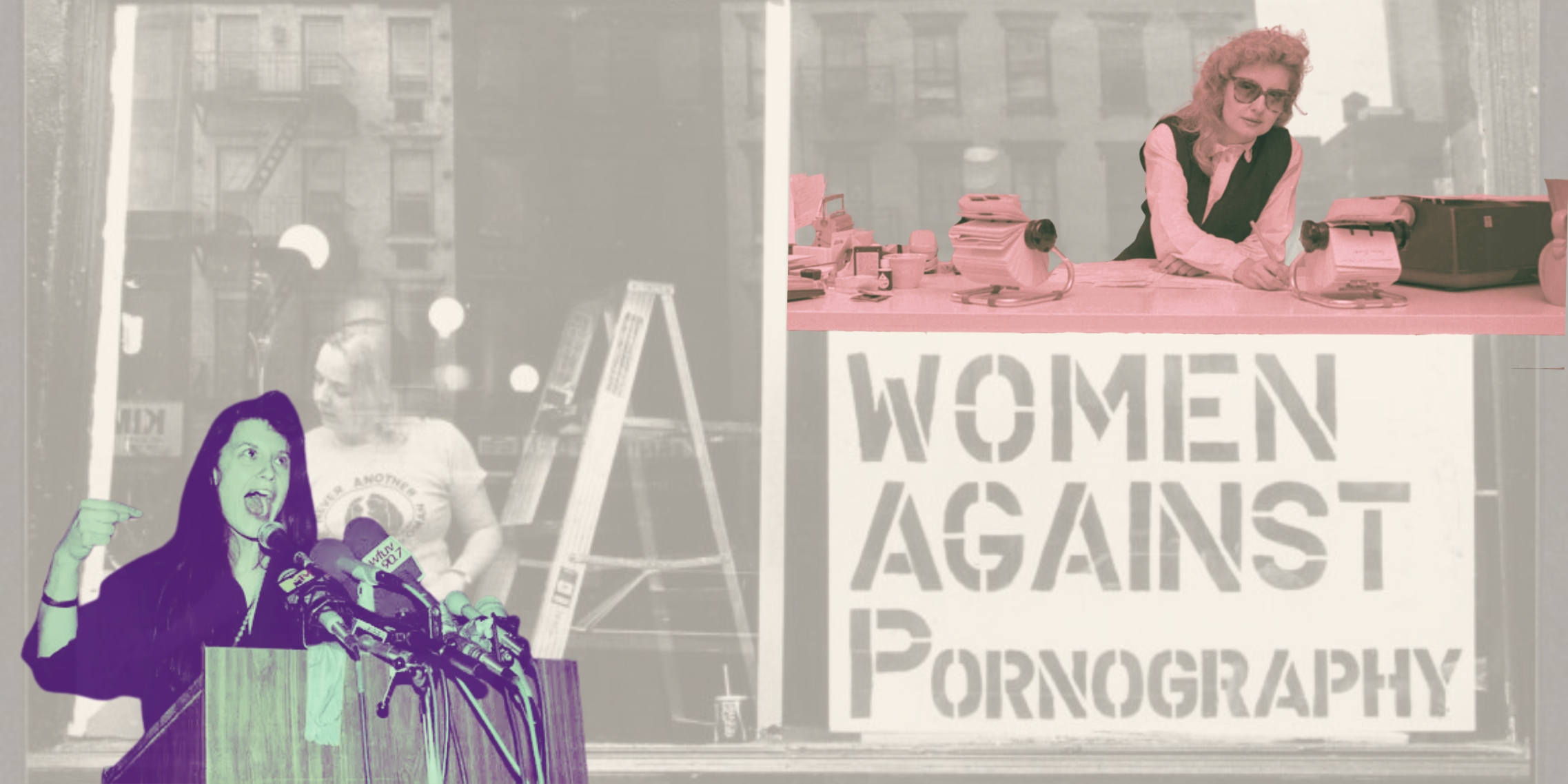
RC: Indeed. She helped establish the group Women Against Pornography. Yet her stance was nuanced: rather than moralizing, she also recognized how media representations of women—fashion magazines and advertising, for instance—could be harmful, and she had herself done modeling work. She rejected limiting the discussion to pornography alone.
If free expression is a fundamental right, then it must safeguard pro-Palestinian protest as well.
IB: It’s striking how some on the left who advocated for free expression ended up aligning with the right’s anti-porn stance. Figures like Andrea Dworkin and Catherine MacKinnon argued against free expression in the name of protecting women, even collaborating with religious conservatives. They formed unlikely alliances with the era’s opponents of porn.
RC: That pattern shows up today too, especially with some anti-trans feminists aligning with conservative forces.
IB: So how did Shere arrive at becoming a writer whose work was attacked as pornographic and then growing into an anti-porn feminist?
RC: The notoriety of her book underlines a practical problem for the left: despite sympathy for concerns about pornography and its effects, banning it would also ban works by Toni Morrison, Judy Blume, Our Bodies, Ourselves, and even visual art that people value. The people who end up being silenced are often not the notorious pornographers but the celebrated creators.
IB: And the Supreme Court’s obscenity jurisprudence is a revealing piece of this puzzle: nine male judges—before Thurgood Marshall joined—who were all uneasy discussing sex, trying to define obscenity in a way that would still permit works like Tropic of Cancer or The Well of Loneliness. The central question—who has the authority to draw the line—remains relevant, especially in the UK today where there is no First Amendment at all.
RC: In both countries today, the Right weaponizes the rhetoric of free expression while conveniently stepping back when free speech leads to real consequences, such as arrests or heavy fines for Palestinian rights activism. There is a particular group—whose name I almost hesitate to utter—that the UK recently labeled a terrorist organization; officials have even jailed elderly clergy for showing support. If free expression truly matters as a core right, it must protect pro-Palestinian protest as well.
And there’s nothing wrong with provocation in art, that’s one of the things it can do!
IB: It’s maddening to see bad faith in action. That sense of pretense is part of what pushed me to be more opinionated in this book than in The Method. Sometimes you have to call out when someone is clearly dishonest. It helps that you appear in your own book and offer your take—the honesty of that choice is something I appreciated. How did you decide to navigate that?
RC: It was a major decision, and I had to define clear boundaries. In academic history, politics tends to be background, but this book is for everyone, so I needed to articulate where I stood. I refused to discuss my own sex life. My approach to Shere Hite was influenced by how she protected women’s anonymity: The Hite Report built on anonymous questionnaires that allowed women to share their sexual experiences candidly. That sense of anonymity felt protective, especially in the historical moment the book reflects.
I’ve also been thinking about today’s climate, where testimonies and traumas are often monetized to build online platforms and personal brands. Feminist consciousness-raising traditions taught women to share experiences to illuminate power structures; anonymity offered protection then, and it might still serve a purpose now.
IB: Definitely.
RC: I also labored to decide where I would insert myself, because I dislike the vibe of authors who insert themselves merely to flaunt their social circle or superiority. Shere had a seductive pull—the way she curated her papers invites a personal relationship with her, even through seemingly trivial items like napkins and scraps with notes. I initially thought her archive was complete, but then realized she had saved only the footage where she behaved well—skimming out the flubs. She curated a polished aura, and I didn’t want to indulge in a hagiography. Including myself in the narrative was a way to demonstrate how I negotiated with her archive and showed that I was aware of her editorial influence over the material.
IB: And it’s clear from your interviews and the book itself how magnetic she could be when she set her sights on shaping the conversation. It’s striking to consider what happened when her star began to falter—like the moment she became a tabloid subject after a dispute with a limousine driver. She even found herself taping a segment for Sally Jessy Raphael, a show that seems more tabloidy than serious. What did you make of that?
RC: I think she was intensely hungry for attention and believed she could broadcast her ideas effectively, an impulse she had cultivated since her early interviews with Playboy and other outlets that yoked her ideas to male audiences in prison or elsewhere. She envisioned continued positive press; perhaps there was naïveté in how she navigated the media landscape, and I wonder how that intersects with the NEA Four story in your book?
IB: Precisely. The second half of The Perfect Moment centers on four performance artists who challenged decency rules as part of funding battles and brought the case before the Supreme Court. They each related to provocation in their own way. There’s nothing inherently wrong with provocation in art; that’s one of its essential functions.
RC: Right.
IB: Yet for Karen Finley, for instance, provocativeness is a deliberate act of transgression intended to jolt audiences awake. Others, like Tim Miller, sought to express themselves openly among peers rather than to offend; Holly Hughes’s case demonstrated how their work was deemed “lesbian in nature.” It’s revealing that much of the provocation was about the existence and self-expression of LGBTQ people, those living with AIDS, and women. I’d like to think progress has moved forward since, though I’m reminded of Erica Jong’s Fear of Flying and Lena Dunham’s Famesick—these works feel in conversation with each other. If you enjoyed Famesick, you might find Rosa’s book equally resonant.
RC: (Laughs)
IB: Yet all three works share a common thread: nothing provokes more than a woman owning how her body is used. People still react with fury to Karen Finley slathering chocolate sauce across her bare chest, to Erica Jong discussing masturbation, or to Shere Hite speaking frankly about sex—and to her past as a porn performer. That very provocation underscores the artistic power and the politics involved.
What these women—and queer activists—ask of us is to approach our sexual lives with clarity, not ignorance.
RC: Lena Dunham’s memoir and the reception of Girls echo this. People often ask me who embodies Shere Hite today, and the answer for many is Lena Dunham. The vitriol surrounding her work is widely known—both left and right attacked her—yet I find her work, including Tiny Furniture, astonishingly powerful.
IB: It’s striking that decades after The Hite Report, the question of female autonomy remains controversial. Some of Dunham’s most vocal critics were supposedly feminist writers on Jezebel, which keeps the conversation alive.
RC: Yes.
IB: And there’s a broader arc tying our books together: my narrative begins where yours leaves off, tracing how market logic and the neoliberal era reshape even the politics of art and free expression. By the late 1990s, everything is framed in market terms. That has a profound effect on who gets to provoke and how much space is afforded to provoking at all, because if it’s a lucrative game, you have to let it run. It’s remarkable to think that a decade that began with political leaders criticizing Bart Simpson ended with South Park: Bigger, Longer & Uncut earning an Oscar nomination. I’m curious about how that shift affected feminism. One of my takeaways is that late-1990s sex-positivity in feminism coexists with media phenomena like Girls Gone Wild or t.A.T.u. How do you see neoliberalism shaping feminism after the era you study?
RC: Lorna Bracewell’s Why We Lost the Sex Wars tackles that head-on—neoliberalism and liberalism both helped seal the sex wars, and in a sense the same forces that produced the anti-porn arguments also shaped the malevolent marketplace that produced sensationalized depictions. It wasn’t the left that created Girls Gone Wild—it was the market.
IB: Exactly—the difference is that Finley’s provocations targeted the degradation of women that Girls Gone Wild thrived on. That brings me back to something you mentioned early on. You aren’t categorically anti-sex or anti-pornography in your feminist stance, though you raise significant questions and have a nuanced stance. After immersing yourself in Shere Hite’s archive and having read the Hite Report since age ten, I’m curious about how your views have evolved. Is pure, unblemished desire in the bedroom even attainable, or is that a utopian dream?
RC: This book fundamentally reshaped my thinking. It sits alongside other scholarship that reconsiders women’s liberation, pornography, and related debates, including your own work from a different vantage. What these women push us to do—and what queer activists push us to do—is to approach our sexuality with intelligence, not naiveté.
IB: Agreed.
RC: Let’s not pretend we walk into intimacy as if it were a neutral contract negotiated from scratch.
RC: I’m curious whether your own work on this book changed you.
IB: Absolutely. Before I began, I wasn’t sure how coordinated the Right’s attacks were; I thought it was a sincere outcry, even if misguided. But I came to see that the offense was orchestrated behind the scenes by a sophisticated political machine designed to inflame their base for strategic gain. It became clear that defending liberal values—free expression, open debate, and the common good—doesn’t automatically level the playing field in these battles. That’s a crisis we see across the United States, Europe, and Latin America, and I’m not certain how we restore balance.
__________________________________
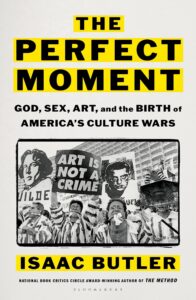
The Perfect Moment by Isaac Butler is available from Bloomsbury.
The Book That Taught the World to Orgasm and Then Disappeared by Rosa Campbell is available from Melville House.