
I recently wandered through a residence on Manhattan’s Upper East Side, a place whose interiors invited warmth even as the doors stayed closed to me. I moved about in the dim, peering in through panes as if someone else’s secrets were on the other side. My imagination ran wild with the thought of curling up in one of the indulgently plush beds, nestled beneath gilded headboards and silk sheets. I found myself marveling at the building’s private elevator, a rarity that I had never encountered in a home before. The collection of paintings, mounted salon-style in a voluminous entry hall with striped floors, left me astonished: cubist works, pieces by Gaston Lachaise and Marguerite Zorach, and Marcel Duchamp’s celebrated Nude Descending a Staircase!
I pressed on toward the other wing of the house, discovering a chamber whose walls shimmered silver and whose furniture wore a bold red lacquer. A mahjong set lay abandoned in the center of a table, and a bookshelf spilled its contents into a corner. I longed to be granted access, to settle into one of the red chairs with a book in hand. Between the shelves, beside authors like Sterne, Swift, and Defoe, rested a light-blue volume titled Love Days, written by Henrie Waste. Oh, how I yearned to read it!
If trespass had ever been a practical option, perhaps I would have found a way inside. Yet how does one break into a house so miniature that its furniture fits in a person’s pocket? Conceived in 1916 and continuously revamped through 1935 by Carrie Stettheimer (1869-1944), the dollhouse entered the Museum of the City of New York in 1945, where I later encountered it encased in glass on a chill winter afternoon. Carrie conjured a “Honey, I Shrunk the Salon” miracle: she captured her family’s world of art and privilege in miniature, preserving a salon hosted by Carrie and her younger sisters, painter Florine and writer Ettie, a circle that welcomed the era’s foremost avant-garde minds and thinkers at the turn of the century.
Her startling novel guides us through the Stettheimer sisters’ fabulous world and the interior spaces of a troubled woman’s mind.
The dollhouse is most often discussed in relation to Florine’s (1871-1944) paintings: bright, dreamlike canvases featuring gigantic blossoms, New York City landmarks, and her stylish sisters, dressed in drop-waist gowns or bounding through rural scenes in trousers. The house, along with its diminutive art collection, crystallizes Florine’s role as an avant-garde force, yet it also holds a rare, tiny copy of Love Days, one of two books Ettie published under the alias “Henrie Waste.” Ettie (1875-1955), youngest of the Stettheimer sisters—nicknamed the “Stetties” by those who knew them—has not received the same attention for her own artistic productions, but she was far from inactive.
A century after Love Days appeared, Ettie’s literary career has largely disappeared from memory. Instead of reading her writings, we see references to her in Florine’s paintings and in the tiny volume nestled in Carrie’s dollhouse. This reissued edition of Love Days, enlarged to human scale by Mandylion Press, shifts Ettie back into the foreground as an author who shaped her own life through words. It invites readers to follow the Stettheimer sisters into their dazzling sphere and into the interior life of a woman struggling with her own sense of self.
Ettie’s alter ego Henrie Waste came to life in 1917 with Philosophy: An Autobiographical Fragment, a narrative voiced by a young woman pursuing a Ph.D. in Germany at the dawn of the century. Henrie’s next and final novel, Love Days, appeared in 1923 from Alfred A. Knopf. The use of pseudonyms by women writers born in the nineteenth century is commonly treated as a feminist maneuver to navigate a male-dominated literary world.
A 1923 New Republic review of Love Days, which refers to Henrie Waste with female pronouns, suggests Ettie’s chosen nom de plume more as a liberation from the Stettheimer identity than as a deliberate gender transgression. The name “Henrie” is drawn from Henrietta’s given name, already present in part; the surname “Waste” stands in contrast to a novel in which nothing is wasted—Ettie herself offers her experiences as raw material for plot and character.
Ettie was born in Rochester, New York, on July 31, 1875, the youngest of five children fathered by Joseph and Rosetta Walter Stettheimer. Joseph left the family in the late 1870s, never to be heard from again. Rosetta relocated first to New York City and then to Germany, raising the children between Stuttgart and Berlin. Extended stays in Europe shielded Rosetta from the scandal surrounding her husband’s disappearance. In the 1890s, the elder siblings, Stella and Walter, married and moved to California, leaving the family unit to four single women who lived together until Rosetta’s death in 1935. Florine studied at the Art Students League of New York, while Ettie completed Barnard College in 1896. She earned a master’s in psychology two years later and, in 1908, a Ph.D. in philosophy from the University of Freiburg. When war disrupted their continental lifestyle, Rosetta and the Stettheimers settled permanently in New York, maintaining homes at 102 West 76th Street and in the Alwyn Court building at 180 West 58th Street.
Love Days traces Ettie’s life through the narrative of Susanna Moore. Rather than a conventional bildungsroman that follows its heroine from childhood to old age, Love Days tracks Susanna from her college days into the sanatorium, with each chapter spanning a single day of her development as she shifts from a dreamy student to a more somber adult. Susanna attends a women’s college in Manhattan, excelling in ancient Greek, yet she struggles to keep track of her peers’ names and hometowns. While some of her classmates marry and establish stable lives, she continues her studies at a German university. Her widowed aunt acts as chaperone as Susanna attends lectures and endures the advances of many suitors.
Exhausted by the relentless advances of German men, she returns to New York, where she rents a bohemian studio and befriends artists who have become household names. She rejects marriage in principle, yet falls for Pol Grodz, a rising figure in the art world whose work feels both modern and richly rooted in the Renaissance’s harmony. The reality of married life disappoints her. Susanna wonders whether the chance to help an artist achieve a lasting masterpiece—perhaps even immortality in a museum—could ever compensate for the protracted “honeymoon.” Henrie Waste answers this with a firm no.
Susanna’s “love days” prove fleeting. Her passion for Pol blazes briefly and then dies out. If the novel has a moral, it’s that marriage can be a trap. She discovers this too late; drawn by desire, she ends up confined within a conjugal prison. The Stettheimers avoided such crises, courting without surrendering their New Woman freedoms. Gossip has linked Ettie, the most sociable sister, to sub‑adult loves and to figures like Marcel Duchamp and Elie Nadelman. Duchamp—present in Love Days as the character Pierre Delaire, a quirky Frenchman who surprises Ettie at the studio after returning from Paris—proclaims, “I didn’t spend all my time playing chess; I started some canvases.” He explains that his new paintings possess “an ulterior purpose that lifts them beyond Cubism.” If Delaire is ultimately left in the friend zone within Love Days, perhaps Pol Grodz is a composite of the many gifted, temperamental men who visited the Stettheimer salon—perhaps Florine herself, or someone closely tied to her sister Ettie.
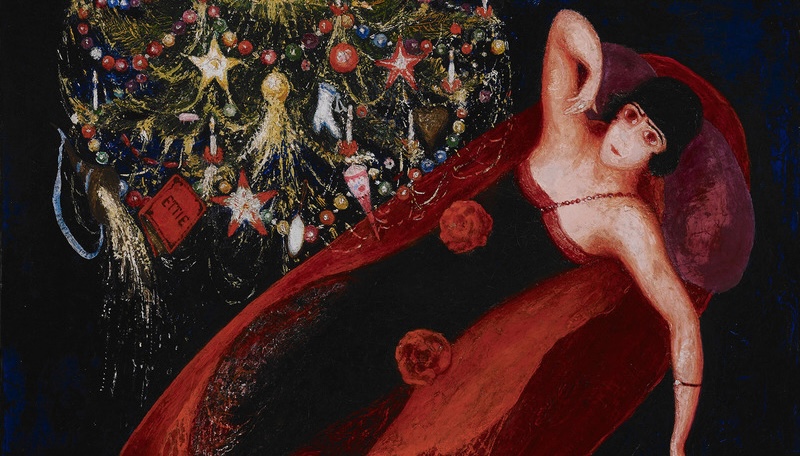
Although Ettie never married, she understood the artist–subject dynamic intimately. Florine illustrated Ettie countless times, capturing her image across various works. Susanna and Pol’s marriage grows strained when Pol spends their honeymoon obsessively sketching his wife. He chides Susanna for posing “as a model before her painter—not as a wife in bed with her husband, her lover.” Ettie depicts the artist–model relationship as a power struggle. Susanna only succeeds as a wife when she bends herself to fit his ideal image, prompting him to cry out, “you are a Grodz!” After Ettie’s death, she managed Florine’s estate, arranged major exhibitions, and placed Florine’s paintings into major collections. In doing so, she cemented her own identity as “a Stettheimer!”—not merely a person but a recurring motif. The sister with heavy brows and dark bangs who often holds a book can be spotted in many museum halls, yet we rarely hear from her directly.
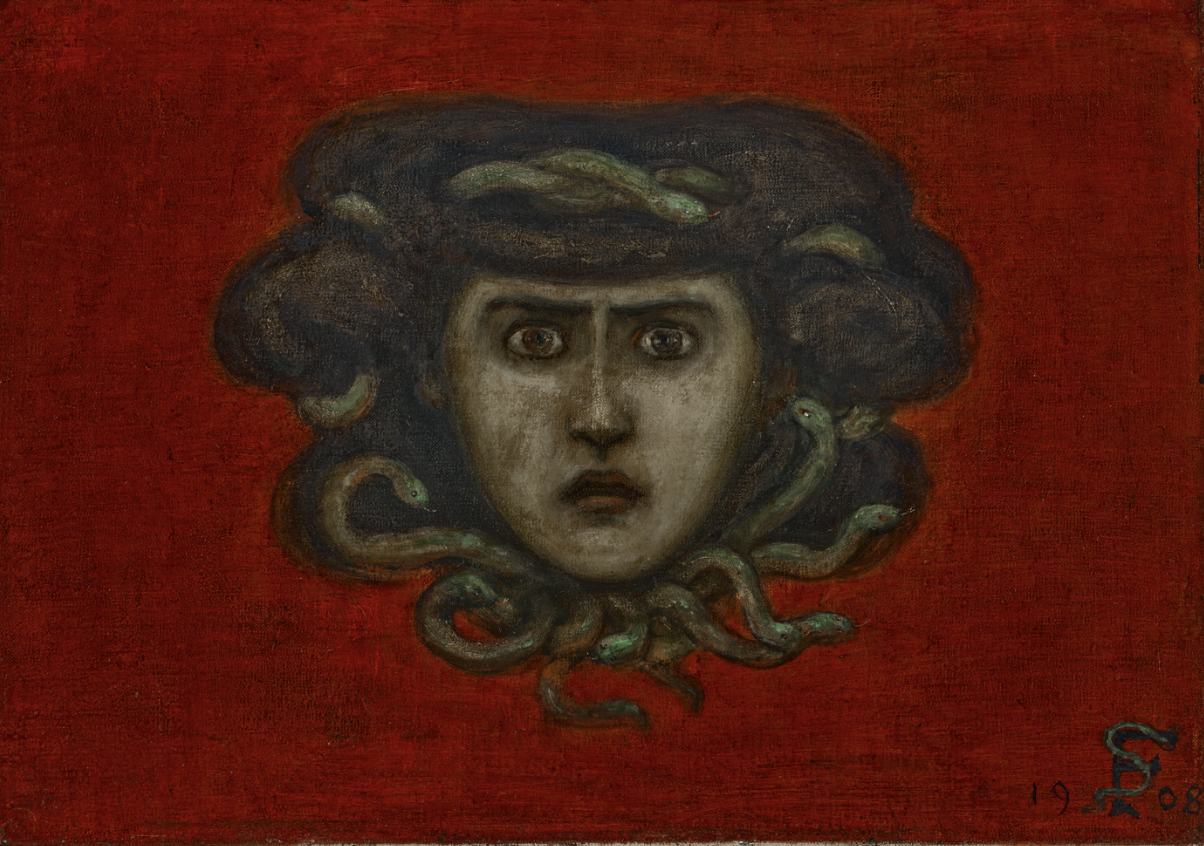
One of Florine’s portraits of Ettie offers a glimpse into the essence of Susanna Moore. Ettie’s visage is transposed onto the head of Medusa; as in real life, her bangs hover near her eyebrows, but in this likeness green serpents coil through her hair. The figure’s mouth and eyes widen in a moment of terror. This portrait dates to 1908, the same year Ettie earned her Ph.D. from Freiburg. At the apex of her intellectual strength, she is rendered as a Greek goddess who petrifies men. What stands out is Medusa’s own stone-like surface. A floating head in greenish-gray against a blood-red backdrop, Ettie becomes both Medusa and her prey. Love Days penetrates the psyche of the severed, Medusa-like woman who uses her art to shield herself from the hazards of her own subjectivity. Susanna’s relationship with her body and sexuality is torturous: she stares at her reflection and wonders what she looks like, and in intimate moments she shuts down completely.
As Susanna wanders through prewar Berlin, taking in its historic architecture, she dreams of her homeland, an ever-shifting New York where buildings rise and fall with astonishing speed. “When the Plaza Hotel grew antiquated, another one would inevitably take its place, a newer Plaza, and vacuously serve its purpose.” In a stark confession of her own dissociation, Susanna longs to adopt what she calls the Plaza method of reproduction—to birth a new version of Susanna while simultaneously avoiding physical intimacy altogether.
Later, during their miserable honeymoon, Susanna pretends to sleep as Pol manipulates her body, drawing her closer with whispered, “I die of thirst and hunger for you.” As he violates her, she lies motionless, rigid as a doll. These scenes resonate eerily with the Stettheimer dollhouse. Susanna looks for an architectural fix for human reproduction—rather than a body, she longs to be a building. When pressed into bodily participation, she adopts a doll-like stance.
Love Days gets inside the head of the disembodied, Medusa-like woman who uses her work to escape the perils of her own subjectivity.
From the opening pages of Love Days, readers are introduced to Susanna’s tendency toward dissociation: she has breakfast but cannot recall what she ate; she never takes the streetcar in the traditional sense—she finds herself on it. The novel is deliberately drawn out by ellipses, as if our heroine momentarily loses not words but consciousness. She experiences true happiness only when she is absorbed in work, yet “happy” does not equal whole. Her labor becomes a refuge from real life. When a nameless German classmate confesses his love, she withdraws—from him and from her own feelings—in favor of obscure ancient texts.
After luncheon she got to work, and she soon managed to detach herself from her troubles by plunging deep into her research, an investigation of certain Greek verse forms. Working, she was no longer either happy or unhappy; she was personally submerged; she existed only as mind, as instrument. As an individual she had become as non-existent—for herself at least—as one becomes in dreamless sleep.
Yet I recognize that impulse to escape through study. It is easier to inhabit “mind” and “instrument” than to acknowledge a living, breathing person who desires and needs. It is worth noting that the privilege of pursuing advanced study was still a hard-won entitlement for women. The Stettheimers belonged to the first wave of female scholars granted access to higher education. Susanna worries that she cannot keep pace with Pol and his avant-garde circle without admitting that earning a college degree was a radical achievement for a woman. The Stettheimer narrative processes this upheaval through Susanna’s inner unrest and the novel’s elliptical structure.
Ettie clearly saw herself as a pioneer. In 1951 she published Memorial Volume: Of and By Ettie Stettheimer, a collection combining her two novels, several short stories, her Ph.D. dissertation on William James, and a letter from James praising her work. In a New York Times review from that year, critic Elizabeth Janeway warned against dismissing Miss Stettheimer. In the context of a Fitzgerald revival that had cast the Twenties into a retrospective glow, Janeway argued that the decades preceding the Roaring Twenties risked becoming invisible. In this historiographic moment, she praised Love Days for its insights into “the real years of anguish and growth” that predated the Jazz Age.
Susanna Moore is terribly important to us, more so than any of Hemingway’s gallant girls. She is greedier, not only unsatisfied as are Lady Brett and Gatsby’s Daisy, but insatiable, for she wants so much more than life can give… She is the creation of that male age so incongruously named for Victoria—she is what emerged at the end of Victorianism when the curtain of male supremacy was finally lifted.
It is tempting to cast the late nineteenth and early twentieth centuries’ high-achieving women as triumphant victors. Yet Susanna’s journey does not end with her college graduation, nor does Avis Dobell’s arc conclude with her training as a painter in Elizabeth Stuart Phelps’s The Story of Avis, which Mandylion is reissuing alongside Love Days because both delve into ambitious women’s lives. The Stettheimer and Phelps novels stand out for their portrayal of change as a slow, uneven process. New opportunities bring new hurdles—a woman can exist as mind or instrument for only so long. If she wishes to couple professional achievement with some emotional, spiritual, or physical fulfillment, there will be consequences. While The Story of Avis remains rooted in nineteenth‑century sensibilities, Love Days occupies the transitional space between centuries. Susanna Moore may be the first Mandylion heroine to place a phone call, drive a car, or ride an elevator, yet, like Avis before her, she loses her independence and creative potential when she opens her heart to love. The persistent, “both/and” character of Love Days—an odd blend of avant-garde experimentation with Victorian prudence—challenges neat timelines and helps justify Mandylion’s aim to extend the nineteenth century’s long form. The joy and pain of engaging with ancient literature and old texts remind us that the past remains relatable: as history advances, so does the risk of stagnation. I completed my Barnard College degree one hundred and twenty years after Ettie Stettheimer’s own graduation, a member of the college’s earliest class. In that span, women won the vote and humankind reached the moon, yet the lure of slipping into an alternate universe where men pose no threat to a woman’s dreams persists.
______________________________
From Love Days by Ettie Stettheimer. Introduction by Mabel Capability Taylor. Copyright © Mandylion Press, 2026 and Mabel Capability Taylor.