The literary world is finally asking a question it has dodged for years: What can a human writer do that artificial intelligence cannot? The answers tend to circle around technical and personal aspects of writing, like voice, lived experience, and emotional nuance.
The literary arena is now confronting a question it has long sidestepped: what is it that a human author can accomplish that machines cannot replicate? The usual replies tend to cluster around craft-related facets—how a voice emerges, the weight of lived experience, and the subtleties of emotion.
But beneath all of the conversations currently taking place lies a term that contemporary literary culture has carefully avoided: soul. AI can absorb every book in a library and reproduce sentence upon sentence, yet it cannot ache for something unnamed or grieve a father it never truly knew. It cannot linger in stillness until quiet solitude evolves into meaning. That realm belongs to the soul. In the era of AI, the writer’s soul remains the single element that cannot be imitated, and we have yet to develop the tools to nourish it. Most people aren’t even comfortable naming it or talking about it.
They use language to enter spaces where mystery lingers and invite others to join them there.
A few courageous books and journals have begun to say this aloud, arguing that the writer’s inner life is not a luxury but the wellspring of any piece’s depth and the originality of any essay. Yet there is a difference between owning a small library and a shelf full of journals and possessing robust structures that truly sustain the souls of working writers. We do not leave craft to chance; we construct MFA programs, conferences, grants, and residencies around it. We do not leave career development to chance; we arrange panels on publishing, money, and marketing. When it comes to the inner lives of writers; however, we mostly avert our gaze and assume people will figure it out on their own. At a daylong gathering in Birmingham, Alabama last May with more than 120 writers from the South, convened to discuss “what writers need,” not a single presentation, session, or panel touched upon the soul.
It is understandable that many avoid discussions about spiritual life. Religion has harmed many people; there is fear of proselytizing; language about the soul can sound hazy or exclusive; literary culture often elevates secular and intellectual values. And while Christian publishing and conferences sometimes address the writer’s soul openly, those spaces are framed by particular beliefs and aren’t designed for the Buddhist poet, the agnostic novelist, or the writer who left the church but not the longing. Secular spaces have banished the soul from the building. Religious spaces have tightened the room around it.
Poets and novelists—think of Toni Morrison, Adam Zagajewski, Kaveh Akbar, and Jamie Quatro, among others—who venture into the deeper currents of the soul don’t demand that readers assent to any specific creed or checklist of beliefs to engage meaningfully with their poems and stories. They use language to enter zones where mystery lingers and invite readers to join them there. Yet when it comes time for a writer to examine their own soul and grapple with spiritual uncertainties about the impact of AI, avenues of guidance can feel scarce.
The need has persisted and grows as institutions and the industry tighten their grip. I work as a spiritual director within a Christian framework, meeting regularly with Buddhists and agnostics who have few other options. Much of my own writing and publication also happens within the Christian market, and creating space for writers of any belief—or of none at all—is, to me, a fundamentally Christian act. Yet I am not arguing for religious programming in secular venues. I believe every writer possesses an inner life worth tending to, and this is a universal human need, not a doctrinal one.
AI will advance, but it will never cultivate genuine longing, grief, or ethical self-questioning.
At the moment when AI pushes us to consider what only a human writer can do, Americans are turning more toward the inner life. Recent surveys indicate that roughly four in ten adults feel more spiritual, even as far fewer claim to be more religious. Younger generations are drifting away from organized religion while maintaining practices such as meditation, prayer, and time spent in nature; a sizable share of those who identify as “Nones” still engage in explicitly spiritual activities. The share of Americans who say religion remains a crucial part of their lives and who regularly pray or attend services has remained steady since 2020, despite a decades-long national decline in religiosity. Taken together, these figures suggest that the audience for soul-centered conversations is not shrinking, but shifting from formal religion toward more personal, improvised forms of seeking.
Meanwhile, most writers do not discuss the soul in workshops, conferences, or editorial meetings. The result is fragmentation: the spiritual life of writers remains hidden as they pitch ideas, meet deadlines, and build their platforms—all while sleepless nights creep in due to AI anxieties and dwindling opportunities to earn a living from their artistry.
On the surface, the writing may appear polished, but many in the literary arts feel divided—curiosity about the spiritual life hidden away in private, while professionally they remain outwardly secular. That division is not neutral; it wears down the soul and gradually erodes the authenticity of creative work. The antidote to fragmentation is integration. When writers bring their entire inner life into the light and into broader discourse, it does more than feel better; it deepens the quality of their craft. The writing begins to emerge from a single, coherent self rather than a chorus of competing voices.
Practical steps could include literary conferences offering sessions on the inner life and sustainable creative practices, MFA programs adding optional courses on contemplation and artistic identity, and residencies that honor time away as soul-tending rather than mere productivity and word counts. I’m not proposing a replacement for the current craft or career infrastructure, merely soulful enhancements.
AI will advance, but it will never cultivate genuine longing, grief, or ethical self-interrogation. These are traits that belong to human writers whose souls require care to flourish. If we want writing that only humans can produce, we must act as though the inner lives of writers matter as much as their published work.
__________________________________
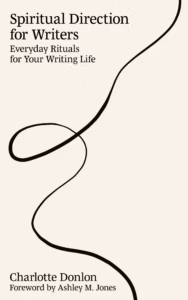
Spiritual Direction for Writers: Everyday Rituals for Your Writing Life, by Charlotte Donlon, is available from Here Below Books.