For the past six years, I’ve been working on a project that I describe to strangers and casual acquaintances as “a book about flowers,” and to friends and family as “a book about flowers and my not-marriage.” Though the book’s narrative throughline is about a cancelled wedding followed by a marriage of convenience, each essay in Flowers pairs a person from my life with a plant I’ve grown in a garden. It is impossible for me to understand any part of my life in insolation, and this is particularly true of relationships, familial, platonic, and romantic.
I love the word “ostensibly,” and I love books that are ostensibly about romantic love but are really about…something else. What follows are some of my favorite titles, both fiction and non-fiction, that complicate and distract from and look askance at the traditional story of two people falling in love and getting married. Just for fun, I’ve organized the list from “least married” to “most married.”
*
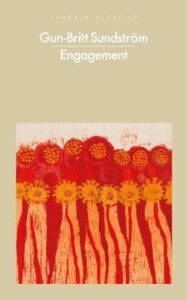
Engagement, Gun-Britt Sundström, translated by Kathy Saranpa
First published in Sweden in 1976 and only recently translated into English, Engagement has been described by The Guardian as a “cult anti-marriage novel” and deserves first place on this list. Though Engagement does concern itself with the complications and trials of courtship, the primary difficulty lies within the heart of Martina, the novel’s protagonist. She does not want to get married, and, this being set in the 1960s, does not need to get married, and is finding the experience of being loved by a man who wishes to marry her, deeply conflicting and oppressive.
The novel covers a seven-year time span, and the book’s Swedish title literally translates to “husband.” Though this reminds me of Marilyn Monroe’s iconic subway-grate photograph, the questions that Engagement is concerned with are of a woman’s autonomy: How much must we give up ourselves to be close with another, especially if that other person is a man? Is it worth it?
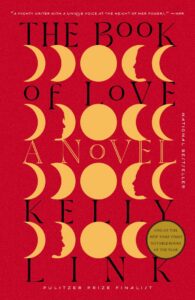
The Book of Love, Kelly Link
Last year, I assigned this book in an undergraduate creative writing course before checking the page count—the paperback is a whopping 700+ pages. I was worried the students would revolt, but my fears were unfounded. Despite the length, The Book of Love is a delight to read. With short chapters and multiple POVs, it is an absolute page-turner, even though most of the plot takes place over the course of only a few days.
Three teenagers are brought back to life in a high school classrooms and no one in their small Massachusetts town except, sometimes, Susannah—the sister of one and the love interest of another—remembers that they were missing. Dear Reader, there is fox sex in this novel. Despite all the courtship and the will-they-won’t-they aspects of this story, the books ends with zero marriages, favoring instead much more substantial and heartbreaking forms of coupledom and partnership.
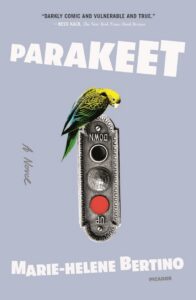
Parakeet, Marie Helene Bertino
This book was first recommended to me during the early days of writing Flowers, and I avoided reading it for several years because I guessed that it would be a book that landed close to my heart. Even though I’d guessed correctly, I still wish I’d read it sooner.
The week of the Bride’s wedding, her dead grandmother returns in the form of a parakeet. Or does she? The book takes as true the unreality of a talking / psychic bird, the Bride body-swapping with her mother, the dissolution of a bathroom stall, but these moments are mostly private, threaded through the heightened stressors of an upcoming wedding that, despite the Bride being the bride, she does not seem to have much control over nor does she particularly want. Though the plot of this book is about getting married, the book is actually about family—the blood-relation kind and the way that the past shapes the future. It is also very, very funny.
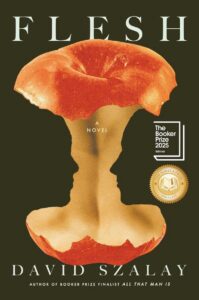
Flesh: A Novel, David Szalay, translated by András Barabás
Flesh spans multiple decades in the life of István, lingering on significant romantic and sexual episodes with substantial leaps in time. István ends up married—we glimpse the start of an affair with a married woman that likely leads to courtship and marriage, but those later moments occur off the page. The dialogue remains remarkably spare. Yes, István marries, but most intimacy is conveyed through his body rather than dialogue. This is an epic, bleak novel that I love deeply.
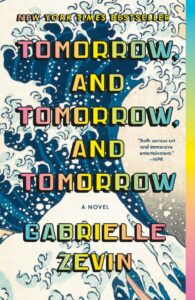
Tomorrow, Tomorrow, and Tomorrow, Gabrielle Zevin
I came to this book at a friend’s urging: I had just returned from a research trip to the Ware Collection and she was midway through Tomorrow, Tomorrow, and Tomorrow, insisting the coincidence was too perfect to ignore. She was right.
At the novel’s start, former childhood friends Sadie and Sam reconnect after many years at a train station near Harvard, where they both study. This, too, is a story in which the marriage unfolds off the page: through Sam, Sadie meets Marx, the man who becomes their business partner and eventually Sadie’s husband. While jealousy and complications swirl around Sadie’s marriage, they are largely contemplated in relation to Sadie’s bond with Sam.
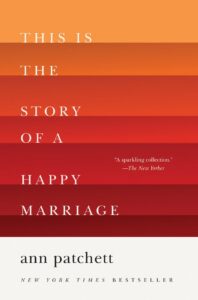
This Is the Story of a Happy Marriage, Ann Patchett
Surely you’ve seen the cover of Patchett latest novel, Whistler, all over this summer’s Best Of lists. Though she’s probably best known as a novelist, her nonfiction is—I think—equally wonderful. Despite the book’s title, this collection of essays is as much about Patchett’s life as an artist as it is about her romantic relationships.
In an early essay, “The Sacrament of Divorce,” we learn that the dissolution of Patchett’s first marriage “began less than a week before we were married.” For many years afterward, Patchett happily lives her life eschewing marital commitment, in several “wonderful, long relationships with people I deeply enjoyed but would not have wanted to marry for a minute.” This does not change when she meets the man who will eventually become her second husband. They live in separate houses for eleven years before her then-boyfriend’s health emergency and the benefits that legal marriage bestow tip the scales. It’s the story of a happy marriage, but a book about how to live happily without being married.
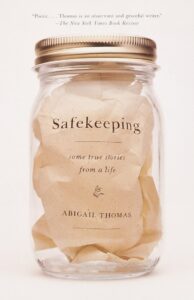
Safekeeping, Abigail Thomas
This is a beautiful collection of perfect, spare vignettes. Told in a mix of first, second, and third person POVs, we move forward and back in time, through different tenses and settings. In the opening essay, Thomas writes, “I am remembering this time just before I knew you, and then I knew you, and then you died. It makes the parentheses within which I lived most of my life.”
Sometimes the narrator addresses the reader, sometimes her grandchildren, sometimes—as is the case with the quote—a deceased “you” that we eventually learn was Thomas’ second husband.
Though this may make it sound as if the book is about her second marriage, the impetus for all this remembering is not only the man’s death, but the fact that he has moved back in with Thomas and her third husband to be cared for during his final days. This is safely the “most married” of the books I’ve included, and the the titular essay suggests that the safekeeping being considered is not the security of marriage but rather preservation and repetition. The book is an apology; the book is a present—but the answer to the unasked-question “For whom?” remains ambiguous.
______________________________
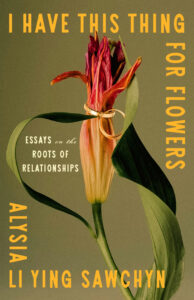
I Have This Thing for Flowers: Essays on the Roots of Relationships is available from Flatiron Books, an imprint of Macmillan.