
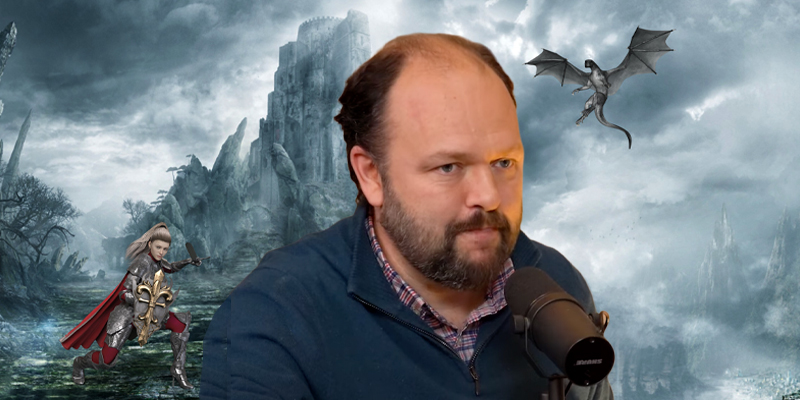
Hold fast, weary traveler—rest a moment and lend me your ear for a while.
Have you caught wind of the Emperors of Narsil, or the Mandoran Invasion of Brethony? No? What of The Skalbard Coast, Cranholt on the Mersana River, or Pharazel Maheris’s Lives of the Great Viceroys? If those names have not crossed your path, then you have not yet heard of The Falcon’s Children, the opening volume in Ross Douthat’s young-adult fantasy trilogy. Fortune smiles upon you, for the project that once resided on Substack as a serialized tale will be published in print next year under Luminor, the Catholic imprint.
What’s that, traveler? Do you mean the very same Ross Douthat celebrated in esteemed journals for mulling over spiritual malaise and the currents of populism after Trumpism? Yes, the same writer who recently parted ways with his position on the New York Times op-ed page and who moved from the editorial fortress of the Times to align himself alongside Bari Weiss and her beleaguered 60 Minutes project. Perhaps, in another era, you would call him a new Andy Rooney—only this time he’s railing against a woke pope?
Hath not thou heard that Douthat has long nurtured a sideline as a teller of fantastical tales for children?
Perhaps the turn toward speculative fiction should not astonish the traveler in you. A 2010 profile in Mother Jones once cast his conservative vision as approaching utopian dreams—“magical, Tolkien-like thinking,” the piece suggested.
I have been too engrossed in the tavern’s wizardly draughts to spend long hours with The Falcon’s Children, save for a few fragments from the opening chapter that you may read for yourself. Yet the ravens whisper of judgmentful reviews. Slate’s critic Laura Miller looked at the opening pages back in 2023 and seemed unimpressed; she suggested that if the rest of the novel mirrors Chapter 1, it would require a wholesale rewrite.
But I shall not pretend to know your tastes, traveler. If you crave dense, richly imagined fiction, you may be right to seek it here. Douthat characterizes the work as speculative historical fiction, and the book’s avalanche of supplemental world-building—dates, dossiers, and lore—runs deep with history and archangels. There is, of course, a hand-drawn map. Surely, true fantasy is not complete without a map to guide the journey!
Who might pick this up? Who can say, traveler. Perhaps a young policy operative at the Heritage Foundation, hoping to lull their children to sleep with tales far removed from the day’s debates, might read it aloud. Beyond such circles, my pockets hold many Mandoran coins, yet I fear they bring little illumination to your question.
I must disagree with your cheer, echoed in good humor, that we have “finally” a fantasy novel written by a Catholic author. I would counsel you to explore almost any other book in the canon before turning to The Falcon’s Children. There is no need to reinvent the grand duo of Tolkien and Lewis for a fresh take; if you must, I would point you toward the Earthsea shelves in the libraries of Nevus Albina instead.
Yet if you seek writing that is open-hearted and from a thoughtful, non-regressive Christian perspective, you might invite the Mandoran Raphielite sisters to fetch you something from their shelves by Christian Wiman. His poetry, along with his essays and reflections in My Bright Abyss and Zero at the Bone, offers a meaningful glimpse into what it means to be human, dear traveler.
Now, I must away to other blogs. I wish you fair winds on your journey, traveler! May we cross paths again down the road, when another conservative mind turns to fiction.
Images from Wikipedia and Pixabay
