
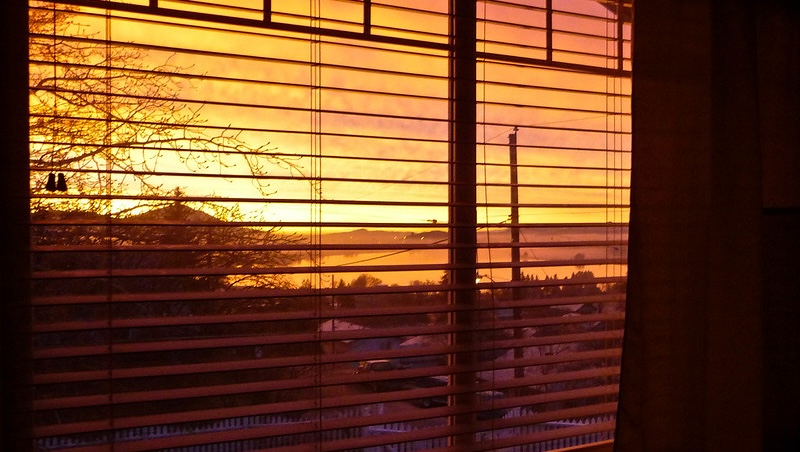
Five a.m.—it’s me and the birds. This is how I like the moment: when the house is still dreaming. Outside, the slow churn of a garbage truck rumbles by. A lone scooter tears through the block. Occasionally a helicopter hovers overhead. A different kind of writer might pause to name the neighborhood birds (mourning doves, blue jays), or open an ornithology app, but here technology has no place, and any research could derail the hour completely. Birds, you ask? Sure. Sweet chirps, gentle croons, the far-off cry of a shorebird steering toward the sea, lively and hopeful, as daylight begins to spill in. In winter, the tone of their song carries a note of desperation, a plea in the dark, joined by the radiator’s heavy breath, yet aside from these seasonal shifts, this is the cadence I’ve grown to rely on as an early morning writer for as long as I can remember.
Tired? Of course, but I’m not sleeping much these days anyway, as I’m at an age when the body starts to rebel, jolting awake at 3 a.m., skin burning, soaking the sheets with sweat. The body is a gremlin, but this isn’t a menopause essay. If anything, exhaustion is essential. Lidded eyes, shoulders slumped over the kettle, I’m up but barely, skimming the edge between wakefulness and sleep, that delicate space where the magic is said to happen. Who am I kidding? There’s no magic. Writing can be a slog. Yet it’s now or never, in this narrow pocket of time or not at all, my dog trailing me downstairs, clacking on the hardwood, before curling up by the window to watch the world and wait for his moment.
All I have to do is show up, be here, stealing time, savoring it, trusting in its possibility, staying open and curious to whatever comes.
It’s my turn now. Coffee in hand I bypass my office, skipping anything formal or upright, and settle into my daughter’s room now that she’s away at college. Bed writing has a certain appeal. In her bed I’m reminded of how and why this habit began, my grown kids then toddlers, my mothering brain stretched thin enough that I blurted to Meg Wolitzer, my teacher at the time, about not writing, about not this and not that, until Meg looked at me, worn out, on the verge of tears, spent from sleepless nights and steady need, from the gulf between who we are and who we want to be, and answered with her measured calm and endless kindness, in what would become the best advice I’ve ever received: “Steal it. If writing matters to you, you’ve got to find a way to steal time. No one is going to hand it to you.”
So began the great heist. Five minutes on a playground bench. In the nursery pickup line. Outside the dojo, on the soccer sidelines, in a crowded subway car, stroller wedged between the knees, wherever. Parents understand. Another episode of Octonauts is worth every sentence.
Until I arrived here: at the wild, expansive hour that feels almost ungodly.
Everyone has a window when their creativity is strongest. For me, it’s a rite of passage with the birds, so the one commitment I could make for my writing was simply to show up for it. This is when I am least severe, least self-conscious, unconcerned with market mess or the many “shoulds.” The critical brain is still in a haze, and with it, its clingy sidekicks—self-doubt and anxiety. The to‑do list hasn’t emerged yet. Teeth brushing can wait. All I have to do is show up, be here, stealing time, savoring it, trusting in its possibility, staying open and curious to whatever comes.
It’s not exactly a revelation. Dozens of writers practice at dawn. Katherine Anne Porter. Hemingway, Vonnegut. Murakami. Regarding her morning ritual, Toni Morrison said: “It’s not being in the light, it’s being there before it arrives.” My writerly neighbor up the hall is already at it long before me, the glow from her desk lamp catching me like a thief as I stumble down for coffee.
Writing early in the morning relieves the pressure, lowers the stakes. It keeps things honest. There’s something about the morning prefrontal softness—an environment favorable to creation, spontaneity, and a porous doorway to discovery. Dawn isn’t the hour for editing or questioning the work. I’m not second-guessing. I’m still half asleep, tangled in the dreamscape’s logic, guided only by the intuition that flickers in the dark. In this state I fall, and keep on falling.
I do it with pen and paper. Old-fashioned, perhaps. The notebook is where I get out of my own way, tricking myself with a playful discipline; as anyone who has done morning pages knows, this is the private space where language loosens and voice bursts forth, intimate and urgent. There’s no hedging, no holding back. No safety net. My handwriting may be barely legible (which makes transcribing this a challenge) but that’s the point: writing longhand propels the work forward. For someone who can turn a single sentence into a lifeless blob with endless edits, morning movement counters that impulse, offering a freedom that the cold glow of a laptop cannot provide for the rest of the day when the editor’s watchful eye is on you.
Early mornings are the time I’m most hopeful. I haven’t checked the news. The world isn’t yet utterly tangled. I’m not thinking about a reader, not wondering what someone will say (hmm, why all the sex, huh, Lippmann?). I am pure instinct and rhythm, moving to an internal tempo, grateful for my third-grade teacher Mrs. Spry whose bangled arms clacked against the blackboard as she painstakingly taught us cursive because it’s the only way to keep pace with the flood of images, scattered bits that accumulate like magnetic shavings and shape themselves into a Woolly Willy form.
As a child, I was the kid who rose with the dawn, reading courtside with a bowl of Cheerios while my father chased his forehand in a 6:30 a.m. tennis match. In college, the pull of a dark room had me burning the midnight oil, drafting papers at impossible hours not merely because I thrived on a deadline’s heat, but because there was a sly joy in staying awake when everyone else slept, a buzzing thrill to it all. Of course, in college I didn’t exactly wake at 4 a.m. for something, but the hour found me anyway and waited for my later self to return. After all, what are we but creatures of habit? Everything I’ve written since has been drafted before dawn.
Writing is a solitary act, true. But there is a palpable energy in knowing you are alone yet not alone. Like this, we hold each other to it.
The hour keeps expanding. A large portion of my first novel was written between 4 and 4:30 a.m. As my children grew and slept more reliably, I could push the start to 5 a.m., just enough time for an hour before breakfast or school lunches. Now that they’re grown and out of the house, I begin at 5:30. I linger until six.
The ritual is simple: Coffee. Notebook. Lately: my daughter’s bed. No lucky pen, no meditative sit. Sometimes it’s hard to pin down where the time went. No one’s crying in the crib. The only whimper comes from my dog, chasing a dazed horsefly, eager to head out already.
Jennifer Egan has said, “You can only write regularly if you’re willing to write badly. You can’t write regularly and well. One should accept bad writing as a way of priming the pump, a warm-up exercise that allows you to write well.”
I produce plenty of atrocious writing early in the morning, but anyone who’s ever been cornered at a party by the person with “an amazing idea for a book” knows: nothing exists until it’s on the page. Only once it’s written can you confront the great divide between how a story feels in your head and how it lives on the page. That’s where revision begins.
Occasionally I host a Zoom session, inviting others to write in silence alongside me. Cameras off. No chatter. No pants. If showing up for ourselves is hard, perhaps we’re more likely to resist hitting snooze when we’re also showing up for one another. Writing is solitary, true. Yet there’s a palpable energy in knowing you’re alone and not alone at the same time. In this way, we hold each other to it.
Consider Louise Erdrich’s iconic Advice to Myself. I am a better person—an editor, a teacher, a mother, a partner, a daughter, and so on—because I’ve claimed this hour for writing. It isn’t a looming burden. Now, life. When the story hums—and especially when it doesn’t—the puzzles of the page stay with me, and I keep turning over phrases or character choices throughout the day, eager to meet them again in the morning.
Whatever your hour is, find it and cling to it. Maybe it’s lunch at your desk. Maybe it’s 10 p.m., or 1 a.m. Whatever it is, honor the moment when you’re most receptive and curious. Defend it with all you’ve got. In EB White’s words: “A writer who waits for ideal conditions under which to work will die without putting a word to paper.” Don’t wait. Take it. Keep taking it.
____________________________

Hidden River by Sara Lippmann is available from Tortoise Books.