
Here the walls felt unusually thick, she remarked with a vague gesture, suggesting that sound from the next room would never reach us. We ought to be grateful for such quiet. And as for these corridors—so long and empty—the dim stretch before us where a lamp continued to flicker and hiss reminded me of how easily lifelike things could be conjured if we possessed the right tools, and how this very spaciousness could be made to speak.
It was then that she opened up about her trove. One of the finest collections in the world, she claimed, a trove of pre-cinema toys and devices. You know, things that play with perception—optical tricks and the like. Someone once observed that the German mind tends to breathe a kind of soul into the inanimate, and in my house that notion was lived out a hundred times over. Picture shelf after shelf of magic lanterns and peep boxes, long mirrors that multipled sideshow reflections, zoetropes and phenakistoscopes, shadow puppets in every nook.
I tried to picture it, though my mind wandered back to the comatose birdsong impersonator.
Do you even know what a magic lantern is?
I sensed she had asked this question many times before. An old-fashioned device rose in my memory, with figures that spun when it was set in motion.
Does it spin?
No, that would be a zoetrope, where you look through the slots of a turning cylinder and watch images spring to life. Or perhaps you’re thinking of a phenakistoscope—discs that, when spun, fuse a sequence of pictures to simulate movement. Both are splendid early forms of animation. As for the magic lantern, my own favorite, it projects pictures onto a wall or screen. If you’ve ever wandered along Bloomsbury Way, I suppose you’ve seen one peering from the Swedenborg bookshop window . . . Once you’ve laid eyes on one, you don’t forget. I owned dozens: tin, wood, porcelain. Half of them bore a masculine aura, squat figures with long lenses that seemed to beckon authority, always ready to pontificate, and the other half were feminine—a shy little box into which a slide could slide, waking the room to life. Of all the dream-spinners, the magic lantern remains perhaps the simplest, almost rudimentary in its essence. Its workings are plain: a box housing lenses and a light source. Sometimes the lantern is the anchor of the magic; other times the magic seems to lift the lantern above its own constraints; at times it isn’t magic nor lantern at all, merely a resting eye waiting to awaken. When we return to London I can tell you more.
The idea of meeting her again, in a completely different setting, in another city, filled me with a kind of exhilaration, and I sensed in her a quiet resistance to the lethargy that the hospital threatened to impose.
I’d like that, I said.
I wish I could show you more than just a lantern, but there isn’t much left of my collection. I once ruled a kingdom of curiosities. For decades I combed flea markets, attended fairs, carried on long correspondences with fellow collectors—even with people I didn’t much care for—and over the years I unearthed things no one else had imagined existed. I shared it all with my husband Jan, the gentle Dutchman they called him, who moved through my days with a certain briskness. You’ll understand, when you’re older, that happiness can stir currents. But I’m wandering again, as usual. Tell me about yourself. Start with your name.
Flora, I answered, but at that exact moment the nurse arrived to wheel her away, leaving my two syllables suspended in midair.
Who was I? Self-portraits sometimes belong to hospital beds, perhaps more accurately than to the world beyond. Mine, I suppose, would not be remarkable. Early forties. Phlegmatic, melancholic, yet capable of daring bursts, a line that usually held steady but could leap. If forced to choose, I would say I lean more toward inward motion than outward. The hermit in me preferred the solace of home, the nocturnal creature within enjoyed stepping out. Sometimes they wrestled with each other for hours. Relationships: abundant yet fleeting. I was drawn to the colder edges of some people and the warmth of others. “People are not made up of your thoughts,” a counselor once told me. Yes they are, I had argued, and I had never managed to stop weaving stories in my mind, especially when reality fell short of what I hoped. Friends came and went. I preferred animals to most people and often wished I’d been born another species. The constant was my home, three spirited rooms on the top floor of a house owned by a retired couple and their cats. After earning a history degree, I longed to pursue something contemporary and expressive—paint, write, photograph, dance—and I sought part-time jobs while trying to develop my talents. But nothing came naturally (you must believe in yourself, at least a little, to create), and I was haunted by a Manuel Manilla engraving of a skeleton seated at a table laid with tools of trade: scissors, saw, hammer, trowel, comb, knife, revolver, books, a wooden foot, and, looming over it as a warning to the drifting multitude, a tiny sarcophagus. Someone later added the caption: Jack of all trades, master of none.
Just when I was about to slip into the bleakness of poverty and despair, I enrolled in a metals course at an arts center and discovered I had a talent for polishing. Since girlhood I’d been drawn to gleaming things, my mother calling me a little magpie, not because I ever took other children’s toys, but because my gaze and hands would gravitate toward anything that glittered—a sequined scarf or a sparkling hair clip—and I clung to the belief that almost everything could be heightened, given a small lift from its dull surface. After countless hours of practice—friends lending me their silver, which I would return transformed—I became a polisher at a jewelry shop in Soho. Our small workshop became the perfect sanctuary after years of disappointment. Not only was I a polisher, but I achieved the status of a master polisher, and to master something is, to me, a source of pride.
Moreover, polishing is not a trivial craft. We add shadow or luster to an object, erase some of its history or slyly insert a false one, and if Wilhelmina asked again who I am I would skip the dead ends and speak only of the silver.
__________________________________
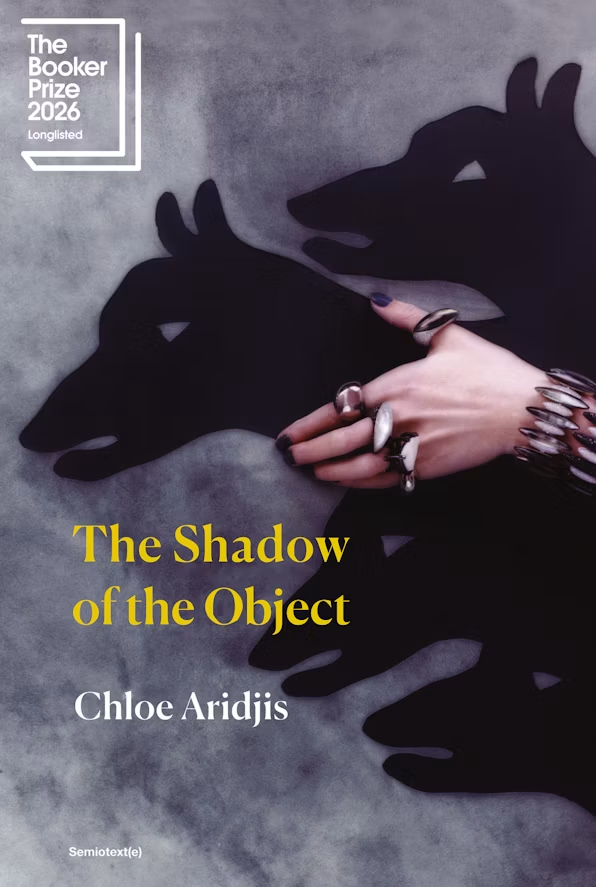
From The Shadow of the Object by Chloe Aridjis. Used with permission of the publisher, Semiotext(e). Copyright © 2026 by Chloe Aridjis.
