
On August 29, 1511, Isabella d’Este, the Marchioness of Mantua, renowned patron of the arts, style icon, and one of the most celebrated women in Renaissance Italy, experienced a profound bereavement.
Isabella cherished animals, and she especially favored small dogs. Her courtiers could always tell when she was about to enter a room by the unmistakable staccato of yap. Aura, her very favorite—“the prettiest and most agreeable little dog that there ever was,” as Isabella’s secretary Gian Giacomo Calandra wrote—met a tragic fate on that day. Aura and Mamia, another diminutive member of the d’Este entourage, were playing a game of chase when Aura toppled from a balcony at the top of a tall stair, plunging into the courtyard below and dying instantly.
Isabella was inconsolable. The following day Calandra sent a letter to Federico II of Gonzaga, Isabella’s eleven-year-old son, who was being held in Rome as a political hostage of Pope Julius II. The grieving patron sobbed at dinner as though her own mother had died, and Calandra confessed that “I too have shed some tears.” She immediately began funeral arrangements: commissioning a lead casket, preparing to lay the first stone of Aura’s tomb with her own hands when astrological forecasts indicated the moment was right. She invited epitaphs for Aura’s resting place, and over the ensuing months scholars and amateur poets across Italy offered their verses. The keeper of the Vatican Library even sent lines of poetry on the dog’s death to Isabella through her son.
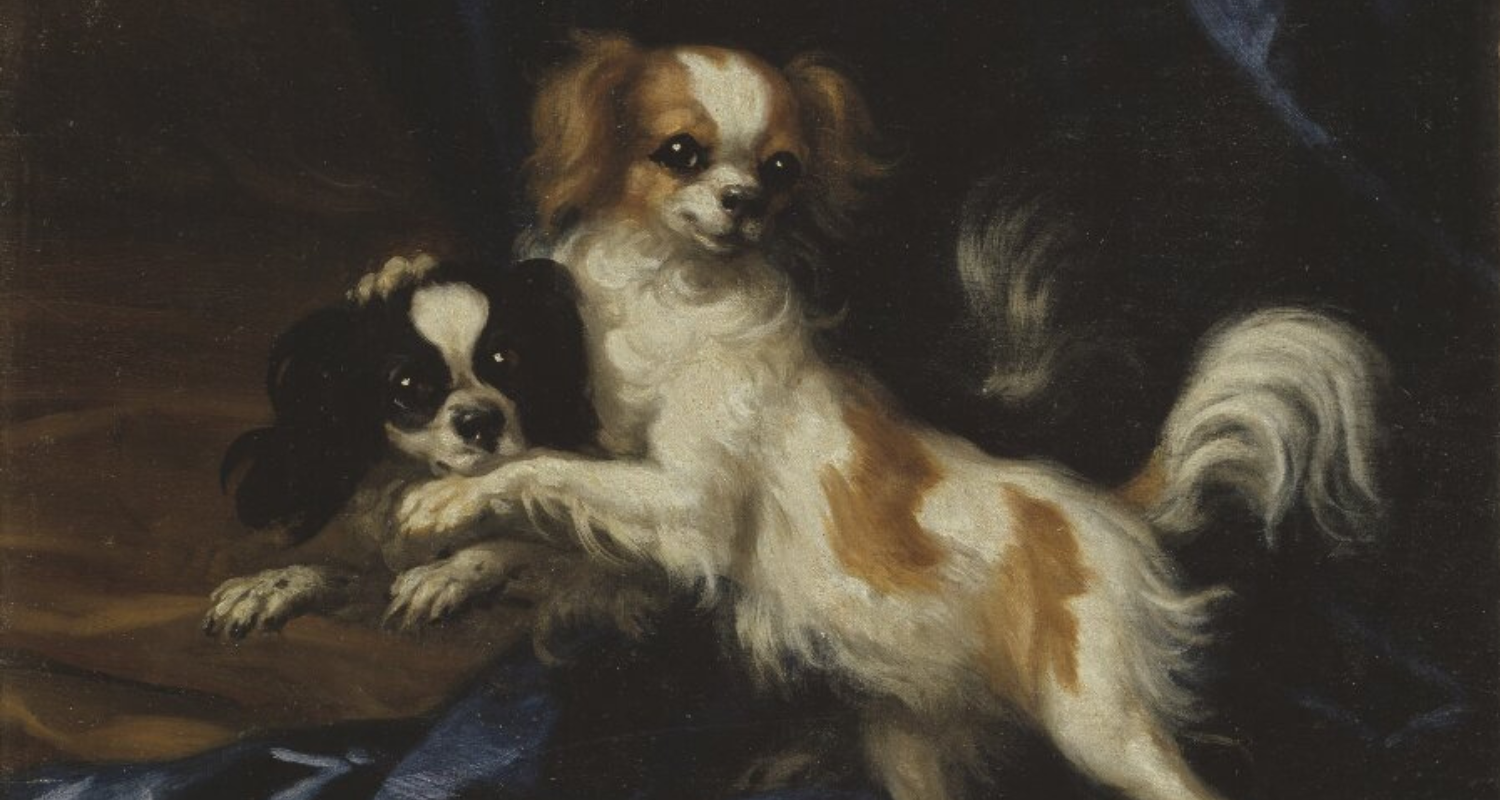
As well as being commemorated in verse, Aura may also have found a place on canvas. A towering patron of the arts in her time, Isabella commissioned paintings that expressed her affection for her little dogs. Two portraits of a woman believed to be Isabella—one by Lorenzo Costa and another attributed to Il Cavazzola or Giulio Campi—depict her with a hairy, white little dog who might be Aura, or perhaps a relative. (The Costa work hangs in the king’s dressing room at Windsor Castle; the other is housed in a bedroom at Hearst Castle in California, the inspiration for Xanadu in the 1941 film Citizen Kane.) Costa, Campi, and Cavazzola were accomplished painters, yet their aptitude with canine subjects seems to have been limited.
Little dogs could also function as a sign of wealth. Some paintings invited a comparison between little dogs and luxury items.
The creature in these portraits bears an unnervingly human face and a notably feline nose. Isabella’s son Federico II appears to have insisted on precise depictions of his own pets. He inherited his mother’s love for little dogs and, as an adult, had them accompany him in his portraits. Perhaps it is Viola—a little dog who died giving birth to a litter of puppies and for whom Gonzaga commissioned a tomb from Giulio Romano—who appears beside him in Titian’s portrait, now in Madrid’s Prado. Titian renders Federico II as a young man with his right hand resting gently on the back of a small sandy-colored dog seated beside him; the fur’s layered waves and shifting tones are meticulously captured. The dog is turned away from the viewer, fully focused on her owner, gazing up at him and pawing at his waist to draw his attention.
Although small dogs had appeared in art earlier, the Renaissance (c. 1400–1600) saw them appear in a wide range of works. Titian painted several small dogs—not only in noble portraits but also in genre scenes drawn from classical and biblical subjects. In Paolo Veronese’s The Wedding at Cana (1563), the Louvre’s largest painting, a tiny brown-and-white lapdog stands on the biblical banquet table, joining the extravagant feast laid out for the guests.
In such works, the little dogs often appear as background details, reflecting how common lapdogs had become in wealthy households across Italy and Europe. Yet they frequently carried symbolic weight. For the same reasons that little dogs appear so often at the feet of deceased women (and clerics) in tomb sculpture, many Renaissance portraits feature them as emblems of fidelity. The most famous example is perhaps the scruffy gray terrier-like hound at the feet of Giovanni di Nicolao Arnolfini’s (likely) dead wife in Jan van Eyck’s 1434 Arnolfini Portrait. But little dogs could also function as signs of wealth. In the 1640s, Giovanna Garzoni, one of the era’s leading female artists, depicted two tiny lapdogs with round skulls, short noses, and slightly buggy eyes—likely relatives of the modern pug—wearing belled collars and sitting beside fine porcelain cups, biscuits, and slices of cured salami.
Gallery-goers may be more accustomed to portraits of private menageries or packs of hunting hounds—both status symbols for the nobility—yet there was also a trend toward paintings that showed large groups of small dogs. In early seventeenth-century Italy, the powerful Medici banking family—the rulers of Florence and grand dukes of Tuscany—had Tiberio di Tito paint twelve toy dogs (along with a larger mastiff-type dog) in the Boboli Gardens at Palazzo Pitti. They are accompanied by a keeper, a man with dwarfism, which was likely a sly joke at his expense. The Medici dogs are a mixed bunch: little spaniels, short-haired dogs with snub noses and longish ears (perhaps precursors to the pugs), and a fluffy white dog with a shaved pink bottom (often described then as a lion dog, a close cousin to the bichon frise and the Maltese). Several wear ornate collars, and—by our twenty-first-century standards—an equal number sport earrings featuring hoops, bows, and rosettes. The tiniest of them, a fluffy white-and-gray creature, peers from a red box resting on the dog keeper’s lap.
Yet the Medici pack is overshadowed by the one belonging to Isabella Clara Eugenia (1566–1633), co-sovereign of the Spanish Netherlands. In a grand painting of her animal retinue, now simply known as The Woman with Dogs, thirty of Isabella’s dogs share the scene with her pet birds, pet monkeys, and the lady-in-waiting. Some of the dogs wear not only earrings but also bows around their legs that resemble leg warmers; others are the short-coated, stubby-nosed white dogs that were in vogue as lapdogs of the era and are now extinct. Each dog is named—Piramo el Blanco (Piramo the White), the tiny, scarf-wearing Piramillo, Sigritilla, Breda, Gris (Gray), and the markedly porky little white dog named Fidiela. It’s clear the commission deemed it important for viewers to recognize these animals as individuals, not merely as dogs, even if the sheer number of them distracts from considering each one separately.
In the ensuing centuries, individual lapdogs began to command more attention, and painters came to endow them with character and a spectrum of mischievous tricks.
In France, artists who specialized in animal subjects became known as animaliers. Animal art tended to revolve around the masculine realm of sport—hunting, horse riding, and, a little later, horse racing. Yet toward the end of the seventeenth century, sporting painters also started taking commissions from pet owners, creating works that celebrated dogs valued for their companionship rather than their hunting prowess. While Nicasius Bernaerts (1620–1678), Alexandre-François Desportes (1661–1743), and Jean-Baptiste Oudry (1688–1755) were hired to paint hunting animals or the occupants of royal menageries for Louis XIV and Louis XV, they also turned their talents to delicate little dogs. Desportes painted Louis XV’s toy spaniels and a Pomeranian named Merluzine, Muscade, Hermine, Jémite, and Cocoq. Jean-Jacques Bachelier (1724–1806) specialized more in Rococo pet portraits than in grisly hunting scenes. He was commissioned by the wealthiest and most powerful people in Enlightenment France, including Madame de Pompadour, who owned a little black spaniel named Mimi and a small black-and-white poodle named Bébé (Baby), both painted by Bachelier.
Among Bachelier’s other paintings is an image of a fluffy little white dog sitting up on his hind legs. The woolly fur on his rear is clipped tightly; at his head, the fur is combed into a topknot secured with a pink bow. For more than a century, the painting has been identified as a “dog of the Havana breed,” but it more closely resembles a woolly poodle. The dog is depicted in a moment of mischief: gnawing a discarded ivory billiard ball, tugging at a ribbon in front of him, and even chewing his owner’s shoes, one of which lies half in and half out of his bed. Though he assumes a pleading pose, there is no sign of remorse in his eyes—he exudes defiance, certain that his owner will not scold him. I’m inclined to call him male—the 1989 restoration using UV light revealed that the ribbon had been extended to drape over the dog’s exposed genitals, a modification made to spare viewers from offense. The image is striking. The Bowes Museum’s catalog even labeled the painting a “splendid piece of Rococo nonsense.” There is a certain repulsive undertone to the painting—the viewer senses a clash between the dog’s dignified presentation and the undignified mischief he is shown engaging in.
Even more than the other accoutrements with which sitters were pictured, dogs could convey a range of qualities.
Bachelier’s Havanese portrait may be unmatched in its flamboyant bravura, but such portraits of little pets were not a uniquely French phenomenon. In central Europe, a member of the Bohemian Lobkowicz family commissioned a painting of two favored pugs named Asinus and Kokrle; the work now resides in Prague’s Lobkowicz Palace in the “dog room.” In Britain, an artist named John Wootton (c. 1686–1764) specialized in sporting pictures but also pursued pet portraits in grand settings. One example depicts four small, brown-and-white woolly dogs—perhaps related to today’s bichons and poodles—named Lusette, Madore, Rosette, and Moucheby. They stand within the ruins of a classical temple, utterly unaware of the solemn surroundings. Wootton’s most memorable piece, Casey, a Harlequin black-and-white lapdog owned by Henrietta Harley, Countess of Oxford, shows the dog basking on a crimson velvet cushion. Casey’s disproportionately tiny head is accentuated by cropped ears. In the background hangs a portrait within a portrait of two dogs—Mina, a black-and-white toy spaniel, and Die, a tan greyhound—beside a large urn. Are they Casey’s ancestors? They appear to reflect Harley’s affection for her pet rather than any lineage, underscoring that Casey’s value lay in the owner’s devotion rather than her pedigree.
The eighteenth century stood as a golden age for portraits of people and dogs alike in Britain and across Europe. Such paintings functioned as status symbols, evidence of wealth and position, and allowed those depicted to shape the image they wished to project. Tiny pet dogs frequently appeared in owners’ portraits, and more than mere adornment, they could signal a range of traits. The choice of breed, the manner in which the animal was rendered—alert and ready to bark, or relaxed and composed—and its interaction with the owner could serve as a legible shorthand for viewers. Commissioning a portrait of a dog on its own was equally meaningful, underscoring the animal’s importance to the person who cherished it. And, of course, there was a deeply personal motivation to immortalize a cherished pet in art—the dog’s likeness would endure long after its life had ended.
In the nineteenth century, demand for canine art only grew as dogs became celebrated for their moral virtues—and as dog ownership came to be linked with moral benefits for people. The most successful animal painter of all time is likely Edwin Landseer (1802–1873), famous, among other things, for the colossal lions flanking Nelson’s Column in London’s Trafalgar Square. Landseer’s talent with dogs began early; the Royal Academy’s head, Henry Fuseli, nicknamed him the “dog boy,” and after gaining prominence he quickly won the favor of Britain’s most influential dog-loving patron, Princess Victoria. Victoria adored a small black, white, and tan tricolor spaniel she called “Dear Dashy,” whom Landseer painted repeatedly. Dash joined the royal household when Victoria was thirteen, and she included him in sittings with George Hayter, whose portrait of the young princess shows Dash at her feet, gnawing on her gloves. On Victoria’s coronation day in 1838, Dash’s barks prompted Victoria to rush from Westminster Abbey to the hall, where she unceremoniously abandoned her crown and robes to wash the little dog. Landseer’s portraits of Dash—both alone and with Victoria’s other pets—present the dog as older and more contemplative, imbuing him with a certain depth of feeling.
Today, Landseer is widely associated with Victorian sentimentality, celebrated for scenes of mourning hounds and noble stags more than for his portraits of pets. There is no doubt that Landseer’s paintings of dogs expressing very human emotions and situations strike some modern viewers as kitschy. Yet they also reflect a broader shift in how many middle-class Europeans perceived dogs at the time, an emotional turn that made such open affection more acceptable.
Landseer was also at the forefront of another revolution in dog art. For centuries, fine art was affordable only to society’s wealthiest dog owners. In the eighteenth and nineteenth centuries, the advent of printing and ceramic techniques and mass production meant that people from all walks of life could purchase and display artwork featuring dogs. Ceramic spaniels became a common sight on Victorian mantels, and homes across Britain, America, and Europe soon overflowed with prints—often reproducing Landseer’s animal paintings. As a historian of dogs, I’m continually surprised by the places dogs appear—sometimes even in unlikely backdrops. On one occasion, I spotted a print of Landseer’s Trial by Jury on the wall behind a deathbed photograph of Otto von Bismarck, where a standard poodle sat as a judge in front of a panel of other canines (including the 6th Duke of Devonshire’s little chestnut-and-white Blenheim spaniel, Bony, added to the scene by special request after the duke purchased the painting).
_______________________________

Excerpted from Yap! A Short History of Small Dogs by Stephanie Howard-Smith. Copyright © 2026 by Stephanie Howard-Smith. Published by Ballantine Books, an imprint of Random House, a division of Penguin Random House, LLC. All rights reserved. No part of this excerpt may be reproduced or reprinted without permission in writing from the publisher.
