I never imagined that horses would drift into the center of my life as a recurring motif. In my childhood, they felt less like living beings and more like a decorative scheme from a kid’s bedroom—something other girls chose to adorn their school folders with, not myself. The inaugural moment I stood eye to eye with a horse, at a state fair, surprised me with an aroma I hadn’t anticipated. It carried a salty tang, slick with thick saliva that felt less repulsive and more earned, like the lubrication of a machine. A man—likely the animal’s owner—asked if I wanted to climb onto its back. I paused, weighing the enormity of such a creature while perched high above the ground. I worried about my own fit in the role, about making a peculiar face up there, or failing to grasp the deeper meaning of sitting atop something with the quiet authority a horse projected. The man read my pause as fear and assured me it was all right. Perhaps next year I would be sturdier and braver. The moment he spoke of “bigger and braver,” the horse lowered its notable, pink, flaky thing toward the earth, almost touching it. The color reminded me of a sunburn. Around us, laughter rippled through the crowd—likely at my expense, since I stood at eye level with that startling sight and appeared to be a naive child who hadn’t earned such a shock. It was as if I suddenly realized I had been observed by a swarm of strangers who might now see me as a coward.
I took the following morning off to drive Nico’s parents to the airport. They acted as if they were doing me a favor by letting me handle the car, insisting that as long as I refueled it, I could use it to haul my belongings toward the apartment they still believed would work out for me. On the ride back into town, I opened every window, letting the air thunder against my hand, whip my hair, and dry out my teeth. Even with all that breeze, I felt confined. The steering wheel appeared absurdly large. The dashboard icons seemed extraneous, the way older technology can seem naive: Don’t the buttons know they can be smaller? Rather than avoiding Main Street to dodge traffic, I cruised at a comfortable pace. The beauty of the metal box lay in its ability to peep at Buster’s Café and the used bookstore without exposing me. The bookstore stayed lifeless as ever, but the café had introduced a new detail: a sandwich board with a balloon attached. TOMORROW, it announced. My thoughts grew cottony, my hands clinging hot to the wheel.
On the next day, the wind roared. The horses wore their nerves on the surface, snorting as if to sift through the chaos. Voices drifted like buoys. Diane wore a tangle of hair and plaid, while Aurora moved with purpose, pushing a wheelbarrow.
“I’m a Taurus,” she explained, offering a justification.
“Oh wow! I’m a Libra!” Diane chirped, treating the zodiac as a game. Tristan, in the midst of laying down fresh wood shavings, peeked at me shyly through the cloud of dust. Had he noticed my absence on my day off?
“You look—” he began, coughing. “Interesting.” It was because I wore a thin veil of concealer and two strokes of mascara, and I had picked a shirt that suited me. I told myself I had done these things so I wouldn’t need to change before heading to the café later. As if I had an appointment at the place. I was tense. I offered Tristan a jittery reply.
“Don’t call me interesting.”
We had two trail rides scheduled that morning, yet one turned out to be a mother seeking a pony ride for her four-year-old son. Tristan assigned that one to the autumn girls since it involved little more than leading the pony around the property, then feeding the child a sugar cube and instructing him to keep his hand flat to avoid being bitten. I envied them. Didn’t they know that walking circles around a pony was my specialty? I threw myself into preparing the horses for the other ride, guiding a mother and her teenage daughter, and leading the way along the trail. The wind persisted. Manes and tails were a mess. There was a muffled roar in my ears. All the while, I obsessed over the café, imagining Cleo behind the counter—frothing milk, tamping espresso, chatting with customers with ease. Not much of that little excursion felt controllable—how many options does a person really have in a coffee shop? In the end, it came down to my entrance: the pace and manner of my stepping inside, whether I would pick a table first or head straight to the counter. Would I speak to her right away, or allow my presence to riffle through the room until her question found me? Was I someone from around here? A college student? Were those muck boots on my feet? I pictured her assessing me from across the room and recognizing, from my plainness and shrewd expression, that I didn’t fit with the summer or autumn crowds. I belonged to a separate category, one I barely understood myself. We were nearly at the clearing where the trail ended when the branches ahead thickened and darkened. Black shadows expanded and drifted downward, and I, with unsettling serenity, thought: The branches are falling on us. I recognized at once that it was only a group of turkey vultures, hopping from a tree like black umbrellas onto a dead squirrel. They formed a somber council. (Later I would learn this gathering is called a committee when vultures come together, and a wake when they close in on a meal, a fact I would share with far too many people.) The mother gasped, which struck me as a strangely belated reaction. I paused my horse and turned toward her. She had her hands clenched, her reins raised to shield her face.
“They’re horrible!” she exclaimed.
You’re horrible, I thought.
“Fun fact,” I told the anxious mother, “if you get too close to a turkey vulture, it will projectile-vomit on you. Roadkill.” I turned my horse back toward the path and urged it forward before I could glimpse Tristan’s disapproving look. I had, earlier and with amusement, imagined becoming obsessed with Cleo, but by then it was already true. I was eager to reach Buster’s Café and lay eyes on the woman I was turning into, and I grew irritable with anyone who stood in my way.
We stayed largely quiet for the remainder of the ride, the only sounds the odd yawning of distressed tree trunks. When we finished, the mother offered a tip and smiled apologetically before driving away. A sense of remorse washed over me and I slipped into the stable to press the bills into Tristan’s hand.
“What’s going on with you?” he asked, not angered. (Heaven forbid he show anger.) “I have my period,” I lied.
“Do you need some dark chocolate with paprika?” Diane called from a stall, leaning on a pitchfork. “I’ve got some in my bag.”
“Of course you do,” I snapped. She wilted slightly. “Why not go home early,” Tristan suggested. I felt like a wayward child exiled outdoors: liberated, yet guilty and tense.
When Cleo was a girl, she attended one of those nun-run schools where even breathing could earn you trouble. Cleo once faced punishment for trying to poison the water fountain. She was always a high achiever.
When she was twelve, she raised a pair of prizewinning steers, which her father converted into hamburgers on her thirteenth birthday. Since then, she has been a vegetarian.
Cleo underwent an emergency appendectomy at fifteen. While under anesthesia, she claims to have glimpsed the future: a world where implants were common, yet reserved for men.
Knowing everything I did about Cleo, I could only picture her as fiercely formidable: disciplined, with steadfast eyes. Images of Anjelica Huston, Angela Bassett, Sigourney Weaver spun in my mind, like queens’ portraits. I could see all my own flaws reflected there. It made me want to clean under my nails, straighten my back, and rinse the back of my tongue.
I parked the Vespa in a public lot two blocks from the café and walked up the sidewalk, helmet tucked under my arm. I liked to tell myself that it gave me an unconscious swagger, though my muddy boots, slender arms, and flat hair might not support that belief. Still, I walked with purpose, passing the bookstore and glancing at my reflection in the many-paned window. That girl on a mission, I told myself. Let Byron see me and wonder what I was about. Ahead, the sandwich-board balloon swayed: This way, this way.
She was already watching me the moment I stepped inside, which disrupted my plan and made me cut straight to the counter instead of seeking a table first. I fell in behind a large man with a blond, braided beard who I would someday know as Amos, though at that instant I used him as a shield to steadiness. Soon enough I would know almost everyone there—by drink order, by first name, by a private nickname. It’s odd to compare your first impression of a place with the intimate knowledge you gain over time. Standing in line, tucked behind the big man, I found the shop both spare and inviting, like a rectangle of sunlight on a wooden floor. I had no idea how drastically that impression would shift with time, as if experience were spray paint, layering the place with every moment I spent there. The big man paid for his drink and stepped away, and for a moment Cleo had her back to me as she prepared his order. I knew it was her, even though it could have been any employee—perhaps the real Cleo wasn’t even in the front of house? The possibility lingered that Tristan’s story about her marriage might have been a misreading, and that the name Buster had been chosen simply for its broad appeal. Who wouldn’t be drawn to a place called Buster’s?
“What kind of bike do you ride?” She had turned around, resting her elbows on the counter, relaxed and unhurried even with the shop packed and the line behind me still growing. “I’ve had my eye on a little mustard-yellow Honda. It’s listed online,” she continued. I knew she had spotted my motorcycle helmet. I understood that she was signaling interest in something we both supposedly knew about—that is, riding motorcycles—yet I could not figure out what to say. My mind was a muddle of what Tristan had planted there and what remained empty at the same time. I forgot how much I was or wasn’t supposed to know, how to pretend I knew nothing of her.
“It’s just a Vespa,” I told her. Then added: “But I had to get my motorcycle license to ride it.” She appreciated this, and I felt that she approved of my need to present myself as someone who could stand up to the ruggedness of a scooter girl. She turned out to be cuter than I expected. Short, with untamed curls pinned back with a woven scarf. Her features were small and direct, and I suspected that with makeup the look would be too perfect. The hoop earrings flashed, and I noticed the sparkle in her left eye. I was unexpectedly moved to see these things. A warmth toward Tristan arose for his honesty and reliability, followed by a similar warmth for Cleo for inadvertently keeping her end of the deal.
“What kind of coffee do you like?” She wanted me to order to keep the line moving, but the question felt personal, playful, and somehow flirty. I felt moved again.
“Hot,” I replied.
I claimed a spot in an armchair by the front window. It was the only one available. I wished I had brought something to read, or at least a newspaper to pretend with. Yet I enjoyed a decent view of the counter and the steady flow of customers. I watched them wait and grow impatient, especially since there was only one person handling orders, drinks, and the register. I worried someone would complain about the wait or walk out, but the routine held: when it was their turn, Cleo smiled and somehow lulled them into a calm passivity. From my vantage, I could see her face and the way her eyes carried pure mirth—which is not a word I would normally use, but it fit here. Her front teeth turned inward in a way that made her smile utterly captivating. I wanted to see that smile again and again, as if it were a mechanism I was trying to decode. When she handed me my mug, winking at my request for “hot” coffee, I felt as if she were fully invested in me, and that she appreciated my dry humor, as if no one else that day had thought to request coffee with such wit. You’re not fussy, seemed to say her eyes. And I like that about you. I soon realized I was not the sole recipient of such an effect. From my chair I watched each new customer turn away from the counter, cup or pastry in hand, lightened by something I could not name.
At last, the crowd thinned, and I watched Cleo finish the rush: brewing more coffee, loading the dishwasher, stacking trays from the display case that had emptied. The lingerers folded their napkins, wiped their mouths, and waved to Cleo with relief and encouragement: Nice job! Thanks! Good luck! Could it be that Cleo was already a small-town favorite, known by everyone, and that the support she enjoyed was as much a product of community faith as of merit? It felt like a little of both, the most plausible explanation I could devise. Eventually, only I and a man with large headphones remained. I expected him to leave, yet I could not predict what I would do once I found myself alone with Cleo. Time seemed to vanish, and I couldn’t even tell what hour it was. Perhaps the shop had closed and Cleo was simply waiting for us to depart. I stood and carried my cold mug back to the counter.
“Hey, Vespa Girl,” Cleo teased. “How was it?” She lifted the mug from my hands with both of hers, a signature move of hers; when she handed you something—a cup of coffee, a book, a muffin—she cradled it in both hands as if warming it for you. The same gesture extended to things she accepted—an extra pen, a hair tie. This wasn’t something Tristan had explained to me, but something I would discover on my own. I hadn’t thought about Tristan at all that afternoon.
“Everything was good,” I replied. “Hot enough.” Cleo studied me with a careful eye. I wanted to elaborate, to justify my presence or to seem more interesting to her, but once again I drew a blank. My mind felt as blank as Nico’s basement. A sensation washed over me, the kind you get when you are about to reveal a secret: I’m afraid of my job. I’m running out of time. Nothing about my life feels luminous.
Just then the door swung open and shut with a thud. A man with a neatly trimmed white beard approached the counter, flashing a five-dollar bill as if buying his ice cream cone.
“Got any coffee left?” he asked. He seemed so earnest that I wanted to disappear. I stepped aside and retrieved my helmet from under the chair. I somehow knew this was not for me. Whatever it was, it wasn’t.
“Bye, Vespa Girl,” Cleo called after me as I left her with the rosy old man. Even though Tristan had explained the logistics of her marriage, it hadn’t occurred to me that the man in question could be her husband, a plain, wholesome figure in her life.
__________________________________
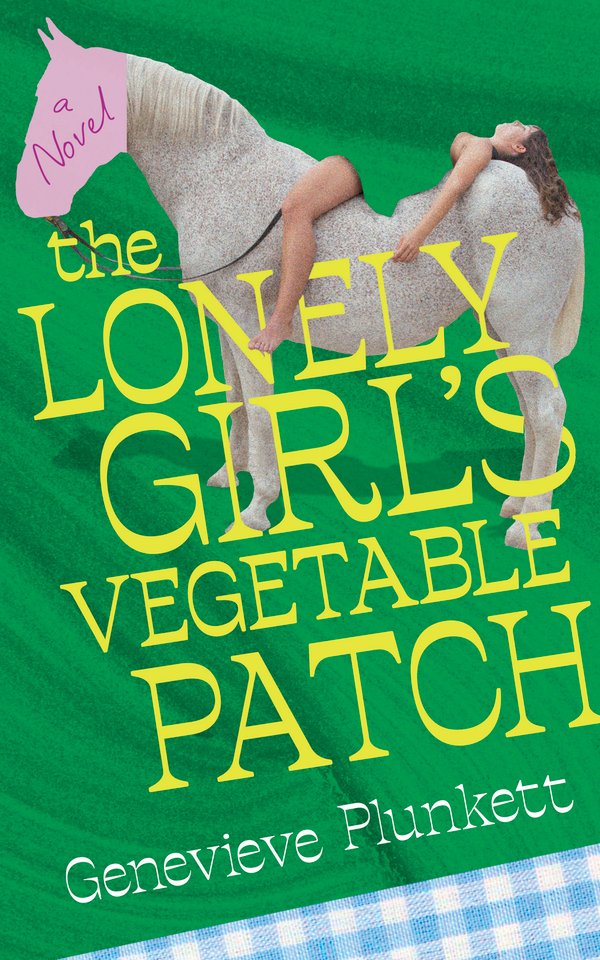
From The Lonely Girl’s Vegetable Patch by Genevieve Plunkett. Used with permission of the publisher, Amethyst Editions/The Feminist Press. Copyright © 2026.