
The child is perhaps five or six years old. He sits with his back pressed against a towering red water tank, one hand gripping the faucet, the other wrapped around the leg of the rusted metal platform that elevates the tank from the ground. His hair and eyes are dark, and while his hands show the plump softness of youth, his face bears an age that seems to have come from experiences beyond years. He meets the camera’s gaze with a look that seems equal parts puzzled and mildly irked, as if asking the person behind the lens “why are you taking my picture?”
There are three other children visible in the shot as well. A girl, bent at the waist, holds a dented tin bucket under the spigot the boy has opened. In her other hand is a plastic jug she will fill once the bucket is full. Her thick, dark hair is tied back in a ponytail, and like the boy, she glances toward the camera, though her look reads more as distracted than defiant; she is in the middle of a task. She is likely about seven years old.
The remaining two children are younger, both girls. One sits atop the metal platform on the far side of the water tank, peering shyly around the red plastic toward the camera. Her grey sweatpants are rolled to her knees, and her feet swing above the ground. The other girl seems not to notice the camera at all; she is turned away, brightly colored leggings rolled up as she stomps through the runoff that has gathered around the tank’s base.
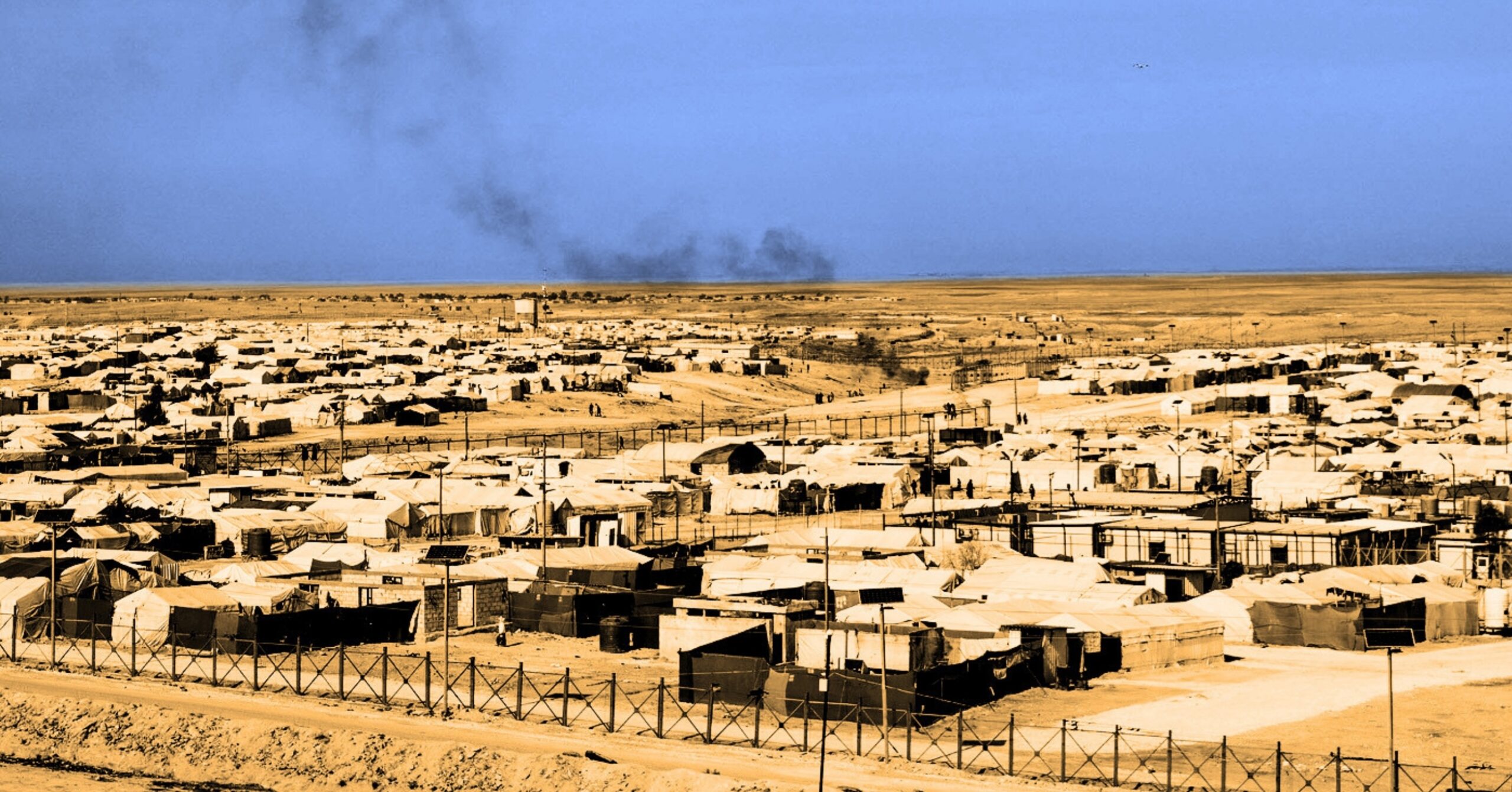
In the background, canvas tents appear, tattered in places and mended in patches, secured with metal stakes and scattered rocks. In this particular shot you can only see the backs of two tents, but if the frame were pulled away for a bird’s-eye view you would witness a city of 15,000 tents—an encampment ringed by a fence of barbed wire.
To tell the life of a child from Al Hol starting from within would have required me to descend into a consciousness I could not reach.
This is Al Hol Camp, set in the sun-blasted desert of northeast Syria. It is September 2019, and here the families of ISIS fighters have been detained since the Caliphate’s collapse in March, six months prior. Roughly 70,000 people live here. Perhaps two‑thirds are children. More than half of the children are under twelve, yet there is no proper school. There is no access to fresh food, adequate medicine, or clean water; the water that runs from the spigots into the waiting buckets is murky and polluted.
Since first encountering this photograph, I have returned to it countless times over more than six years, and for reasons I cannot explain, my eyes keep returning to the boy’s yellow shirt. On the fabric are two block letters, X and O. Is this a nod to Tic Tac Toe? A quick sign of affection—an odd abbreviation of a hug and a kiss? Whatever it is, its incongruity clashes with the harsh reality wrapped around the boy.
I do not know who this child is. I cannot say what he has endured, or what horrors he may have witnessed during his brief life inside the Caliphate. I do not know if his father is imprisoned somewhere or killed in the battles around Baghuz. I do not know if his mother is at the camp with him, or if she has perished; among the roughly 45,000 children here, nearly half are orphans. I do not know the origins of his parents, whether they came together to Syria or met there.
What I do know is that this boy likely possesses no birth certificate. He lacks a nationality any state would recognize, regardless of his parents’ citizenship. He was born into the Caliphate, a state that no government recognizes, now defunct and never legally established. Now, he sits in a desert camp administered by a Kurdish authority that is itself unrecognized by the world. He is nameless, stateless; in bureaucratic terms, a mere placeholder. That is the cruel, imprecise language used to describe Al Hol’s children: of the camp’s 70,000 residents, approximately two-thirds are children, and approximately half of those are under twelve. In 2019 alone, approximately 500 children died.
The image of kids clustered around the water tank, and the many others like it, pointed me toward the book I would devote years to writing. The photographs raised questions that I could not dismiss—not the political questions journalists and human-rights advocates were pursuing, but the more intimate, less answerable ones. Who were these children, and what had they witnessed in their brief lives? Who had loved them before all this, and who would love them afterward? These questions felt like they deserved the kind of speculative exploration a novel might offer, at least as a way to probe them.
Yet when my novel finally reached its end five years later, the children who had precipitated the project showed up only in the last three pages of three hundred. They arrived as an epilogue, not in a third-person voice like the rest of the book, but as a collective they, unnamed and undifferentiated—a chorus rather than a cast of individuals. It was as if the novel, after circling around them for three hundred pages, could bear direct attention to the children only in the final three.
I keep returning to one question: why?
*
There has never been a shortage of journalism about Al Hol. Reporters from the New York Times, the BBC, and Al Jazeera have filed dispatches about the overcrowding, malnutrition, and the absence of medical care. They have recounted stories of sisters found dead in an aqueduct, tent fires, and babies stillborn. They’ve published interviews with mothers, some radicalized and some seeking return home. They have photographed children with fingers hooked through the perimeter fence, staring out; and children playing soccer with a battered ball.
I read Human Rights Watch reports about indefinite detention, collective punishment, and violations of the Convention on the Rights of the Child. I read about the international reluctance to repatriate, and about how boys at Al Hol were routinely separated from their mothers at age twelve, deemed too dangerous to stay with their families.
I grew frustrated with the politics that blocked action—the refusal to bring people home, the political status of the Kurds, the tangled questions around terrorism—both past and potential.
But what kept drawing me back were the children, and the childhoods they were being denied.
Childhood, in its best sense, is a distinct and irreplaceable texture. It is the warmth of a summer afternoon with no commitments, the freedom of not needing to understand the wider world beyond your own small radius, the security of being known and unconditionally loved. Childhood includes grandparents, ice cream, balloons, and school—the latter not merely an institution for academics, but a training in social life and compromise. It encompasses art, music, and comfort in fear, companionship in loneliness. The youngsters at Al Hol did not merely lack adequate nutrition, clean water, and a home; they were deprived of the very experience of being children.
The most troubling part was that none of these children had chosen any of this for themselves. They were born into the Caliphate or brought there before they could decide for themselves. They suffered daily because of adults’ misguided choices, consequences that these children would bear for the rest of their lives. Thinking of those parents fills me with anger—and it still does. There are few offenses as unforgivable as forcing a child to participate in something beyond their understanding.
And the grandparents left behind carry their own ache. If the thought of the children’s parents stirs anger, the image of the grandparents triggers grief: they have not only lost the children they loved, but the grandchildren they never had a chance to meet.
They are the unseen figures in journalism, nameless men and women in New York, Melbourne, or Paris, scanning papers and TV news for tiny faces that might belong to grandchildren they never met. I cannot imagine what it would feel like to know that a grandchild exists somewhere in a place like Al Hol and to be unable to rescue them. I cannot imagine loving someone you have never met—someone you might never meet.
The grandparents did not choose this limbo either.
It is this fragility—the link between grandparents and grandchildren, severed lines of love—that pushed me toward the novelistic approach. Journalism can supply precise facts, explain the politics and the law, but it cannot reveal the interior experience of living in Al Hol from the inside out. It cannot trace the threads that connect these children to the world beyond the camp. It cannot expose the invisible chains of love tying the children to people who, through no fault of their own, find themselves bound to them. I believed a novel could do that work.
And so I began planning one. I wasn’t sure exactly how, but I knew the story would focus on a child—a little girl—who lived in Al Hol. She would have her own section within the book, her own point of view and interior life. Readers would come to know her in a way that nonfiction cannot allow—from the inside out. The girl would embody the novel’s central claim: that these Al Hol children are blameless, deserve to be witnessed, and deserve a chance to be seen as individuals, if only on the page.
Yet when I reached the part of the novel devoted to this little girl, I could not find a path into her perspective. I have thought about this a great deal, about how I approached the threshold and then stepped back, and I have reached an uncomfortable honesty: my imagination could not. To write a child of Al Hol from the inside out—to access her inner life, her thoughts, her understanding of the world—would have required me to inhabit a consciousness I could not reach. This is a child born and raised in the Caliphate, formed entirely by her experiences there and now in the camp. She has never tasted ice cream. She has never attended school. She has witnessed killings, floggings, and even the display of heads. I could not reach that consciousness not because it is alien or because I lack empathy, but because it has been shaped by a sequence of deliberate human choices into something the conventional imaginative tool—fiction—cannot faithfully reproduce without misrepresentation.
If I had written her anyway, with the typical novelist’s commitment to making fiction feel real, it would have been a kind of falsehood. And after everything, these children do not deserve to be lied about.
The epilogue became the clearest truth I could reach; it represents honesty when imagination encounters its own limits. The nameless, collective they that the children become—and the three pages they occupy—are not a surrender, but an acknowledgment that, even in fiction, they remain beyond the reach of my capture. I had hoped that distance between a writer in Massachusetts and a boy in a yellow shirt might be bridged by research, empathy, and years of focused writing. I learned that such bridging is possible only through acknowledgment.
*
The question of which interior lives a writer can honestly claim to access is one I have faced before. When I wrote The Mercy Seat, a novel told through nine viewpoints, I feared entering the mind of Willie, a Black man in 1943 Louisiana who is wrongly accused of raping a white woman who is, in fact, his lover. I am a white woman, and the gulf between my experience and Willie’s felt vast and daunting. Yet the rest of the novel centers on the moment of his impending execution, so I felt compelled to try to write him, despite my misgivings. If I left him opaque, a silhouette at the center of his own tragedy, that would be a different kind of dishonesty—an evasion. So I tried, and something took hold. The imagination found footing.
With the little girl at Al Hol, it did not. And this, I think, is what the boundaries of imagination feel like for a writer—less a deliberate choice than a visceral sense in the bones. It simply feels wrong. It’s like striking a five-note chord on a piano when one note is off. You may not know which one, but you sense that the sound is not right, and increasing the volume won’t fix it.
I know other writers who may have felt similarly and, rather than impose a dishonest form, have found a workaround in formal invention—like the epilogue I chose. In Beloved, Toni Morrison gives the trauma of slavery a bodily form in the shape of a ghost; perhaps because confronting the reality directly would diminish it. In Rings of Saturn, W. G. Sebald approaches the Holocaust through photographs and digression; he sidesteps its head-on confrontation as one might avoid looking at the sun—if you stare too long, you cannot see anything at all. I don’t believe Morrison or Sebald engaged in mere aesthetics. I think, through their chosen forms, they acknowledged that some interiors—some experiences, some consciousnesses—are beyond what imagination can honestly render. The collective they in my epilogue is a modest, late entry in that tradition: a writer sensing the wrong note and choosing restraint over a false chord.
*
There is one child in the epilogue about whom I do know something.
She appears in a single sentence: one dark-haired girl has a scar that runs from the corner of her eye back to her ear. Yet in the epilogue’s collective world, she is as close as the writing gets to a single individual. She does not receive a paragraph of her own. She does not receive a sentence of her own. She is not even named.
This, I think, is what the limits of imagination feel like as a writer—not a principled decision made in advance, but a sensation deep in your bones.
She is the only nameless child in the epilogue who also appears in the novel’s body. She is brief in the book’s final pages, where she does have a name, a personality, and a little bit of history. The scar across her face becomes her identifying mark, a thread pulled from the book’s fabric into its aftermath.
The reader who reaches the epilogue and encounters the scarred girl is meant to recognize her. In Al Hol, she has no birth certificate, no nationality, no name. Yet she bears the scar—her body’s own archival record, the one scrap of history that could not be erased when everything else was. I gave her that mark and sent her into the epilogue’s anonymity, trusting that readers would locate her there and recognize her. Not intimately, and not from the inside out, but as something more than a mere approximation.
The other children in the epilogue lack such a thread, even though their faces are what originally compelled me to write in the first place, and their questions are what I hoped fiction could answer. But I could not reach them. The novel could not reach them. They have no history within its pages, no present, and no future—the exact structure of their erasure in the world.
The novel did not intend to reproduce the logic of abandonment it sought to witness, but it did, to some degree. And I think it’s worth saying so.
*
In January 2026, the Kurdish-led Syrian Democratic Forces withdrew from Al Hol. Syrian government forces moved in, but the transition’s chaos fractured the camp and scattered its population. The change happened so rapidly that even journalists who had covered the camp lost track of where the displaced had gone. The children of Al Hol were folded into a Syria being rapidly remade after Assad’s fall in late 2024. I do not know where they have gone, which is almost worse than declaring, “there they are, behind that fence, in that desert.” I do not even know their approximate location. Their story persisted in reporting, and then it went dark.
As a novelist, encountering the limits of what imagination can accomplish and then seeking a form that acknowledges that truth felt strange. Yet that form—the collective they—proved less a solution than an honest account of the problem.
And now the problem has deepened beyond the reach of any form. The boy at the water tank is no longer there. He is already beyond the novel’s reach, and beyond the reach of photographs and journalism as well. I have studied the image so often that I know it by heart—the dark hair, the small fingers, the expression of mild, almost ancient irritation. But I do not know if he is alive. I know he was alive, and where, that someone once photographed him and that photograph sparked a novel that could not reach him, nor any of the other children of Al Hol. The gulf between us cannot be bridged—only acknowledged. And now that the place where they once stood has dissolved, that recognition feels thinner than ever. It is not enough. It did not help them. It never did.
These children were let down by their parents, by the nations that produced those parents, and by the international community that failed to figure out what to do with them. They were let down also by the camp that held them and by the turmoil that scattered them. A novelist’s witness cannot alter any of this. It cannot balance the ledger. Yet silence would have been a choice, too. Choosing to look away is always a choice.
The boy in the yellow shirt did not avert his gaze. He looked straight into the camera—and, tangentially, straight at me. The least I can do is return that gaze.
____________________________
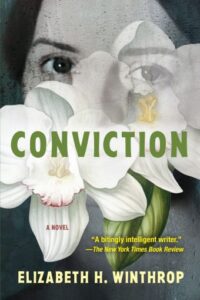
Conviction by Elizabeth H. Winthrop is available from Grove Press, an imprint of Grove Atlantic.