
In the spring of 1983, the poet Eileen Myles went for a stroll in Manhattan with their friend Tom. There was probably nothing particularly unusual about the walk, except that the light that day seemed unusually poised to cluster around the tall buildings. As they sat, puffing and gazing across the Hudson toward New Jersey, two friends in their early thirties felt a surge of joy, suddenly aware that they were not dead. This vignette of an urban landscape sits alongside much of Myles’s verse, which crackles with ordinary detail and the everyday architecture of our feelings.
I remember being struck by that description when I first encountered it in Myles’s 1999 essay “Coming Clear,” which centers on Myles’s sobriety, and, years later in 2022, when I, newly thirty and only weeks sober myself, felt moved, grateful, and eager to find representations of this new mode of living—this not-being-dead.
If recovery meetings offered fellowship, strength, and hope, I figured literature might offer something else: alternate frames for this opening chapter of a life without alcohol. So it was a joy to read Myles, one of my favorite poets, on the particularities of early recovery—how it can illuminate new forms of attention, revealing “a whole world…all out there waiting for you, in a way it never was before.” In my own first weeks, I too noticed the world seemed brighter, its colors more vivid.
This sensation was often ecstatic, and at times overwhelming. The closest benchmarks I could point to were being in love, or being drunk or high, as if relief from self-destructive cycles remained part of the ecosystem of addiction. This is why recovery-circle conversations spoke of it with caution, as a “pink cloud,” something elevated and rosy that would eventually be pulled back by gravity.
To drink is to enter a labyrinth of romantic, thrilling, even glamorous myths; to give up drinking is to give those up too.
The conventional idiom of sobriety abounds with such metaphorical frames; we mark recovery in steps, even if the path is rarely straight, and seek to fill the hole in the soul, a single image that explains the root of addictive behavior. The question is what to fill it with when the pink cloud fades and you’re exposed. The discipline and regular rhythm of the 12-Step program provides a meaningful framework for many. Then there are changes to daily life—where you go (especially at night), who you spend time with, how you partition your time—ranging from the mundane to the profound.
In “Coming Clear,” Myles describes “not going to bars much lately,” nor dinners, but staying close to really good friends, spending evenings looking up at the sky through their telescope, and “reading several books at once.” Perhaps sobriety shifts not only what you read, but what you write, a reorientation of creative practice. There are “water poets and wine poets,” as Myles recalled being told; “and so I began to toy with the idea of becoming a water poet—a reluctant lover of clarity.”
I quit drinking and using drugs just over four years ago, and in that span I’ve confronted many of these same questions. Insobriety has often drawn me in as a topic; it was one of the through-lines of my first nonfiction book, Fire Island. A queer literary history of New York’s eponymous island—long a liberating, often hedonistic destination for queer city-dwellers—its experiences brought me face-to-face with what I already knew about my own problematic drinking habits.
This is something I wrestled with in the book’s first-person passages, yet I wasn’t sober while writing it, though some readers assumed I was. My rock-bottom moment, perhaps not by accident, arrived just weeks before it was published. I felt grateful for sobriety’s clarity as I launched the book, but I was also anxious about plunging into the subject of my next project—flamboyance, a similarly fiery and unbridled aspect of queer culture.
The word flamboyant literally means “flaming” (from the French flamboyer), and it describes someone who draws attention through their confidence, stylishness and exuberance (OED). At first glance, it seems tethered to the loud, proud disinhibition that often accompanies intoxication, not the contemplative quiet of sobriety. Alcohol and flamboyance are indeed closely linked in the cultural imagination. Drink has certainly made me less inhibited, enabling me to tap into my own flamboyance. When the shame of growing up closeted is lifted, even momentarily, it’s easy to mistake that feeling for one’s true, unfiltered self. To drink is to enter a labyrinth of romantic, thrilling, even glamorous myths; to give up drinking is to give those up too.
“I want to live,” declares Emma, the central figure in Duncan Macmillan’s celebrated 2015 play People, Places and Things, set in a rehab facility for recovering addicts. “I want to live vividly and make huge, spectacular, heroic mistakes.” Giving up drinking can feel like exchanging a life full of excitement, chaos, and heroism for something dull, dreary, and tame. “Because what else is there?” Emma asks, “This? Shame and boredom and orange squash?” All of which underscores that sobriety—or the more traditional images of it that predate the era of sobriety-influencers—faces a public-relations challenge in a culture that worships pleasure and thrill. Swap that blazing shot for a cup of tea, exchange the neon glow of a bar for an Alcoholics Anonymous gathering in a carpeted church hall. Emma’s resistance to the bland wholesomeness of recovery spaces taps into a familiar cultural trope across film and television; sobriety is where flamboyance goes to die. Opposites—like water and fire.
This premise is literalized in a scene from Rocketman, the 2019 biopic of Elton John. At the film’s opening, the musician (portrayed by Taron Egerton) wears one of his signature flamboyant ensembles: glittering orange lycra, shaped like a flaming bird’s plumage. He looks as though he’s just stepped off a stage, yet he’s headed toward a recovery meeting. He sits in a folding chair with a petulant scowl, seemingly resistant, but tearfully aware that he needs help and is exactly where he belongs. It’s a tidy joke, this visual mismatch between a glamorous, larger‑than‑life rock star and the subdued quiet of a plain room, its occupants seated in a circle, ready to listen.
I recalled that scene a few summers ago when I saw Elton John headline Glastonbury. It was a profoundly moving performance, a culminating moment in a storied career and reportedly his final UK appearance. I was swept up by the spectacle and what it signified; a queer elder and cultural icon, surviving in a gleaming gold suit. In the back of my mind I considered what it took to reach this point, to live long enough to witness one’s legacy celebrated amid fireworks. It deepened the poignancy of John’s tributes to vanished stars like Marilyn Monroe, and to friends such as George Michael. I imagined him offstage, at a meeting, and the work that happens behind the flamboyant spectacle.
“The thing I’ve come to understand about being a water poet,” Myles writes, “is that if I’m writing the score to this film, I have to be in it. Even how it feels.” The film of my early years of sobriety has contained scenes I could not have imagined at first. Being able to attend music festivals and have experiences like this—powered only by caffeinated soda and sheer enthusiasm—has been a source of immense joy and deep feeling. While it isn’t always easy to move through crowds chasing various highs, it is possible. When I first stopped drinking, I feared I would lose the queer nightlife spaces I cherished, convinced they would be too hard to navigate without substances.
Happily, that hasn’t proven to be the case, though it remains an ongoing journey, and one that has shaped my latest book, Flamboyance: The Power of Living Boldly, which functions as both memoir and cultural history of its central subject. It probes, among other things, what sober flamboyance might look like, whether that’s Myles, observing the textures of a sunset, or Elton John, headlining Glastonbury as the sun sinks. Flamboyance, as the poet Harriet Monroe once suggested, is “at least the beginning of art,” an expansion of our imagination; not simply a surface display, but an inner capacity, a mode of creative attention.
I have also found solace in the examples of sober artists, who have shown that such candor can possess a flamboyance all its own.
I added another example to this improvised canon recently when, a few weeks ago, I watched Lily Allen pour out her heart on stage to a crowd of 30,000 in a park in South London. Of the suite of candid and often unsparing songs on Allen’s widely acclaimed comeback album West End Girl, inspired by her marriage to actor David Harbour and their subsequent divorce, one track in particular sent a jolt through the audience. “If I relapse, I know I stand to lose it all,” she sings—her voice plaintive, almost ghostly thanks to Auto‑Tune. Like many tracks on the record, “Relapse” nods to facets of Allen’s life that are well documented elsewhere; in this instance, her struggles with drugs and alcohol and her six years of sobriety. What makes the song land emotionally is the sense that the ground beneath is shifting, a safety net being pulled away, as a moment of upheaval threatens the hard-won balance of recovery. “I-i-need a drink,” Allen repeats, over a garage beat—a sentiment to which anyone who has relapsed can instantly relate.
Stylistically, Allen’s performance didn’t shout flamboyance in itself, nor did her onstage demeanor—an understated, biting delivery. Yet her hot pink, custom bib, emblazoned with the word “CUCK,” commanded attention, as did the glossy array of outfits she wore—from a feathered nightgown to a ruthless wrap dress printed with receipts of her husband’s purchases for other women. A palpable defiance came through in her willingness to expose so much, to sing about relapse fears to thousands. Hearing those lines live, among a crowd dressed to the nines in leather, feathers, and pink cowboy hats—the dress code for London’s premier LGBTQ+ music festival Mighty Hoopla, where Allen performed—I felt something shift inside me as well.
The Lily Allen of West End Girl makes sense as a Mighty Hoopla headliner. Queer communities have long favored performers who embrace messiness and drama in order to defy the shame many of us were raised to fear. With tears in my eyes, I reflected on how intimacy between candor and clarity works; how both constitute forms of “coming clear,” to borrow Myles’s phrase; how sobriety requires that we finally know ourselves honestly and share that understanding with others, without fear. I have certainly felt fear about revealing my own experiences with drinking in my work, and about composing words like these. Yet I have also found reassurance in sober artists, who demonstrate that such candor can carry a flamboyance all its own.
____________________________
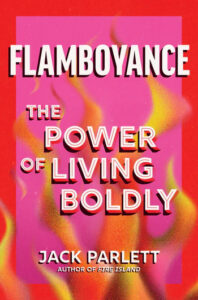
Flamboyance: The Power of Living Boldly by Jack Parlett is available from Hanover Square Press, an imprint of HarperCollins Publishers.