
I’m named Eleanor because I arrived a week after Eleanor Roosevelt visited Kansas City to campaign for her husband. At that time my parents lived in Rolla, Missouri, and my mother said that even without my imminent birth she wouldn’t have bothered crossing half the state to wait with the crowd at the airport. Yet the following day, Rolla’s newspaper devoted a third of its front page to a photograph of Mrs. Roosevelt smiling in front of the small TWA airplane she didn’t seem frightened to ride. My mother admired her bravery.
My father liked the name Eleanor, but worried it would backfire, as many people in our part of Missouri held strong opinions about the Roosevelts, and not all of those opinions were favorable. He suggested they name me Nora for short, and my mother agreed with that.
*
I didn’t know until I met Leonard that the name Eleanor derives from Helen, which in Greek means “shining light.” Even at seventeen, Leonard carried that kind of knowledge around in his head. But I doubt my mother ever learned what my name means in Greek. She would have delighted in learning it, because she loved sunlight. More than most people, I mean. When she came in to wake us, before she even kissed our foreheads, it was always shades up, curtains back. She despised the long nights of winter. Every July, we spent a weekend at the Lake of the Ozarks, and once, while my father was fishing, she had me and my brother climb a slope with her so she could photograph the water at sunset. Back home, when she had the film developed, she was disappointed. The sparkle couldn’t be captured in black and white.
Another thing I remember about her is that she didn’t tolerate lies. She regularly reminded my brother and me that liars died twice in the Lake of Fire, and that the one who breathed out lies would perish. And to her, a lie was a lie was a lie. It didn’t matter if you were Hitler claiming he only wanted peace (a piece of Poland, the joke went, a piece of France . . .) or the woman who swore she’d already paid the bill for her laundry when both she and my mother knew she hadn’t. Or, it should be said, if you were a particular daughter, tempted to deceive when asked why the bowl containing that week’s sugar ration didn’t seem as full as it should be.
Because I admired my mother and loved her, and because I didn’t want to be punished by God, and because I most certainly didn’t want to have anything in common with Hitler, I tried hard not to lie to anyone. About anything. If a friend at school asked me if I liked her new dress and I didn’t, I’d pretend I’d forgotten something and had to run back to get it. Or I’d change the subject to something of hers I did like, maybe a barrette or her socks. But if pressed, I’d tell the truth.
In sixth grade, however, I told a blatant lie, and though I obviously didn’t perish, I still believe what followed altered the course of my life.
My teacher that year was a Mr. Pile, and from the first day of class, I loathed him. He was nice enough to me, as I was quick, studious, and a girl. But he called Tom Bigby, who was the smallest in our class, “Mr. Littleby,” and he kept doing it long after even the worst of us stopped laughing. Ronald Bell, wall-eyed and slow, was unimaginatively called “Mr. Fish.” Peter Schultz sounded as Missouri as the rest of us, but Mr. Pile would only address him as “Herr Schultz,” in the thickest of German accents, and this at a time when no American wanted to be thought of as German.
Mr. Pile lectured at us from behind a podium, and he’d made a little sign for this podium that said mr. pile in spread-out letters, as if he wanted to spell it for us slowly: m r. p i l e. I’d often stare at this sign and think about what it should say, or rather, what it could say. He’d used his fountain pen to make the letters, so nothing could be erased from the sign, only added.
One morning when we were out at recess, I fell off the monkey bars—it was winter, and when the temperature dipped below a certain degree, girls were allowed to wear pants under their skirts, so those were big monkey-bar days for us. I wasn’t hurt when I fell, but I muddied the hem of my skirt, and I asked Mr. Pile if I could please go in and rinse off the mud. He gave me permission, and I went in. Some of the younger grades were on a different schedule, and I remember that there were other girls in the washroom, and other students and teachers in the hall. By the time I got the mud out, the bell had rung and the hall was quiet again, though my class had ten more minutes of recess.
I realized I had time to do something I very much wanted to do. Throughout my life, I’ve seized such opportunities. Sometimes this seizing has very much worked to my advantage. Sometimes it has not.
I ducked into our classroom and closed the door behind me. I found Mr. Pile’s fountain pen in his top desk drawer. With a few strokes, I changed the sign to read m r. r u d e, then capped the pen and returned it. When I went back outside, I showed Mr. Pile I’d gotten out the mud, and thanked him for letting me go in.
“You’re quite welcome, Miss Nora. You did a good job getting that stain out.”
I smiled back, not feeling bad one bit. I hadn’t lied. I’d made the sign on the podium more honest.
Once we were back at our desks, it didn’t take long for my classmates to start smiling and looking at one another. But Mr. Pile, standing behind the podium, had no idea what was so funny. I must say, I was pleased to witness how scared he looked, realizing he was being laughed at. Shoe, meet your new foot. The good time went on until Wilma Cooper raised her hand. Wilma believed that because of her faith in Jesus, she had to be nice to everyone, and when Mr. Pile called on her, she sorrowfully pointed to the sign. He came around to look for himself. By then, no one was laughing. We could hear him breathing through his teeth.
When he turned to face us, he raised one finger, and it trembled.
“Whoever did this,” he said, “will be discovered.”
I wasn’t worried. Everyone in our class had been outside with him, except, briefly, for me. And Mr. Pile only knew me as a good girl, well-mannered and compliant, with no reason to dislike him. I have a picture of myself from that era, and I look irritating and prim—my mother used to wrap my hair in rags Sunday nights so I’d have curls like Shirley Temple through the week. In this picture I’m smiling, resting my chin on folded hands, and I have an enormous bow in my hair that looks gray in the picture, though I remember the bow was yellow. I believe I wore that yellow bow in my hair the day I changed Mr. Pile’s sign.
He was still breathing like a bull when he gave us a page of math problems and told us to work quietly at our desks. He went out into the hall, and though he left the door open, some of the boys started to turn around and whisper to one another, trying to guess who might have done it. No one thought of me. Mary Pank turned around, waited for me to look up, then whispered, “Mr. Rude!” I smiled just enough to show I agreed it was funny, then went back to work.
Good thing, because Mr. Pile came back in quickly, and when I looked up, he was staring right at me.
“Miss Chesnow,” he said.
Terror bloomed, unhelpful. I put my pencil down. “Sir?”
He took a step toward my desk, and then another. Behind me, the radiator hissed.
“When you came inside during recess, did you see anyone coming or going from this room?”
“No sir,” I said. It was true. I hadn’t seen myself. But I was aware of my classmates watching, and of their fear on my behalf. Mr. Pile seemed mostly bewildered, as if he’d set something down and turned around, then turned back to find the thing missing.
“Miss Chesnow.” A vein on his forehead bulged. “I’m going to ask you one last time. Do you know who altered the sign?”
Now the choice was clear. I would confess, or I would lie. For just a moment, I considered revealing myself. It was like standing at the edge of a dock, your body already leaning forward, and deciding almost too late not to jump.
I recently read a book by C. S. Lewis in which he says that you don’t really know what you believe until the truth of it becomes a matter of life and death. It’s one thing to have faith that a rope is strong when it’s coiled in a box. But would you dangle from that rope over a precipice? In those moments that Mr. Pile stared down at me, waiting for an answer, I was more afraid than I’d ever been in my life. And C. S. Lewis was exactly right. I discovered that I didn’t truly believe my mother’s warnings of eternal punishment. Or rather, I was willing to bet against them in the face of Mr. Pile’s certain, and imminent, wrath.
“No sir.” I managed to sound indignant. Unpracticed as I was, fear pushed me to excel.
“I see.” Shame filled his eyes. “Forgive me.”
My heartbeat steadied. I nodded once, an insulted but merciful queen. Mr. Pile retreated from my desk, dabbed at his forehead with his handkerchief, and with a shaky voice, resumed class.
What C. S. Lewis didn’t say: After the danger passes, you might go back to not knowing what you believe and start to worry that you chose wrong.
I spent the rest of the day in a silent panic. At lunch, both Mary and Wilma expressed outrage that I’d been unfairly accused. I said nothing, and felt even worse. When school got out, I waited for my brother at my usual spot, watching fat snowflakes fall from the pearly sky, their beauty no consolation.
When I got home, my mother asked me about my day. I said my day was fine. Because why not? In for a penny, in for a pound. She looked up from her ironing, wincing as if in sudden pain. Or that’s how I remember that moment. She’d always told me she could tell when someone was lying, and so I held my breath and waited. The look of pain left her face. She smiled, reached out to muss my hair, and said if I changed my clothes and wore my warm hat, I could go out and play.
That night, I was not visited by demons, and I woke to find, to my surprise, that I had not perished in my sleep.
When I returned to school on Monday, I noticed that Mr. Pile didn’t call Tom or Ronald or Peter any names but their own. He didn’t call on them at all—his pride was too great for that. But at least some decent part of him realized he shouldn’t be dishing out what he clearly couldn’t take.
And so my relief turned to jubilance. I didn’t care that no one knew I was the one who’d taught the teacher a lesson. Everyone thought Diana Prince was a regular army nurse, but she was secretly Wonder Woman, using her jet and lasso and superpowers to fight evil, near and far. I had no magic lasso, and no invisible jet, but I could lie with eyes of steel, and that felt like a superpower. Over the next few days, I planned an entire career of secretly using this power to take down other villains.
On Friday, the principal showed up outside Mr. Pile’s door. He said my name and told me I should gather my things. I could barely strap my books because my hands were shaking, though Mr. Pile himself only seemed surprised. Out in the hallway, the principal touched my shoulder and spoke to me gently, saying my father was in his office. And I knew. My father was a machinist at a metals plant. He went to work even when he was sick. If I was in trouble, no matter how serious, my mother would have been the one to come. I broke into a run, ignoring the principal calling after me. Some of us are like that with what scares us. If we know it’s coming, we rush to it. The dread is worse than the thing itself.
When the secretary saw me in the doorway, she looked at me with pity, then glanced at a door a few feet from her desk. I moved past her, opened that door, and there was my father, a giant in a chair made for a child, the laces of one of his boots undone. He’d been crying. And just that, seeing tearstains on my father’s cheeks, was like seeing water run uphill. I’d entered a new world, with different rules.
“Oh honey,” he said, and held out his arms.
My mother had collapsed while she was hanging clothes in our backyard. I learned later that Mrs. Ritchie next door saw her fall, and she’d had to run and get her step stool so she could get over the fence and try to help. By the time she did, my mother was already dead. An aneurysm, my father said, and I could tell the word was unfamiliar to him as well. But he explained as best he could, putting a fist by his left ear, then shooting out his oil-stained fingers. A burst vessel in her brain. He couldn’t understand it. She was the best person he knew, my mother. And there was no family history of any such thing. She was young and healthy. It made no sense, he said, gasping through sobs, his shoulders heaving. No sense at all.
Of course, all of it made sense to me.
*
If my father had asked me directly why she died, I would have told him the truth, even if he hated me for it. I sincerely believed my lie had killed her, and that if I lied again, my father or Bobby might be taken as well. But he didn’t ask me why she died, and I didn’t volunteer the information. My whole life, my father had brightened at the sight of me, laughed at my jokes, and advised my brother, three years younger, to follow my example. I’d grown up basking in the warmth of his esteem, and I couldn’t bear the thought of losing it. So I let him think that my misery was like his, coming only from grief.
My shame was so great that I told no one of my guilt, though for months it was always with me, an itch under my sweater, burning but unseen.
__________________________________
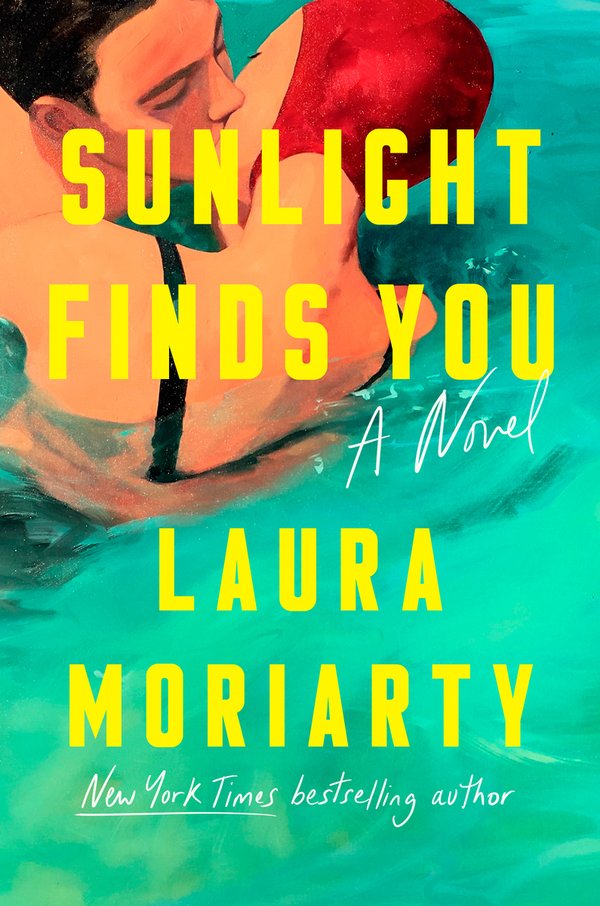
From Sunlight Finds You by Laura Moriarty. Used with permission of the publisher, Riverhead Books. Copyright © 2026 by Laura Moriarty.