
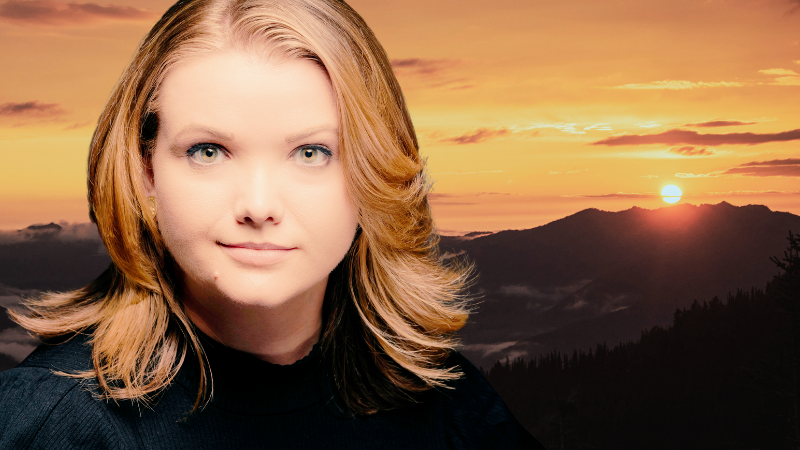
Belgrade-born Téa Obreht’s first novel, The Tiger’s Wife (2011), set against the landscape of the former Yugoslavia, blended myth, village life, wartime strife and deep grandfather-granddaughter love into a marvel that won her the Orange Prize for Fiction at the age of twenty-five. Her follow-up, Inland (2019), brought her magic touch to parallel tales of two characters adrift in the ghostly desert of frontier-era Arizona where it’s “hard to distinguish waking from dreaming.” The The Morningside (2024) imagines a young eleven-year-old and her mother, displaced by war “Back Home,” living in a mostly empty thirty-three-story apartment building in a flood-ravaged Island City, trying to find a way forward.
Her new novel reinvents the Western crime novel, wrapping together stories from 2024, 2003 and 1902, with characters ping-ponging off each other, surprises at every turn.
The opening lines to Sunrise are gripping:
Now you glimpse her. From above, she appears as a dark speck on even darker water. Her head, shoulders, and the occasional hand make brief silhouettes. Beneath, her legs churn, flashes of green glinting as she fights against the chaotic moment, as if she’s been hurled into a frigid nightmare. For the moment she keeps crying out, grabbing at vacant space while her clothes fill with water. Her mind believes her feet will eventually meet solid ground. They won’t—she’s nearly half a mile from shore, and the lake beneath her is more than four hundred feet deep. In a minute or two she’ll grasp the big picture and calm her flailing.
How complicated was it to begin a novel with a woman tumbling from a plane into a lake? I asked Obreht.
“I mulled over the opening for months before actually sitting down to write it (a rarity for me, since I usually need to see sentences, even the worst possible version, before I can start shaping a story),” she explained.
No matter how long I waited, I couldn’t glimpse the details that led up to the crash. Only the aftermath was clear to me: a young woman, cold and alone, fighting to stay afloat in the moments after the most terrifying thing she’s ever endured. I did want the book to begin with the plane wreck, but it was excruciating to write without knowing anything about Nina, or what she was doing there, or who was piloting the plane—essentially to feel, as readers would, totally cold to this scene. Once I embraced that, though, it became liberating. The rest of the book then became about Nina proving herself capable of surviving that initial horror.
*
Jane Ciabattari: What inspired this novel?
Téa Obreht: About a decade ago, while I was absorbed by dime-store Westerns, I drafted an initial version of a tale about an aging gunslinger wrestling with remorse from a long-ago rift with a longtime acquaintance. In those early drafts, Anton Vargas resembled the figure he is in Sunrise: vain, self-centered, defensive about his role in pushing the continent’s expansion westward. I couldn’t figure out why I kept stalling on finishing his story, or why I couldn’t simply abandon the project.
I realized that these three nagging, unfinished pieces all evoked the same feeling in me when I thought about them, and that this probably meant that they were trying to tell the same story.
In the meantime, I wrote Inland. I began what I thought would be a novella about a young woman who is shipwrecked on a tropical island and discovers a corpse with an unfinished manuscript beside it. I drafted The Morningside. I started what I believed would be a short piece about a young historical re-creator who becomes caught up in a violent incident at a Wyoming tavern. Then, one afternoon on a flight back to Wyoming, it hit me that these three stubborn, incomplete pieces were expressing one shared feeling, suggesting they were all trying to tell the same story.
JC: How did you settle on the title—the setting that orbits these narratives? There’s a Sunrise in Wyoming. Is it inspired by that true ghost town?
TO: The process of naming this book Sunrise began on that plane ride when I realized Nina’s story, Vargas’s, and Coll’s were parts of a single whole. I was returning from Vermont via Chicago, where I had just encountered a startling realization at the airport bookstore. Casually, I picked up a bestseller everyone at home seemed to be reading, opened it, and suddenly recognized that my own manuscript matched its premise almost exactly. The moment was utterly overwhelming. I bought a few magazines, boarded the next flight, and tried to steady myself.
There was a long internal monologue: it’s not the end of the world, it isn’t a catastrophe to shelve a project you’ve spent a year on, you’ve endured worse, etc. I tracked the flight’s path, feeling the red evening light, wondering where I should redirect my energy now that I could not return to the previous book. Vargas, Coll, Nina—each of them lit up in my mind in the same purple hue, and the in-flight tracker pointed me to a Wyoming location tied to the moment of revelation: Sunrise. So yes, there is a real Sunrise in Wyoming and it is a ghost town, but the town in this novel is named Sunrise to honor that moment of discovery more than anything else. In terms of appearance and geography, it’s drawn far more from the ghost town of South Pass, which I began visiting in 2015 when I first started drafting Anton Vargas’s story.
JC: You untangle several mysteries across generations. There’s the “Incident at Horseshoe Lake in August 2024”—the plane crash that brings Nina to Sunrise and the question of why Ben pushed her out of the plane, raised in early pages. There’s the tale of a legendary gunslinger named Anton Vargas, told in a heroic 1882 Western version and a 1902, less idealized, revision written by a 2003 author. And a storyline about Coll, leader of the 2003 Sunrise reenactment, who becomes entangled in a disreputable bar incident and pursued by a would-be author who wants details about Sunrise. How did you manage these interwoven threads?
TO: I’ll admit it was the most enjoyable experience I’ve had in crafting a book. It helped to know with certainty that these three strands belonged together and depended on one another for both meaning and existence. Practically, though, I first drafted as if I were writing three separate volumes so that each character could grow and each voice could develop independently. By the third draft I started working on them in tandem, and it was exhilarating to see how information from one thread could inform the others and how they ultimately fit together.
JC: A key tension in your opening is Nina’s reliance on her cellphone. She and her fiancé Ben have a dinner reservation at the Black Horse in Moraine, Wyoming, after their flight from Hollis, South Dakota in a Cessna owned by Jones—the friend who will meet them there. She hopes Jones will notice their absence and summon help. But signals fail. She can’t reply to messages, only reads texts from her mother and a restaurant confirmation, and their call for help drops on deaf ears as the line dies. With power dwindling, what was your approach to modeling these modern-day obstacles?
TO: A lot of Nina’s early trials echo my own fears about being at the mercy of technology. I’ve lived in Wyoming for years, yet I wouldn’t call myself an outdoorsperson. Every time I head into the wild, I imagine the worst-case scenario and how little I’d be prepared for it. I carry bear spray, extra water, snacks, layers, and a first-aid kit, but when that tiny satellite icon appears I worry that I wouldn’t even know how to start a fire or improvise a tourniquet if I truly needed to. Those fears guided the obstacles I placed in Nina’s path to reveal how fragile her situation could be. One habit I’ve shed over time is the impulse to shield my characters from harm or bad choices; with Nina, she’s going to face as many rough moments as she does setbacks.
JC: Nina makes a number of missteps in the hours and days as she strives to stay alive with scant rations (a single protein bar daily, some trail mix, and water). Is this because she’s a city dweller from Queens juggling graduate school and nannying on the Upper West Side, with little familiarity with mountains and forests? Or is it a fundamental trait of her character?
TO: It’s a mix of both. Nina is very much a city girl, with limited wilderness experience. Yet she’s forged a different kind of resilience: she’s an immigrant supporting a financially vulnerable mother, and she herself suffers from anxiety and OCD. These challenges have trained her in endurance. Her relationship with Ben—an outdoorsman—shapes her inner voice and expectations. A major arc of the journey is learning to quiet that inner voice and discovering the strengths she can rely on to walk out of Sunrise alive.
JC: Nina’s relief when she finally finds a town only to discover it’s deserted and offers little sustenance is palpable. She shelters in a stable and, beneath a trapdoor, uncovers a satchel filled with papers, old newspapers from 1872, a book, a manuscript, and a corpse, which shocks her. She calms herself, retrieves a jacket from the body labeled “property of LT Hawley,” and starts reading the “old-timey” book in the satchel, An Incident at Greyrock, which introduces Anton Vargas and his crew (Fred Kipley and Doctor Maclean), who rescue Sadie during a robbery at a snowed-in telegraph station. Nina is unimpressed, noting that the only reading material in this godforsaken place is “the kind of ancient dreck that makes you slog through fifteen pages of general wilderness description before a human being even appears on the page.” What kind of research did you undertake for this scene that sets up the rest of the novel?
I’m fascinated with the Western as a genre, as theatre, as propaganda, as a vehicle of nationalism.
TO: I pursued two very different kinds of research for this novel. The first was a sensory immersion in the world of Nina, focusing on the immediacy of her experience. Since she isn’t an outdoorsperson and has to interpret many unfamiliar things, I spent substantial time exploring ghost towns and abandoned homesteads with meager supplies and inadequate gear, asking myself: what would this feel like? What would you see, smell, or hear? How hungry would you need to be to risk those berries? If you’re shivering and exhausted, would you be tempted to light a fire here and accidentally scorch the whole place? The second kind of research was the opposite end of the spectrum—the intensive reading of dime novels to build the backstory and myth of Anton Vargas.
I’m fascinated with the Western as a genre, as theatre, as propaganda, as a vehicle of nationalism. There’s a wealth of material in the dime-novel origins of the Western, plus the evolution from dime novel to Wild West show, which helped forge global legends from figures like Buffalo Bill Cody. Beneath the pomp and pageantry lies a particular grotesque, garish spectacle of white frontier heroism, where people disguised as others reenact murders, gunfights, and even acts against Indigenous people. I wanted to capture that grotesquerie with as much accuracy as possible while acknowledging that Vargas’s youth carries a nostalgic pull—despite everything he knows about it.
JC: The second portion of Sunrise is LT Hawley’s September 2003 novel manuscript, “Sunrise,” a sequel to The Incident at Greyrock, recounting Vargas’s return to Sunrise two decades later (and another puzzle: how did Hawley end up dead?). All of this is tucked into your overarching novel Sunrise. How did you manage this?
TO: I’ve long found the notion of a book within a book compelling, and I was thrilled to realize Vargas’s story—that I’d been toiling on for more than ten years—could only exist by incorporating intertextuality. Vargas’s tale needed to function as an actual book inside the novel, with the power to affect other characters in multiple ways. For Coll, the official Vargas biography becomes a foundational myth. For LT Hawley, the revisionist version provides identity and purpose. For Nina, the actual manuscript by Hawley serves as a lifeline.
JC: The danger of Nina being attacked by a bear or wolves is a constant undercurrent. At one point she observes a pack of wolves closing in on a bull elk. Your depiction of the landscape, storms, and the fall foliage is richly detailed. How did you come to know so much about Wyoming’s wilds?
TO: I spent years visiting Wyoming before we eventually relocated there with my family, drawn by its beauty and complexity. I’ve learned from scholars, thinkers, and writers deeply rooted in the American West about its realities and contradictions. For Sunrise, I tried to be mindful of restraint—much of the knowledge I possess cannot be fully conveyed through Nina’s point of view. She experiences the land through sensation and immediacy. The love of the land and its brutal history are revealed through Vargas and Coll’s sections, a different kind of challenge because they operate under myth and wish to see beyond it. That leaves part of the narrative in readers’ hands, inviting their own knowledge—folkloric, historical, or natural—to fill in the blanks.
JC: How did your ending take shape?
TO: Early on I realized the book’s architecture would resemble a descent into the core of the story and then an ascent back out, meaning readers would end up with more information than any character possesses by the final pages. It’s the first time I’ve written a book without a predetermined ending; I wrote toward it as I went, and the final pages surprised me as much as I hope they will surprise readers. The ending stayed largely intact throughout revisions, which felt like a positive sign.
JC: What are you working on now or next?
TO: I’m in the very early stages of a new novel, about which I’m keeping details sparse for now. It appears to be drawn toward following three sisters as they navigate the death of their renowned mother and strive to carry out her last wishes. While I wait for those specifics to clarify, I’m also drafting a handful of short stories, which I’ve finally returned to after years of notes and fragments.
____________________________

Sunrise by Téa Obreht is available from Random House, a division of Penguin Random House, LLC.