
Pure originality was a modernist dream. Everyday speech is famously built from clichés—terms and expressions that have been reused so often they vanish from sight. They sprout like dandelions, growing unnoticed until they suddenly dominate the landscape. At one point John Updike urged a pause on the word “stunning,” even as he himself kept using it. A well-known New Yorker essay noted that the magazine’s editors seemed to favor poems about water. Attempting to craft fiction without clichés is like Dorothy from Oz attempting to cross the poppy field: she won’t succeed, and eventually she’ll drift off to sleep. A handful of authors keep going, like the Straw Man and the Tin Man, writing page after page without obvious clichés. Ali Smith, Anne Carson, Will Self, and Nicholson Baker can do that. Paul Celan may hold the title of Most Immune to Clichés: he literally broke words apart in order to avoid conventional German, which he believed was forever tainted.
Thinning prose of cliché is an endless task. It’s equally hard to dodge stereotyped plots. A traumatized child seeking redemption, a tragedy that ruptures then repairs a couple’s bond, a journey that reshapes an uncertain girl into a self-possessed adult. Readers expect to recognize the kind of plot a novel uses, and to relish the author’s twists on it. Stereotypical plots are even more pervasive than clichés because many writers never bother to evade them, and those who try frequently fail. Crafting truly fresh storytelling is enormously challenging. Nabokov was particularly adept at this. When he wrote Lolita, nothing like it existed; when he died he was at work on The Original of Laura, another original scenario. He delighted in unsettling his readers. He once quipped that he wished someone would write a novel about a serial killer who lives contentedly into old age, with an adoring family and proud grandchildren.
Genre represents a third kind of cliché. There are websites that list dozens: young adult, Scandi noir, chick lit, mystery, thriller, horror, Westerns, historical fiction, alternate history, hard and soft science fiction, litRPG, steampunk, space opera, crime fiction, police procedurals, courtroom drama. One peculiarity of publishing is that the category “literary fiction” lumps all of these under the banner of “genre,” as if a literary novel should resist any mold. Yet only a few writers of “literary fiction” manage to craft novels that genuinely avoid genres.
These three sources of unoriginality—clichés, plotlines, and genres—function as rough guidelines for me. When a book manages to dodge them, it can feel truly original. That isn’t necessarily what every reader or writer seeks: familiarity has its own irresistible pull, especially when the twists are clever. And while avoiding genre altogether isn’t always sensible (think Stephen King or Agatha Christie), and everyone, at times, speaks in clichés, originality remains an incredibly seductive lure.
These are the books I often reach for while I write. They illuminate ways to sidestep a host of formulas, clichés, banalities, and stereotypes. If you’re curious about what reading feels like when a book genuinely sits outside the box, here are some of the most unorthodox novels of the last century.
*
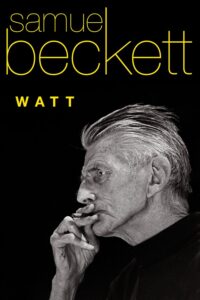
Samuel Beckett, Watt
One consequence of approaching Watt after all of Beckett’s other works is that I’m left astonished by how broadly admired he remains. I grasp why Godot is celebrated, and I see his postwar writings as examples of existential inquiry, but I’m baffled that a text so peculiar, so emotionally and affectively opaque, so structurally unruly and fragmentary, so far from a coherent logic, could ever be widely accepted as a classic—one that garners Nobel prestige. Watt makes Flann O’Brien’s near-dissociated fantasies like The Third Policeman seem domestic and genial by comparison. Watt makes Daniel Paul Schreber’s Memoirs of My Nervous Illness, written during psychosis, feel like a sentimental diary piggybacked on a mental landscape.
This is a novel driven by barely contained compulsions, by experiences that feel almost randomly meaningful. The narrator resembles a helium balloon tethered to his own life by a loosening thread. He constantly rebinds his experiences to their meanings, inventing rules and games to organize them. He finds particular solace in running through lists. Entire stretches of Watt consist of manic formulas separated by commas:
Not that Watt felt calm and free and glad, for he did not.. but he thought that perhaps he felt calm and free and glad, or if not calm and free and glad, at least calm and free, or free and glad, or glad and calm, or if not calm and free, or free and glad, or glad and calm, or if not calm and free, or free and glad, or glad and calm…
I doubt Beckett could have conjured a conventional explanation for the architecture of his book. The scholar Hayman describes it as “astonishing” to learn that Beckett had “no idea where he was going, no project, no outline, no plot, no setting, and effectively no characters: tabula rasa.” That is as close to incoherence as literary criticism dares to get. And it isn’t astonishing that Beckett didn’t know where he was headed with Watt. By the fifth page any reader alert to anything other than a clue or key or plot already knows this is radical material. Watt stands so far beyond conventions, so far beyond clichés, that the question isn’t understanding the book so much as enduring it.
César Aira, How I Became a Nun (and all his other books)
The opening two chapters of this brief work are excruciating and wonderfully controlled at once—funny, odd, and tense. The narrator is a boy, yet he might be a girl as well, a detail handled with offhand ease; some people refer to the protagonist as “he,” others as “she.” The child is offered a strawberry ice cream as a rare treat, because the narrator has never tasted it before. The ice cream nearly makes him gag, and Aira’s description is unnerving. The father questions and argues with his child, then loses his temper. Every child in the world loves strawberry ice cream, the father insists, and he forces another spoonful.
I felt the ice cream dissolving, and my whole body was seized by a convulsion… disgust flooded through me… another big spoonful was on the way, I opened my mouth. I was already crying, Dad put the spoon in my free hand.
“Go on.”
I choked, coughed, and began to wail…
“Don’t like it? Eh? didn’t you like it? You’re a moron, you know that?”
Eventually the father tastes the ice cream and discovers it is poison. He erupts in rage and kills the ice-cream vendor.
That opening is without equal. Afterward, the book wanders along the unpredictable byways characteristic of Aira’s prolific output: he composes short novels by the dozen, and claims he never plans and never revises. The pieces vary in spellbindingness. Could a cluster of his tiny works count as a single kaleidoscopic novel? I’d nominate four more to accompany this one. They can all be read in a single evening.
An Episode in the Life of a Landscape Painter is drawn from a real memoir, yet the storytelling arrests the eye with its stark way of recounting a man struck by lightning and dragged by his horse until he bears a grotesque injury. Ghosts is a magnificently strange tale of naked, paunchy, middle-aged male specters who drift about without frightening anyone. At times they pose as clock hands, at others people mistakenly grasp their genitals. The Literary Conference concerns a man who solves an ancient mystery and discovers a treasure chest, only to forget about it and continue with his life.
The finest of Aira’s books function as an encyclopedia of methods for dodging clichés. Most of the rest of the time he meanders, sidestepping stereotypes by abandoning one plot thread and embracing another.
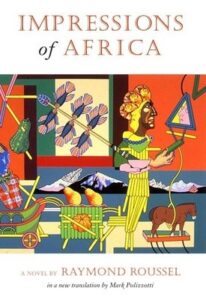
Walter Abish, Alphabetical Africa, and Raymond Roussel, Impressions of Africa
Two works that pretend to be about Africa, yet primarily reveal their authors’ peculiar notions of what novels might be.
The chapters of Abish’s book proceed from A to Z and back to A, with each successive chapter using only a subset of the alphabet. The initial chapter contains only words beginning with a; the next includes words starting with a and b, and so on. The book begins:
Ages ago, Alex, Allen and Alva arrived at Antibes, and Alva allowing all, allowing anyone, against Alex’s admonition, against Allen’s angry assertion: another African amusement…
When he reaches z, Abish rolls back to a, and then the volume finishes. By the time he closes, he appears rather exhausted:
Another abbreviation another abdomen another abduction another aberration another abhorrent ass another abnormal act…
And yet this final passage (which occupies two pages) also reads like a précis of the book. In the middle he ventures into stories of greater breadth. Abish has said he composed the work to convey his “distrust of the understanding that is intrinsic in any communication,” and the characters sometimes reflect this idea. Here is the opening of the first chapter labeled “M,” with words that begin with m or with any letter preceding m:
My memory isn’t accurate anymore. Mentioning my memory makes me feel insecure. A few months ago Alex and Allen kidnapped a jeweler in Antibes and killed him almost inadvertently…
And the second chapter titled “M”:
Making memory more meaningful in darkest Africa, a certain Chief Auwick measures all meaning in his former life.
With the letters g or h you sense that you won’t unearth anything about Africa, or anything truly worthwhile as fiction, and you recognize the author’s genuine interest in how communication fails. You observe how he threads his own rules for the first letters of words while simultaneously reading his stories, and yet you never quite grasp how the two strands relate. The reading experience remains persistently odd from beginning to end. What game is this author playing, exactly?
All of the Africa references in Alphabetical Africa are fictional, and Abish is engaging with Raymond Roussel’s Impressions of Africa, an even more deranged book that likewise isn’t about Africa. There has been a lot written about Roussel, so I’ll keep this brief: the book concerns a group of Europeans shipwrecked in Africa who stage an entertainment for the king who hosts them. Yet that isn’t really the point. The first half unfolds as a series of disconnected depictions of elaborate, bizarre sculptures, dances, and performances. A statue of Immanuel Kant built from cuttlefish bones placed on tracks made from veal lungs. A coral bracelet that is actually a colossal worm trained by a Hungarian man to play the zither. A man who sings Frère Jacques in four voices from the corners of his mouth. For the entire first half you read minute descriptions of these objects one after another. The second half explains how the sculpture was constructed, how the worm was trained, and so forth, but in the end everything remains as strange and unmotivated as at the start. No reader finishes Roussel and says, Oh, now it makes perfect sense. Roussel is a complete world unto himself—his next book, New Impressions of Africa, which is likewise not about Africa, took him seventeen years—and he must be read to be believed.
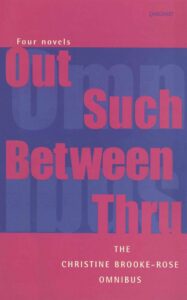
Christine Brooke-Rose, Thru
Christine Brooke-Rose stands as one of twentieth-century England’s most singular eccentrics. Reading her work is like attending a seminar where you’re the lone participant. Thru is saturated with names and ideas. Published in 1975, Brooke-Rose was in Paris, absorbing French theory, philosophy, and linguistics, and the book culminates in a five-page list that catalogues seemingly every proper name in the text. Here is a fragment of that list, with a few annotations added for flavor.
Proust, Marcel
Pygmalion
Quipu [ancient Andean counting method using knotted cords]
Ra
Racine
Rachmaninoff
Ram, The
Rastier, Francois [French linguist, born in 1945]
Rastignac [character in Balzac’s La Comédie humaine]
Rustaveli, Choto [a 12th century Georgian poet]
Ruwet, Nicholas [a Belgian linguist and critic who died in 2001]
Sade, Marquis de
At the end she grades everyone from A+ to F (using Greek letters instead). It’s as if the teacher is composing her own canon of literature.
Thru unfolds around a literary conference and asks what kinds of books people should write. At one point the narrator offers a kind of moral: “The two pleasures—the pleasure of your game and the curiosity—should be skillfully balanced, which is the work of a lifetime.” The book is a treasure trove of curiosities and games. Many pages resemble diagrams more than prose. There are concrete (shaped) poems, acrostics (where certain letters in words form hidden sentences), mesostics (reading down through lines to reveal concealed lines), and pages that look like interconnected Olympic rings formed by letters.
When I read Brooke-Rose, I’m struck by how isolated she must have felt, how resolute. She wrote this at a time when experimental layouts were scarce. She drew inspiration from Ezra Pound’s Cantos, and he did push the boundaries too. There was also Guillaume Apollinaire, a pioneer of concrete poetry, and Maurice Roche, who is now largely forgotten, whose Compact (1966) blended graphics and found text. Yet Brooke-Rose really stood apart, writing for a remarkably small circle.
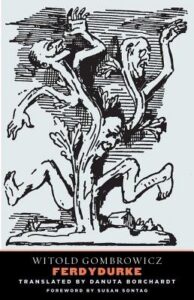
Witold Gombrowicz, Ferdydurke
Had modernism not carried such gravity—had writers like Woolf, Joyce, and their contemporaries not treated their work with such solemn weight—this novel might frequently be read alongside Stein’s The Making of Americans or Joyce’s Finnegans Wake as a prewar work so radical that it reads as postmodern. Yet Gombrowicz is insecure, humiliated, obsessive, jumpy, and mischievous. The closest kin in this respect may be Flann O’Brien’s At Swim-Two-Birds, published two years after Ferdydurke in 1939. Both works explode control and overflow with raucous humor.
Ferdydurke follows a serious young novelist who frets over form, and there is an extended digressive chapter in the author’s own voice, theorizing how structure underpins ambitious literature. Yet the book’s central theme is simpler and sharper: Gombrowicz is preoccupied with the precarious, unreliable sensation of growing up. A young person’s adult mask might crack at any moment, revealing a ridiculous and misshapen reality, complete with embarrassment, awkwardness, itching, giggles, blushing, and even bodily noises. In Gombrowicz’s terms, if a group of children taunts you until you wet yourself or otherwise reveal your vulnerability, you have just been “dealt the pupa”—exposed as a grub.
Compared with Gombrowicz, major modernists can seem sober and deliberately mature. In the face of this book’s acid comic energy, most attempts at humorous fiction—by John Barth, Thomas Pynchon, Adam Levin, or Charlie Kaufman—sound like professionally scripted stand‑up.
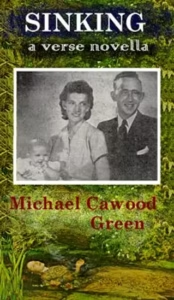
Michael Cawood Green, Sinking: A Verse Novella
This piece blends poetry, song lyrics, historical narrative, essays, and a glossary, attributed to a range of voices. It centers on a real event—a sinkhole that appeared in the South African mining town Blyvooruitzicht in 1964, swallowing a house and killing five people. At first glance the book seems to be a versified report. It opens with twenty-one poems, most about those who died or were involved in the disaster. One poem dwells on a washing machine perched just inches from the edge of the ruined house, a striking image of proximity to oblivion.
The second part opens with six short poems about the ethics of writing poetry about tragedies. (“If I could turn all this / Into poetry / Would they forgive me? / — for getting it all wrong.”) Then there are comments supposedly authored by various others, and finally a prose essay titled The Secret History of Sinking, signed Michael Green. The book ends with a supplement of Green’s song lyrics.
What makes it memorable is that it refuses to present a straightforward dossier of facts. Rather than a conventional chronicle, it interweaves verses, reflections, and songs, along with a mock-documentary frame. The back cover even features an aerial shot of the pit where the houses disappeared.
There are echoes of older writers. I thought of William Carlos Williams’s Paterson, a long verse-like chronicle, and of Walter Benjamin’s attempts to capture nineteenth-century Paris through clipped newspaper clippings; and there are resonances with modernist poets like Wallace Stevens. Green’s approach also points toward two lesser-known relatives: Paul Metcalf (my next entry) and Hans Magnus Enzensberger’s monumental poem The Sinking of the Titanic.
Still, as with any powerful book, those references matter less than the piece’s own voice. Sinking isn’t famous, but its blend of memoir, self-doubt, contrived documentation, and Afrikaans flavor is a memory that lingers. In an era when the fiction–nonfiction boundary is often debated, that blend feels like a notable achievement.
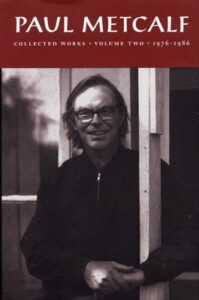
Paul Metcalf, U.S. Department of the Interior
Metcalf, famed for his Melville lineage, wrote in Melville’s house, at Melville’s desk, contemplating how to craft experimental American fiction in the twentieth century. The book opens with a chapter about an Alaska earthquake, then abruptly shifts to a seemingly unrelated chapter on migraine symptoms. A short list gives a flavor of the language:
an edging of light of a zigzag shape and curruscating [sic: coruscating] at right angles to its length
stars, circles, squares or squiggles, throbbing, spinning, flickering and spinning
bubbles and balloons
in a visual storm, a brilliant sand dune, the brains shimmering
The next line then links migraines with the earthquake:
a road cracking up with a severe earthquake
This is a surprising and beautifully executed return to the opening scenes of Alaskan roads cracking under the quake. The earthquake reappears for the reader as a kind of scotoma, an abstract vision. When I first read this, I flipped back to the start and began again. In hindsight, the transition is prepared by the preceding earthquake section, which describes how Houston rose four inches from a distant seismic wave—3,300 miles away—signaling that distant connections will recur.
Metcalf ought to be on every MFA student’s required reading list, for he demonstrates how to forge connections that aren’t contrived, programmatic, or awkward. In interviews and essays, he claimed that Melville wrote poetry in prose, even if his poetry was not good, and that writers like Melville and Poe blurred the line between poetry and prose. In Metcalf’s work, both forms—poetry and prose—are blended and transformed.
Flann O’Brien, The Third Policeman
At first glance, this book seems outrageously mad, both hallucinatory and dissociative. Nearly every page hosts some oddity—knives so thin they’re invisible, minuscule carved wooden boxes, bicycles that switch sexes and transform in an instant. A scent machine can “split any odor into sub- and inter-smells,” exposing the hidden odors beneath perfume.
Readers offer multiple explanations for the book’s strangeness. There are at least five standard readings:
(1) O’Brien is the overlooked Irish modernist, untouched by exile; The Third Policeman is a close kin to Joyce’s Finnegans Wake.
(2) The novel captures a generation in Ireland when humor could be sharp, when church authority loomed large, and the social world of pubs and rough camaraderie substituted for broader international culture.
(3) O’Brien is a contributor to what scholar Hugh Kenner called “Irish nihilism”—a text that lacks a conventional moral compass, beginning with a decapitation by a garden spade.
(4) O’Brien was a minimalist with a strong kinship to Beckett, a point Fintan O’Toole explored in a 2009 review for the American audience in The New York Review of Books.
(5) And then there’s O’Brien’s own account—that the book concerns a dead man and that the final scene reveals how the damned suffer their punishments forever. But that explanation only makes sense if one’s notion of hell accommodates knives too fine to see, minuscule wooden boxes, and bicycles capable of sexual fluidity. Otherwise it simply fails to illuminate anything.
The persistence of these competing readings demonstrates that the work remains too peculiar to fit into a mid‑century modernist category or even a postmodern label. It’s a real achievement to stay unclassifiable after nearly a century. I’d prefer to call The Third Policeman one of the best examples of truly avant-garde modernism because—by the standard definition of the avant-garde, as Theodor Adorno framed it—it refuses to settle into any single category, even after all these years.
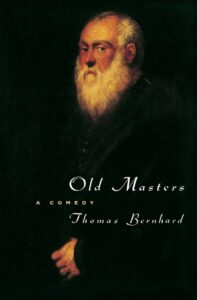
Thomas Bernhard, Old Masters
The literary world seems crowded with novels about works of art, especially paintings: Tracy Chevalier’s Girl With a Pearl Earring, Donna Tartt’s The Goldfinch, Heather Mariah Webb’s Rodin’s Lover, and earlier generations’ retellings like Irving Stone’s The Agony and the Ecstasy (Michelangelo) and Lust for Life (Van Gogh)—not to mention Proust’s memory-laden rendering of Vermeer’s View of Delft. What unites these works is a reverence for art and artists, with plots revolving around them. Bernhard, by contrast, is notorious for his sharp-edged antagonism toward Austria and its culture. (There’s even a separate volume, My Prizes, collecting his caustic remarks about prizes and the institutions that awarded them.)
In Old Masters, Reger—an art historian—visits Vienna’s Kunsthistorisches Museum repeatedly, not because the Tintoretto captivates him in a sublime way, but because it’s the only painting he can tolerate. That stance—love for one work’s stubborn survivability rather than for traditional beauty or inspiration—feels refreshingly blunt and disenchanted. The text treats art as a form of survival rather than worship, insisting that even great pictures are haunted by lies, hypocrisy, and self-deception, regardless of their exquisite craft.
In the narrative, Reger’s friend intends to meet him but stops short upon finding him seated before the Tintoretto, and the prose lingers over Reger’s aversions, how this single painting serves as a refuge, and what he loathes about everything else in art and life.
Art altogether is nothing but a survival skill… and attempt to cope with this world and its revolting aspects, which, as we know, is only possible by resorting to lies and falsehoods, to hypocrisy and self-deception, Reger said. These pictures are full of lies and falsehoods and full of hypocrisy and self-deception, there is nothing else in them if we disregard their often inspired artistry.
In the end, the two friends decide to attend a theater staging, and, of course, they despise what they witness.
*
I hope you might be intrigued by one or another of these. These ten books helped me see just how far novels can stretch, how badly they can misbehave, how much they can torture language, how close they can get to just being irrational. It’s liberating as well as daunting to see a famous author indulge in dialogue as batty as this mock philosophic debate from Ferdydurke:
“Noodles!”
The Synthetologue responded: “One noodle!”
The anti-Filidor roared: “Noodles, noodles, namely a mixture of flour, eggs, and water!”
Filidor retorted instantly: “Noodle, namely the higher being of the Noodle, the highest Noodle himself!”
His eyes flashed lightning, his beard fluttered, it was clear he had scored a victory.
You can’t eradicate every cliché and commonplace in your writing, but if you have models like these ten books, you’ll stay alert for longer. You might even make it partway across the poppy field.
__________________________________
Stories, Like Illnesses by James Elkins is available from Unnamed Press.
