
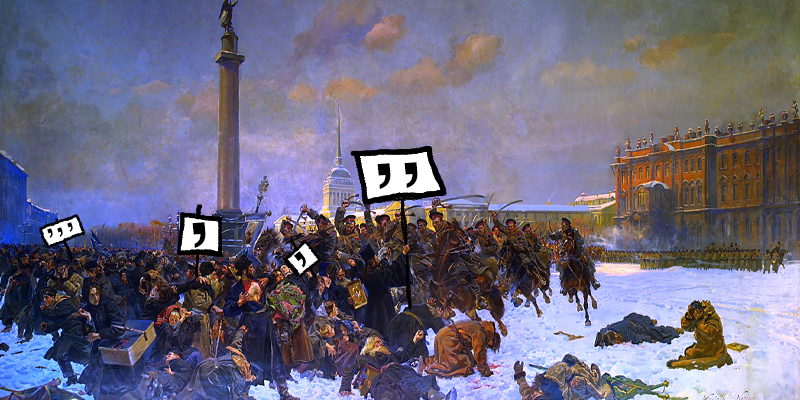
Commas hold real power to shift how a sentence is understood. Think of the difference between “eats shoots and leaves” and “eats, shoots and leaves,” or the oddity of “I ate, grandma” versus “I ate grandma.” Yet more than a hundred years ago, such punctuation helped unsettle the very structure of the Russian state.
In 1905, unrest spread across the Russian Empire as peasants, workers, and soldiers rose up against the repression and violence that defined daily life under the regime. This broad movement would eventually topple the tsarist autocracy and open the door to a constitutional framework for the country.
Among those stirred into action were the laborers at Sytin’s Moscow publishing house. Printers at the time were paid by the line of type, but punctuation did not count toward their wages. Florence Hazrat notes in a history of punctuation published by Aeon that, in 1905, Moscow printers insisted on being paid for setting not only letters but also punctuation marks, which required the same effort and time as the alphabet. The episode, widely referred to as the Comma Strike, sparked a nationwide boycott and helped push the czar toward granting Russia its first constitution.
Feliks Gross, in a 1950s piece titled “The Strike and The Revolution” published in Il Politico, adds that the October phase of the 1905 upheaval began with an economic stoppage. The printers in a Moscow shop walked off the job because they were not compensated for punctuation—commas, semicolons, and periods—essentially for punctuation itself. A subsequent railway strike emerged, rapidly spreading and evolving into a broader political protest.
Ultimately, the commas touched off more than a dispute about type and pay; they ignited a political moment. The lesson endures: even a small act of labor, such as placing punctuation, can carry substantial consequences.