
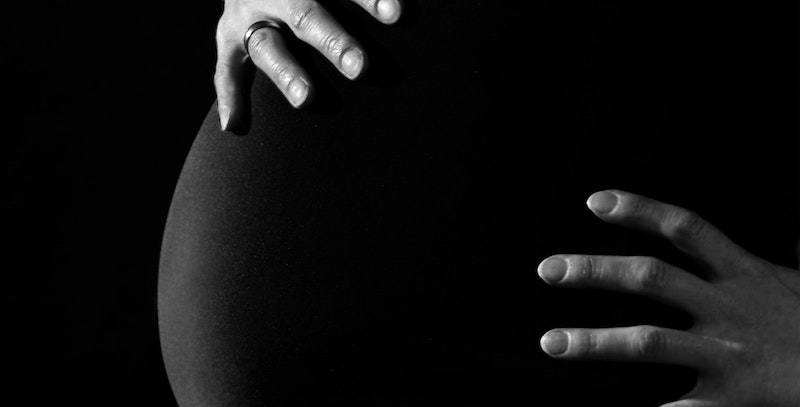
From as far back as I can recall, language has been the tool by which I mold my reality. Yet last year, when I searched for a guide into motherhood, I found myself emptied of words that could sustain or console me for the first time.
I was carrying life and craving a volume to shepherd me into this transformation, one of the most profound shifts of my existence. So I did what I always do as a writer and archival filmmaker: I combed both digital and physical shelves for anything—anything at all—that might answer not with instruction but with resonance. What I needed were stories, not tips or recipes, grounded in lived experience and imagery. The search yielded nothing. There were no intimate portraits of pregnant and newly postpartum Black bodies or the vulnerable reflections of that moment. It felt as though a literary absence had been engineered. How could this be, given that Black women have been giving birth, raising families, and shaping communities for generations, yet our collective and personal experiences remained undocumented? The absence provoked fury and ache. I had hoped the wisdom of the generations before me might map out the current voyage.
Then Sasha Bonét’s The Waterbearers appeared at just the right moment—a literary balm that soothed me through the tenderest season. Bonét braids together the matrilineal stories of her own kin with those of America’s maternal icons, Black women like Iberia Hampton, Camille Billups, and Betty Davis. From the very first page, she wrote as if she were addressing women like me—those who have felt a void, yet did not know where to find what would fill it. Somehow she understood that I needed to feel less isolated.
Those more than three hundred pages pressed with the weight of a late-teenage read, the kind of intensity I once aimed at understanding myself better. I had never encountered anything quite like this before. The prose conjured a world that felt almost dreamlike yet deeply recognizable. I wasn’t merely seeing myself on the page; I was present—through Bonét’s depictions of her mother, her aunts, and even her daughter. When I pressed Bonét about what hole she intended to fill with this book, she urged me to begin writing because what she wanted to read did not exist. “The absence [of a book on Black womanhood] felt a lot like what it feels like to be Black in the world—you’re pulling from all these different resources,” she explained. Bonét shared my frustration that our stories exist only in fragments. She longed for “to have all of these things in one place.” That remark echoed a line I’d highlighted in her book: “concealing history is another kind of violence that goes unnamed.” It branded itself on my mind and intensified my longing for a comprehensive collection of Black motherhood narratives. This literary gap wounded us all. Stories are how we recognize ourselves in the world.
As I journeyed through Bonét’s book, her voice offered a form of witnessing and wisdom I couldn’t quite name. The interpersonal clashes and joys passed through generations in her family felt oddly familiar to me. Not the specifics—we were separated by thousands of miles—but the core of their lives and their ways of navigating the world. As she did, I wrestled with how the choices of my mother, and her mother, seemed to travel through time and shape me. I asked Bonét why preserving the daily experiences of her family through literature felt so essential. She replied that it was her mentor, the artist Camille Billups, who insisted that archiving is our duty. “Whatever you do, whatever you write, put everyone that you love in it, because they’ll try to tell you that you weren’t here,” Bonét told me. This is precisely why the lack of Black maternal literature cut so deeply. Because we were here, we are here, and we matter.
I spent my whole life finding myself between pages. Now I am putting myself there, so others can find themselves too.
Reading Billups’ story in the book left me struck by her fascination with the seemingly ordinary. Her entire apartment functioned as an archive, and she preserved things that many would overlook as inconsequential. It was a reminder that the everyday holds equal significance to the extraordinary. This is exactly what I hungered for: the incidental moments, the quiet and messy reflections on motherhood, the photograph that almost didn’t happen. The in-between moments that could offer a real window into someone’s life. “She kind of told me in this way that it felt like a responsibility,” Bonét explains. It was, in her view, the most crucial lesson Billups imparted. Hearing her describe how Billups inspired her not only sparked my own inspiration but also planted a sense of obligation. I am a writer, a creator of worlds, not merely a reader. I must wield my words to illuminate the gaps I discover—to inscribe myself onto the page and to mirror others. Just as Billups shaped Bonét, and Bonét shaped me.
That sense of permission arrived anew for me. Not only to feel seen, but to build something tangible. So I did: I launched The Black Motherhood Archive, a living record of my experiences as a Black mother today and those handed down through generations. I began with informal, in-person chats and text messages with mothers whose caregiving I admired—women from my circle and their elder generations. I wanted to understand how these women stewarded both self-hood and motherhood. Those conversations, and the insights they yielded, formed the backbone of a Google Form I distributed via social channels and to my wider network. Bonét has often felt, while reading the literary foremothers who came before her, that they were telling her her life deserved witness. “I gather elements of different women’s stories and try to build a life of my own,” she told me. I am constructing my own life and this archive so that others have something to lean on and borrow from. This experience illuminated a truth I had nearly forgotten: sometimes the most powerful act is simply to ask, to create space.
Since launching the archive and sharing my own narrative, many women have entrusted me with their stories. “It hasn’t so much shaped, but more so unearthed me,” one participant shared. “Motherhood has broken me a million times,” another confessed, “and the breaking has been brilliant, painful, rewarding, and most importantly meaningful. The breakpoint has always been a portal—and as I have come to appreciate it, it has also become a pathway to real peace.” Another woman described the experience as a rupture that opened her into a mosaic of pieces being reassembled again and again. These are the kinds of phrases I had been seeking—the language that arises when a life is given space to be named and witnessed. When we fail to record our stories, especially in books, so much vanishes beyond memory: not only recollections but the very language that validates our existence as lived experience. As Bonét put it, “all of us are just the sum of everyone who came before us. How can we know who we are if we don’t look to the past?” The ache I felt for Black births, joys, and struggles as a mother grew into a demand for terms and narratives that could render my experience legible and shared, rather than solitary and singular.
That is the aim of the archive I am building. And the women who have contributed already demonstrate its feasibility. “Motherhood has broken me a million times,” one collaborator said. “And the breaking has been brilliant, painful, rewarding, and most importantly meaningful. The breakpoint has always been a portal—and as I have come to appreciate it, it has also become a pathway to real peace.” Another participant offered: “It hasn’t so much shaped, but more so unearthed me. It’s like I’ve been broken open, into a smattering of pieces and am reconfiguring myself over and over again.” These words crystallize the language I sought. This is what vanishes when we neglect inquiry, neglect recording, neglect preservation. Each generation inherits what was not named or documented by those before. I want those who come after us to recognize and lay claim to the wisdom of Black women as their own inheritance. Documenting these stories, including my own, is not a sentimental gesture but a pressing imperative.
Billups’ archive, Bonét’s book, and my own archive all matter. Each serves as a continual reminder that we matter, that our lives deserve to be wondered at. My dream is to assemble a collection of Black motherhood narratives so rich and varied that every reader can discover a fragment of themselves reflected within. I spent my whole life looking between the lines. Now I am choosing to place myself there openly, so that others may locate themselves too. When books work at their best, they authorize us to conjure what does not yet exist, to witness our own journeys, and to envision what is possible. As Bonét writes in The Waterbearers, “be a woman who chooses.” And I am choosing—choosing to use my voice to carve out space. Bonét lit a path for me, and I am now treading it for those who follow. I am crafting what I could not previously find, so that no one else has to search in the same way I did.
