J.P. Donleavy, called Guts by his closest friends for his fighting spirit, refused rejection. The kid from the Bronx who knew how to box and eventually became famous as the author of The Ginger Man, is revealed in all his complexity, doubts, defiance and iconic humor in newly published letters.
“If it [The Ginger Man] gets published at all will not make money, that’s a certainty. The publishing game here is also a little rough. There will be no sky-pie as expected. Any money I make will be on painting,” he wrote Gainor Crist, his unlikey muse.
The Ginger Man Letters: Correspondence by J.P. Donleavy, Gainor Crist and A.K. Donoghue, has just been published in the U.S. by Dalkey Archive Press, after its initial Irish publication by The Lilliput Press. Crist and Donoghue were Donleavy’s pals at Trinity College Dublin in the late 1940s, models in part for The Ginger Man characters Sebastian Dangerfield and Kenneth O’Keefe. The three were U.S. military veterans who wound up at Trinity on the G.I. Bill of Rights after World War II. James Patrick Donleavy, 20, and Gainor Steven Crist, a feckless charmer from Dayton, Ohio, were out of the Navy. Arthur Kenneth Donoghue, brilliant, blunt, funny but neurotic from Massachusetts, was an Army veteran, drafted out of Harvard despite having only one good eye, having lost the other in a childhood accident. They and other veterans were colorful characters, catching up on lost years in Dublin’s pubs and after-hours hangouts like the Catacombs. They were joined by veterans of a different sort, Brendan Behan and Tony McInerney, out of the IRA.
Back at the Wicklow cottage in Kilcoole where he lived with his young British wife Valerie, Donleavy began writing the story that became The Ginger Man, a fictional re-creation of brawling, balling, bohemian Dublin.
Numerous comments in these letters wound up coming out of the mouths of Dangerfield and O’Keefe. Crist, a non-believer, jokingly venerated Blessed Oliver Plunkett, closing a 1953 letters to Donleavy: “May B.O.P. intercede for us all.” In The Ginger Man, Dangerfield repeatedly beseeches Blessed Oliver to get him out of jams. A lackadaisical law studnt, Crist observed “people are always torting one another and thereby come quids into my purse.” And Dangerfield would fantasize he’s Sebastian Bullion Dangerfield, chairman of Quids Inc.
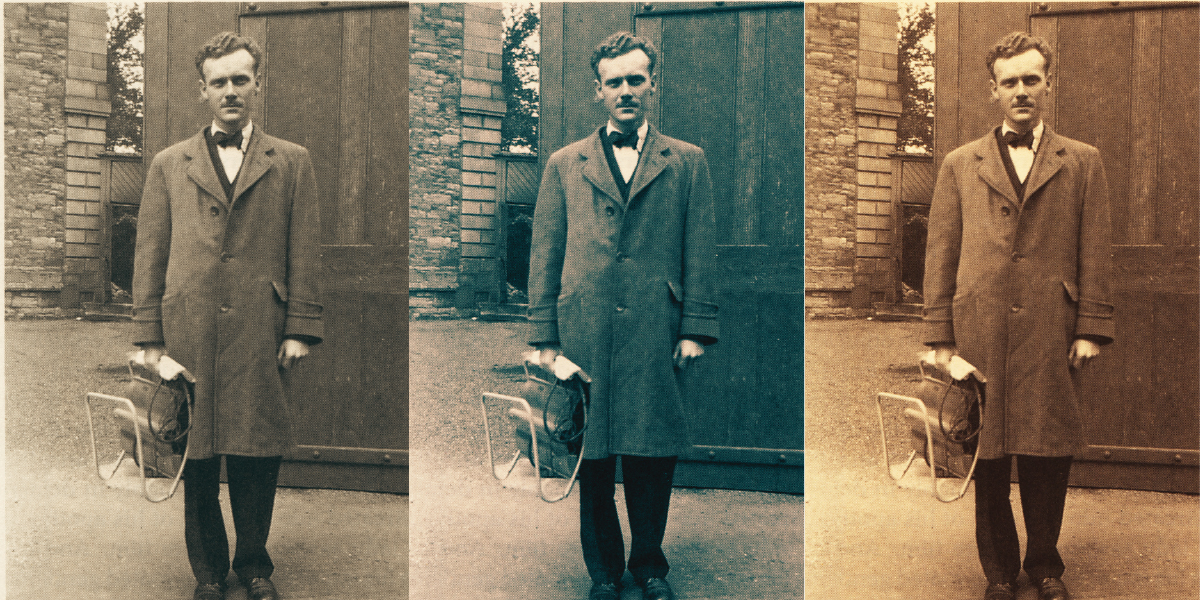
A casual student himself, a smiling Donleavy is seen in a revealing photo, books in hand, outside Davy Byrnes pub. To study? He focused instead on painting and writing. In just two years, he had four exhibitions – sales so-so, reviews mixed, some hostile. Donleavy tried a London gallery – his art was praised but rejected because he wasn’t famous. “Shaking my fist, I announced to the street that, goddamnit, seeing as I was contemplating it anyway, I would write a book that no one could stop and would make my name known in every nook and cranny all over the world,” Donleavy recalled.
Back at the Wicklow cottage in Kilcoole where he lived with his young British wife Valerie, Donleavy began writing the story that became The Ginger Man, a fictional re-creation of brawling, balling, bohemian Dublin. The novel focuses on the antics and escapes of Sebastian Dangerfield, who pursues fun times, ignoring his studies and his family. He keeps sailing dreamboat on rough seas of reality without sinking.
Two-hundred-twenty letters tell the true story behind the fiction: influences on Donleavy and his novel, its problematic publication, the author’s battles, the time and place the threesome shared and what came later. They had nicknames for each other. Donleavy was Guts, recognition of his fighting spirit and boxing skills honed at the New York Athletic Club. Donoghue was General, promoted from his Army rank of private and Doctor, another promotion for attending medical school after Trinity, without finishing. Crist, usually Gainor or GSC, sometimes signed himself S.D. Here follow excerpts from their letters.
An undated Crist postcard to Donleavy without salutation reads like a passage in The Ginger Man:
“Things here really FUBAR; but will be glad to see you and hear yr detached opinions. As yet no mon nor lovely soft tweed suiting. But these will come! That’s an Article of Faith. For a time my stock rose. I imposed a rule that all scoffers and doubting Toms would be excluded from the ultimate benefits. This led many to encourage me and for a few golden days we were secure in our faith that all would be well. Now there is a schismatic group, called the Mazoos (from Missouri) who say that seeing is, etc. Furthermore, a completely antagonistic sect says that there is nothing there at all – no sky-pie, just a solar myth, a fantastic bit of chanciness, etc. Let me tell you Deanlay, I’ll remember my friends. And I’ll not forget the others, either. The mockers, the iconoclasts, the appostates. … I still can see what it could be and I’ll have it. Oh, I’m struggling, guts, each day. … We’ll see each other right over a pint of bitter beer. S.D.
Donleavy returned to America in early 1952, submitting his novel, S.D., as it was initially titled, to John Hall Wheelock at Scribner’s. The writer reported the results to Donoghue:
“Wheelock wrote me a letter in which he said that he was sure I must know that I was possessed of an extremely vigorous and fresh writing talent but that S.D. presents the reader with a concentration upon certain aspects of life, unrelieved by contrast and that such a book for all its talents would be unpublishable. …
“Wheelock told me that S.D. was an extremely exciting book, an uproariously funny book and that as a writer there was no question as to my exceptional talent. He said that it was not only his opinion but that the three other editors on the staff had read S.D. and all agreed that I would arrive on top of the literary pile- one of them had gone so far as to say it was one of the finest pieces of writing they had ever read.”
Over two and a half years, Donleavy collected some 30 rejections. Publishers censored themselves, fearing prosecution for publishing obscenity or controversial material. “Don’t give up,” wrote Donoghue. “Been reading some new books they all stink. S.D. a better book.”
He maintained The Ginger Man, a serious work of fiction, was being misrepresented, damaging the book and its prospects and his reputation as a serious writer.
Donleavy and family returned to Europe in 1953, settling in London’s Fulham district. One day in 1954, Behan showed up unexpectedly. He and Donleavy embarked on pub crawl, which would change Donleavy’s life. Over their last pints, Behan said: “I know who will publish your book for you in Paris.” He identified someone to put Donleavy in touch with Maurice Girodias, publisher of The Olympia Press. After discovering Olympia published serious writers like Samuel Beckett in its Collection Merlin, Donleavy wrote Girodias, then sent the manuscript and was excited when the publisher accepted it, but wanted a different title. Donleavy proposed His Hands Refuse to Labor. Girodias rejected that. Donleavy then offered The Ginger Man, which Girodias liked.
Donoghue wrote from Boston, “That is a very symbolic title. … Run run as fast as you can You can’t catch me I’m the Ginger(bread) Man.” The ginger-haired Crist himself occasionally sang the first verse of the Scottish children’s rhyme. Donoghue anticipates problems ahead: “When do the printed copies start being smuggled into the States for surely as a great work of art it will be banned.”
Girodias published The Ginger Man June 1955, but not in the Collection Merlin. Instead it appeared in the green wrappers of The Olympia Press as no. 7 in a new collection, The Traveller’s Companion Series. On a back page appeared a list of 15 titles in the series. With the exception of The Ginger Man, all other titles were formulaic pornography by authors hiding behind pen names. A furious Donleavy protested, demanding his book’s removal from the list. He maintained The Ginger Man, a serious work of fiction, was being misrepresented, damaging the book and its prospects and his reputation as a serious writer. Girodias brushed him off. In a July letter to Crist, Donleavy wrote:
“Olympia Press says that obviously I am a very difficult person- easily given to ignoring the problems of others and also given to violent outbursts of self pity- this in reply to a letter of mine forbidding them to send this edition to England with it included among list which for your enjoyment- is as follows- THE ENORMOUS BED: RAPE: SCHOOL FOR SIN: TENDER WAS MY FLESH: THE WHIP ANGELS: MY LIFE AND LOVES (FRANK HARRIS): CHARIOT OF FLESH: and one last that I must admit to being proud to have listed with Ginger Man- THE SEXUAL LIFE OF ROBINSON CRUSOE. Also one more title: WHITE THIGHS. An author I should suppose is a frustrated bank clerk who wants to be respectable- but of course this whole business is unfortunate-merely because book deserves something more than this. … ”
The Ginger Man wound up being banned in Australia, Ireland and supposedly open-minded France. U.K. and U.S. customs and postal agents were seizing copies, but some got through.
Donleavy went to Paris in late 1955 to resolve matters with Girodias. Crist came to Paris too, by train from Madrid. It would be the last time the old friends saw one another. As for the meetings between Donleavy and Girodias, that resolved nothing, as Donleavy reported to Donoghue:
“Am back from Paris. Crist was there towards the end after money to go on to Spain. Evidently to threaten publisher for some obscure reason- mostly because he feels I owe him something or else he ought to put me down. …
“Girodias is a most extraordinary man- a hater of his father- who was also a publisher- a man who wants to make lots of money- he evidently thought very highly of book but had trouble with home office and customs here and found he could no longer send book to England and so had to try to sell it off as pornography together with my reputation, future and everything else. He intends to do nothing about selling book and is indifferent to what happens to it. But as I said- it will do in spite of him or anybody- but will take a few years longer. … ”
The search was on for mainstream publishers in the U.K. and U.S. to publish The Ginger Man anew. Neville Spearman Ltd., a mainstream British house, agreed to publish The Ginger Man with trims to get the book past British censors and into book shops. Donleavy agreed to tone down profanity, cut references to homosexuality, the practice then a crime in England, and eliminate Chapter 10, in which Dangerfield, rushing from a lavatory to catch a train, forgets to button his flies and winds up exposing himself to his fellow passengers.
And after 21 years, he finally prevailed in his legendary legal battle when Girodias’ last appeal was rejected.
Queen’s Counsel issued an opinion clearing the way for Spearman to publish. Copyright for the work – thus control over how and where it could be published – had not been properly assigned to Girodias under British law. “An exchange of letters was not enough; copyright could only be assigned by the author to someone else by completing an official form and signing it,” reports Girodias biographer John de St Jorre.
Spearman published The Ginger Man December 17, 1956 in a hardcover edition, with a laudatory introduction by Irish scholar and author Arland Ussher: “A book of quality … if it startles, that is incidental.” Spearman ran ads. U.K. bookshops stocked and displayed The Ginger Man. Reviews – generally favorable – appeared in major publications. Spearman reprinted the novel numerous times.
Girodias responded June 21, 1957 to Queen’s Counsel by suing Donleavy for breach of contract. Donleavy counter-sued. Olympia continued publishing the novel. Donleavy through Spearman authorized foreign editions of The Ginger Man, including McDowell, Obolensky’s first U.S. edition in 1958. As censorship laws eased, Donleavy authorized unexpurgated editions. And after 21 years, he finally prevailed in his legendary legal battle when Girodias’ last appeal was rejected. Donleavy wound up owning The Olympia Press. “I hope you made a lot of dough out of it, put your enemies down, cheered up your friends and confirmed you in your theses that the writer is a fighter,” wrote Donoghue. Donleavy did, indeed. The Ginger Man has never been out of print in English. It’s been translated into two dozen languages. Worldwide sales are upwards of 50 million copies.
__________________________________
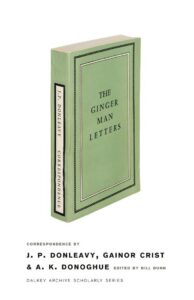
From The Ginger Man Letters: Correspondence by J.P. Donleavy, Gainor Crist & A.K. Donoghue. Used with the permission of the publisher, Dalkey Archive Press. Copyright © 2026 by Bill Dunn