
My Sylvia Plath fandom dates back to the early nineties, when I was in my late teens and randomly pulled The Bell Jar off the shelf at my local library in suburban Salt Lake City. I had never heard of Plath, but there was a section on one shelf containing books by and about her. I was intrigued, and by looking through various biographies, I learned the story of her suicide in 1963. This knowledge would shadow my experience of reading her work for the first time, and as tends to happen with Plath, her life and her work became inseparable.
Reading The Bell Jar had a profound effect on me as both an aspiring fiction writer and as a young woman living in a deeply patriarchal culture. Although the novel takes place in the 1950s, I could relate to the conflict in Esther as she feels her ambition and intelligence crash into the stifling gender roles for women that were available to her, something I felt acutely as well growing up in the conservative religious culture of Utah. Esther’s story, told in her first-person, intimate, confessional voice, enthralled me—I had never read anything like it, and years later I would end up using a similar narrative technique in all three of my novels, including my most recent one, Furious Violet, about a true crime writer whose mother was a Plath-like poet.
Plath’s personal story, as I interpreted it at the time, was that of a creative genius literally destroyed by a toxic, male-dominated culture, which was embodied by her husband, Ted Hughes. Yet even in death, she couldn’t be silenced—her literary brilliance lived on in the novel I loved and in her confessional, often rage-filled poems. She became an alluring symbol for me, the sad-girl literary equivalent of Jim Morrison, forever young and suffering for her art and feminism. She so bewitched and fascinated me that over the years, I became what you might call a Plath groupie, following in her footsteps and wanting to get close to her, even though she was dead.
Studying abroad in London in the late 90s, I made a pilgrimage to the house on Chalcot Square where she had lived and to the house on Fitzroy Road where she died. On a trip up north to the Brontë parsonage, I lamented that I couldn’t visit her grave in a nearby cemetery, since it was difficult to reach without a car. As a Plath fan, I was already predisposed to hate Hughes, and I felt my anger towards him burn even brighter then for burying his American wife in this remote corner of England.
Soon after this trip, Hughes himself, along with Seamus Heaney, appeared at my university to promote their poetry anthology, The School Bag. As the two men stood at lecterns on the stage, I sat in the second row, my eyes fixed on Hughes, with his perfect head of hair and tall but surprisingly slight frame. (Unbeknownst to the public, he was already suffering from the cancer that would kill him the following year.) I had expected to see a monster, but he looked so ordinary and I couldn’t wrap my head around the experience, being in the presence of this man who had married and fathered children with my beloved Sylvia, a figure who for me was more mythic than human.
This symposium should have been a non-stop thrill for someone like me, but I was surprised by how unsettled I felt.
Back in New York, I stood in line to meet Plath and Hughes’s daughter, Frieda, at a Barnes & Noble on the Upper West Side as she promoted her book of poetry, Wooroloo. I worried she would sniff me out—a young woman who came to her event just because she was Plath’s daughter—and I suspect she probably did, but she was friendly and gracious regardless. This was an encounter I would recall years later as I wrote my novel and imagined what it would be like to have a mother who, after her death, becomes an iconic feminist poet.
Throughout my twenties, my life intersected with Plath’s in weird ways, in part because I was a writer who (coincidentally!) lived in places she had lived, including New York, London, and the Boston area. When I was a freelance magazine writer, I wrote for Mademoiselle, where Plath had interned in college, which she fictionalized in The Bell Jar. Like her, I also wrote for Seventeen, and when I worked in their offices, I went to the archives to look up her pieces. When I lived in a suburb of Boston, I passed by McLean Hospital, where Plath was famously a patient, every day on my way to work.
My Plath fever finally broke in 2007, when I was living in London again, studying for my Ph.D. in English. I managed to scrape together enough money to attend two days of the four-day Sylvia Plath 75th Year Symposium at Oxford University, knowing it would be a who’s who of Plath scholarship. Not only were major figures in the field there in abundance, but also people who had known her personally, from Al Alvarez to Jillian Becker. This symposium should have been a non-stop thrill for someone like me, but I was surprised by how unsettled I felt.
I was surrounded by people from around the world, mostly women, who had devoted their professional lives to studying Plath, who knew everything about her and talked about her like she was an old friend, and in them I saw my own behavior reflected back at me, and I was disturbed by it. Plath’s fans have always vilified Hughes, who mistreated his wife during her life and took ownership of her work in death, but my experience at the symposium revealed how we were also fighting for ownership of her. This event was a turning point for me, it seared into my memory, and in Furious Violet I would satirize this behavior by labeling these types of ardent fans “Furies,” underscoring the anger and obsession that is often part of Plath fandom.
We all have our own reasons for connecting with Plath, but I realized then that I didn’t fully understand my intense interest in a woman I didn’t know, one who had been dead for over 40 years. After the symposium, my devotion to her began to wane, even though her work still meant a great deal to me. Only later, as I was writing my Plath-inspired thriller from the point of view of a true crime writer—a mash-up of what seemed like two completely disparate worlds—did I begin to make sense of my feelings.
Writing about a true crime writer required me to completely immerse myself in the genre, which I had long been fascinated with. As a young child, when my family lived near Palm Springs in a neighborhood that was generally very safe, our neighbor across the street was murdered by robbers while we were home eating lunch. This event is one of my earliest memories, since it was scary and the adults around me were all shocked by it in a way I had never experienced before.
While we can’t know whether the real Plath would have lived if she hadn’t married Ted Hughes, he has always been the main antagonist of her story, as villainous to any Plath fan as the rotten husbands we see most weeks on Dateline.
This is perhaps when I developed my tendency towards what I’ll call morbid curiosity—the desire to understand violent tragedies, an obsession with unsolved mysteries, the need to comprehend how human beings can do such terrible things. As I grew up and we moved to Utah, I became interested in the many weird crimes that happened there during the 1980s (see Under the Banner of Heaven on Hulu and Murder Among the Mormons on Netflix). In college in the 90s, I (like many others) became seriously invested in the O.J. Simpson trial, followed by other big cases over the next decade, including most significantly the murders of JonBenét Ramsey, Chandra Levy, and Laci Peterson—cases that would become the foundation of my now decades-long interest in true crime.
When I went on a research trip to Colorado, where my novel is set, I couldn’t resist driving by the house where JonBenét Ramsey was murdered, wanting to see it for myself after being obsessed with her case for so many years. (I also attended CrimeCon in Nashville several months later in part so I could see her father, John Ramsey, in person.) A few days later, I went to see the house where Shanann Watts and her daughters were murdered, since that case had haunted me after watching American Murder: The Family Next Door on Netflix. I told myself this was research for my novel, which required me to inhabit the mind of a true crime writer, one who travels the country researching cases like this—and that was certainly true. But I was also drawn to these places to satisfy my curiosity about tragedies that had captivated me. It wasn’t long before I began to see the connection between my fascination with these dead girls and Sylvia Plath.
This realization, while startling at first, shouldn’t have been a complete surprise, since Plath, despite her well-documented history of depression and suicide at age 30, seemed to have had big-time “girl who lit up a room” energy during her life. She indeed shares much in common with the mostly young, white women who are featured prominently in true crime, having been conventionally attractive and tragically dead at a young age. Plath could still be alive now, which only highlights the unfairness of her fate.
My interest in Plath’s life was often quite morbid, I can see that clearly now, but her tragic story—her real death at the metaphorical hands of the patriarchy—satisfied a need for me when I was a young woman, causing me to reflect on gender, power and writing in ways I never had before.
Most importantly, as I wrote about the Plath-inspired character in my novel, “she had married the wrong man, which was how so many women’s lives took a turn toward tragedy.” While we can’t know whether the real Plath would have lived if she hadn’t married Ted Hughes, he has always been the main antagonist of her story, as villainous to any Plath fan as the rotten husbands we see most weeks on Dateline. In fact, feminist writer Robin Morgan famously accused Hughes of murdering Plath, metaphorically speaking, in her poem “Arraignment,” from 1972.
Like the girls and women of true crime, Plath is famously a victim—of an abusive husband, of a misogynist society, of her own brain chemistry. This victimhood is as integral to her legend as Laci Peterson’s or JonBenét Ramsey’s is to theirs, but with Plath there can be a tendency to focus only on that at the expensive of her brilliant work, which has rightfully earned her a place in the American literary canon. Despite the ways that women’s narratives, both fictional and real, have been rewritten and liberated since Plath’s time, women are still drawn to tragic stories about other women—it is women, after all, who are the main consumers of true crime. These stories, almost always about untimely and violent deaths, are a way for us to see our worst fears realized—to imagine what that experience would be like, and to be grateful that it hasn’t happened to us.
My interest in Plath’s life was often quite morbid, I can see that clearly now, but her tragic story—her real death at the metaphorical hands of the patriarchy—satisfied a need for me when I was a young woman, causing me to reflect on gender, power and writing in ways I never had before. Creating a Plath-like character in my novel allowed me to explore and also satirize this kind of fandom, but it also forced me to confront the reasons we are drawn to women’s tragedies, and how we too often want to take ownership of women’s lives, their bodies and their bodies of work.
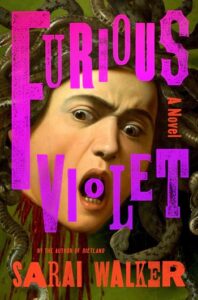
Furious Violet by Sarai Walker is available from Harper.