

In my life as a literary agent, I’ve spent years shaping the way others articulate their grief. There was the Pulitzer-nominated journalist who’d lost her only child when he was seven. And the Black descendant of Thomas Jefferson who, after her father’s death, finally gave serious attention to the family narratives. Then there was the New York Times bestseller who cared for young animals only to face the heart-wrenching duty of euthanizing them when the moment arrived.
Over time, I built a business around polishing heartbreak into narratives that reveal strength earned through hardship. Yet, amid my own sorrow story, I found myself cracking apart.
Literally.
Months had passed since my mother’s senseless death in a car accident, and I found myself back in the dentist’s chair. A part of me felt like Veda Sultenfuss from My Girl, that invisible bone lodged in her throat. But I was certain: one of my teeth had split.
The manuscript was full of metaphors about the healing power of nature and how plants adjust to change as the cycles of life and death unfold.
The dentist was skeptical at first, but after “taking a look,” he admitted that my molar had indeed cracked down to the gumline. He’d seal it, and we’d hope the bonding would hold.
“How long will it last?” I asked.
“Maybe months. Maybe forever,” the dentist said. “We can’t know.”
This felt too on the nose, like a trope I’d have edited out of someone else’s manuscript.
I had earned my publishing stripes by representing heavyweight works of narrative nonfiction—the kind that went on to become New York Times Editors’ Picks and earned prestigious awards. And yet, whenever I opened another nonfiction proposal, intending to do what I had always done—apply the logic I’d studied as a PhD student in Logic and Philosophy of Science to test the central claim—the words on the page blurred into sameness. Those grand ideas that once helped me parse life’s complexity, enabling me to recast my own story into one of triumph, now seemed irrelevant, as if I’d opened a book written in a language with no frame of reference in my world.
I needed to get back to doing my job. I needed my teeth to stop breaking. I needed something steady to stand on. But what I truly needed, I realized, was what I had offered so many of my authors: a narrative that could reframe loss into something intelligible.
I took more than a month off from work. I spent time with my husband and our two young children, and I wrote.
I produced sad essays that never found a true throughline. I wrote letters to my mom that wandered through melancholy before I finally admitted there was no plot. I wrote emails I never sent and others I did, yet no line I drafted managed to capture any healing.
So I decided to write something different, a book unlike anything I would have represented at that moment. I wrote fantasy.
The book was full of metaphors about the healing power of nature and the way that plants adapt to change due to the natural cycles of life and death. It was a tightly contained tale, with every thread neatly tied, illustrating how grief might serve as a doorway to genuine strength.
At last, I’d crafted a narrative that anchored me within my own story.
“Have you thought about therapy?” the doctor asked gently.
I felt a wave of relief. With those two simple words, this chapter of my life finally reached its end:
THE END
A few months later, I returned to the dentist for my biannual checkup. The hygienist noted hairline fractures along the tops of my teeth and signs of excessive wear. He advised wearing a mouthguard not only at night but during exercise as well. “And please,” he added, “find a way to manage your stress.”
I left the office aghast. I had exorcised my grief through storytelling. I’d used that narrative to rise above the pain. Did this man not realize I’d achieved a form of healing?
A few months later, I visited the doctor for my annual physical. My blood pressure was high enough that the nurse had to take it twice. That was common, she explained. It happened to many people. I didn’t tell her that it didn’t usually happen to me.
The doctor, a kindly man I’d long tried to impress by mentioning that I often work with physicians on their books, asked how I was doing. I told him I’d shed the last of the weight I’d been carrying since my baby.
He congratulated me as he typed into the computer on the wall. “Any changes to your medical history?”
In that moment, with that blunt but necessary question, I began to cry.
In a few heartbeats, tears clogged my throat, making it hard to speak.
Once I gathered myself, I explained that I’d been sleeping poorly because my mother had died six months earlier. It was a car accident that wasn’t her fault. Did that count as a change to my medical history? Probably not. But it felt worth mentioning, right?
“Have you thought about therapy?” the doctor asked gently.
I told him I didn’t like therapy. I rattled off reasons why it hadn’t worked for me. He handed me coarse paper towels and explained why it might be worth trying.
Reluctantly, I left his office with the help of an automated service that would match me with a therapist and promise a follow-up check-in to monitor progress.
I began to identify with the discomfort of the moment instead of crafting a narrative to situate my grief so I could escape from it and be somewhere else.
When I met Quatasia a few weeks later, the first thing I told her was that I didn’t want to be there. She offered a validating response and then asked questions to get to know me. I tried to impress her with the usual stories about growing up on reduced-fare lunches, starting college at 15, entering a PhD program, becoming a literary agent, and also an author. Then she said words I’ll never forget.
“So what I’m hearing is—though I could be mistaken—that you construct stories to avoid feeling your own emotions. Is that accurate?”
I felt her words land like an air bubble in my chest, so uncomfortable that I burst into hysterical laughter.
At the end of that session, Quatasia asked whether I wanted another appointment.
Over the next six months of therapy, as I retold the story of my life, complained about therapists treating people as metaphors, and debated the perils of religion because Quatasia had once mentioned Jesus and I wondered if my atheism would repulse her, I gradually lowered my defenses. I began naming my emotions instead of simply thinking them through. I started to feel the discomfort of the moment rather than always shaping a narrative to make it seem manageable.
Slowly, week after week, I began dismantling the grand narrative structures I’d built to shield myself from vulnerability. In doing so, I came to realize that, contrary to everything I’d believed, my life isn’t really a narrative. I am not meant to display a neat arc of growth and change over time for my life to have meaning.
I don’t confuse the way that I communicate my story with the story itself.
The purpose of storytelling isn’t to erase a person’s experiences but to complement them. Stories are just another way of looking sideways at something that resists easy deconstruction. Even if I once survived many horrors by using narrative—as I had built a career around doing—turning heartbreak into triumph can be maladaptive if it stops me from being present with my pain in the moment.
I still grind my teeth. There are days when I simply don’t want to eat. And there are nights when I lie awake because my mom should be here and isn’t, and that brutal truth sits there, heavy as a rock.
Someday I might view things differently. Someday I may reframe this period of my life depending on what I need to glean in that moment. Someday my story might evolve.
Each day I sit with the friction of an unresolved narrative is another day I might stumble upon more memories of my mom. The living force of that remembering is what keeps her alive in me, like a second pulse, and more than any tidy ending, that is precisely what I’ve longed for—even if I didn’t fully realize it.
Because the thing about turning chaotic experiences into fixed stories is that it doesn’t always leave room to shift how we perceive the events of our lives—or how we regard the people we love.
Today I’m back at work, handling books with much of the same energy I had before my mother’s death, drawing out intricate human experiences so others can grasp them. Yet I no longer allow the books I agent or write to substitute for being fully present in my life. I don’t confuse the way I convey my story with the story itself.
I let my own narrative be messy.
__________________________________
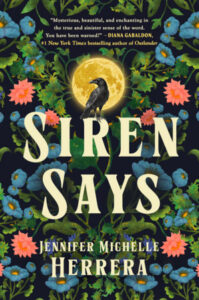
Siren Says by Jennifer Michelle Herrera is available from Putnam.
